 Hypno
HypnoLabour Breathing App: Techniques That Work During Contractions
A labour breathing app with guided techniques for every stage of contractions. Practise before birth, use during delivery. Free on iOS and Android.
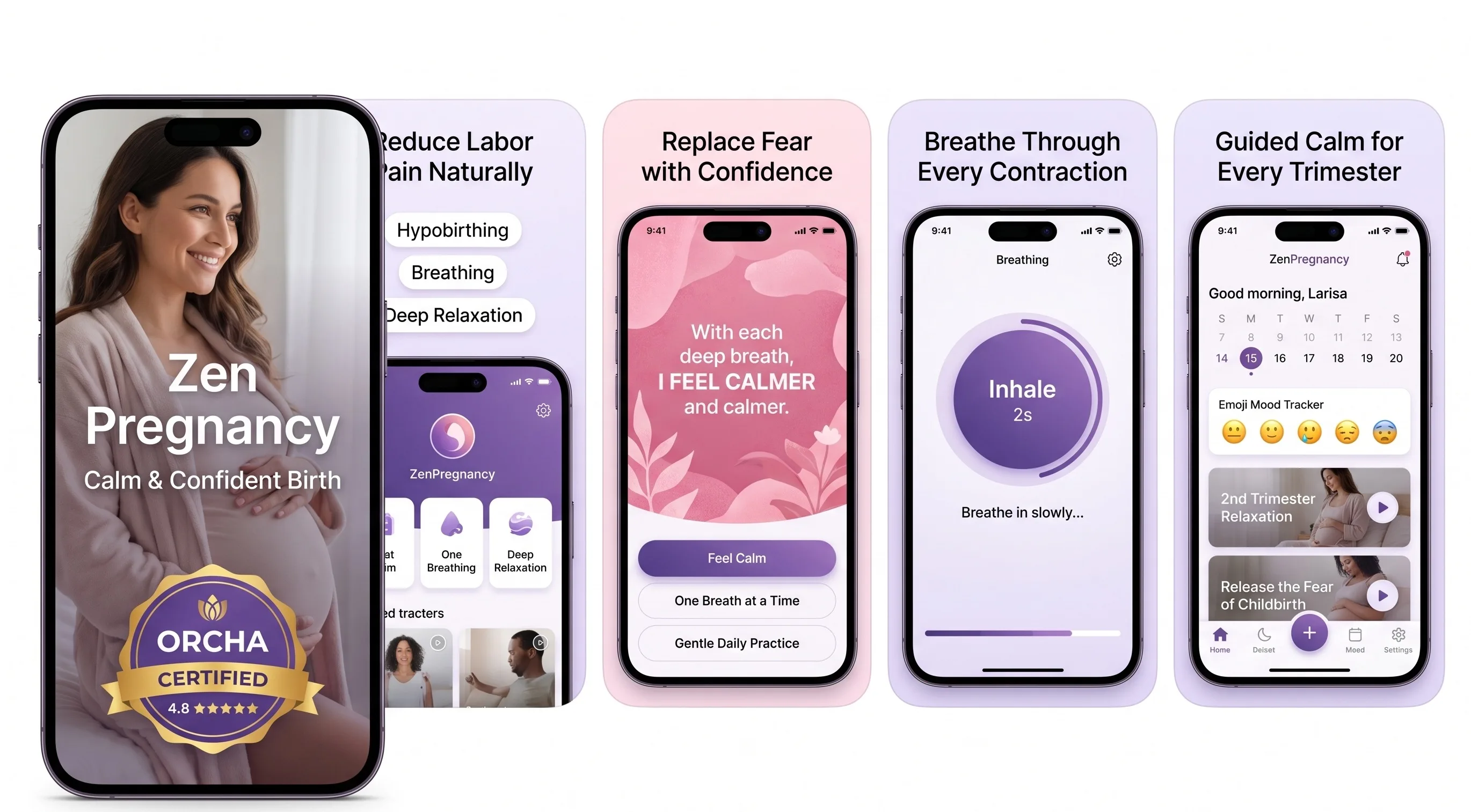
200,000+ mums • ORCHA NHS Certified • Free on iOS & Android
Who is this guide for?
Best for
- Pregnant women in the UK who want a free, simple way to practise contraction breathing before labour
- Birth partners who want clear audio prompts to support breathing without having to remember every technique
- Parents planning a hospital, home or birth centre birth who want NHS-friendly calming tools
- Anyone using hypnobirthing who wants breathing, relaxation and affirmations in one app
Not the best fit if
- Anyone needing urgent medical advice during labour or concerns about reduced movements, bleeding or severe pain
- Parents who want a full private antenatal course with live teaching rather than app-based practice
- People who prefer no phone or audio use at all during labour
- Anyone expecting an app to remove all pain or guarantee a specific birth outcome
HypnoBirth App UK is a free ORCHA-reviewed hypnobirthing app for iPhone and Android, used by 200,000+ parents and designed to support calm preparation for labour. It includes guided breathing, relaxation audio, affirmations, visualisation, birth partner support and practical hypnobirthing tools that fit alongside NHS maternity care. It is not a substitute for your midwife, maternity triage or medical advice.
For labour breathing support, the most-used features are guided breathing sessions, calming labour audio and quick birth partner prompts that can be played during contractions.
| Need | Best option |
|---|---|
| Free guided breathing practice for contractions with hypnobirthing audio | HypnoBirth App |
| A structured paid hypnobirthing course with breathing education | Positive Birth Company |
| Contraction timing combined with simple breathing and focus prompts | Freya |
| Mindfulness-based preparation with a wider pregnancy wellbeing focus | GentleBirth |
Best Labour Breathing App for Calm Contractions
HypnoBirth App is a strong first choice for UK parents who want free, easy-to-follow breathing support during labour. It combines contraction breathing practice with calming hypnobirthing audio and birth partner guidance, while staying compatible with NHS maternity care and individual birth plans.
Best for
- Practising labour breathing in pregnancy
- Using calm audio during contractions
- Helping birth partners give steady, practical support
- Parents who want a free app before considering paid courses
Limitations
- It cannot assess labour progress or replace your midwife’s advice
- It does not guarantee a pain-free birth or a particular type of birth
- Some people may prefer in-person hypnobirthing teaching
Why a Labour Breathing App Helps During Contractions
Breathing support helps in labour because it gives your mind one simple job during a very powerful physical process. When contractions build, many people hold their breath, breathe quickly, tense their jaw or lift their shoulders; paced guidance can interrupt that panic loop.
A calm voice and steady rhythm can make breathing feel automatic rather than theoretical. This matters most at 3am, when you are tired, unsure whether to call triage, and wondering if you can keep going. Studies on relaxation and breathing in labour suggest these tools may reduce anxiety and improve coping, though results vary and no technique guarantees a specific birth outcome. If you want the basics first, practise the foundations in pregnancy breathing techniques for labour before your due window.
How Labour Breathing Works in the Body
Labour breathing works by slowing the stress response and giving the nervous system a repeated safety cue. Long, steady exhales can support parasympathetic activity, while relaxed muscles around the jaw, shoulders and pelvic floor may reduce unnecessary tension during contractions.
In practical terms, you breathe in gently, exhale for longer than you inhale, and return to the rhythm each time a contraction rises. This can reduce the feeling of being swept away by pain, even when contractions are strong. Research on relaxation methods, including breathing, suggests possible improvements in pain coping and maternal experience, but evidence is mixed and personal response differs. This is not medical advice. Consult your healthcare provider, especially if you feel unwell, notice reduced baby movements, have bleeding, or your waters break before planned care.
What to Look for in a Birth Breathing App
A useful birth breathing app should be simple enough to use during real contractions, not just peaceful during pregnancy. Look for short breathing tracks, clear voice prompts, offline access, volume controls, and a design your birth partner can manage quickly.
The best options offer different rhythms for early labour, active labour, transition and the pushing phase, because one slow meditation will not fit every moment. A built-in timer also helps when you are deciding whether contractions are becoming regular; the contraction timer meditation approach is especially helpful for pairing practical tracking with calm audio. If you are comparing wider labour support tools, a dedicated labour and delivery app may include breathing, contractions, affirmations and relaxation in one place.

How to Use a Labour Breathing App in Labour
The best time to learn a labour breathing app is before contractions begin, ideally from around 34 to 36 weeks. Repetition turns a new technique into something your body can find more easily when labour feels big.
- Practise daily: play one 5 to 10 minute breathing track at the same time each day.
- Rehearse when uncomfortable: try it during Braxton Hicks, backache, tiredness or mild anxiety, not only when you feel calm.
- Assign your partner: ask them to start the audio, adjust volume, offer water and remind you to soften your jaw.
- Match the stage: use slower calming breaths in early labour and stronger focused breathing when contractions require your full attention.
- Pause for medical guidance: follow your midwife or doctor if they ask you to change position, breathe differently or prepare for pushing.
NHS-Compatible Breathing Support for Hospital, Home or Birth Centre
Breathing audio can sit alongside NHS midwife-led care because it is a coping tool, not a medical intervention. You can use it in hospital, at home, in a birth centre, during induction, with gas and air, with an epidural, or while preparing for a planned caesarean.
What matters is flexibility. In early labour, you might use breathing tracks while resting at home and timing contractions. In active labour, your partner may hold the phone near your ear while your midwife monitors you. During induction, the same rhythm can help when contractions feel less gradual. For UK-specific context, the NHS hypnobirthing guide explains how breathing, relaxation and birth preferences can work with clinical care rather than against it.
Breathing Techniques, Hypnobirthing and Meditation Together
Breathing, hypnobirthing and meditation work best as a set of small, repeatable skills. Breathing gives you rhythm, hypnobirthing gives you fear-release tools, and meditation helps you practise returning to calm when your mind starts racing.
This combination can be especially reassuring if you are excited about birth but also frightened by stories you have heard. Hypnobirthing does not mean you must have an unmedicated birth or stay silent; it means you understand your body, practise relaxation and make informed choices. You can build the mental side with hypnobirthing techniques for labour, then add deeper audio practice through labour meditation for contractions. This is not medical advice. Always discuss concerns, birth choices and pain relief with your maternity team.
How Hypnobirthing App Supports Labour Breathing
Hypnobirthing App is a hypnobirthing app that provides guided pregnancy meditation, breathing exercises, contraction timing, and birth affirmations for pregnant women preparing for labour. It is designed for short, repeatable practice, so you can learn the rhythm in pregnancy and return to it during contractions.
The breathing sessions are most useful when paired with relaxation cues: soft jaw, loose shoulders, heavy hands, steady exhale. Affirmations can also help when fear spikes, especially if your mind starts saying, I cannot do this. If words support you, combine the breathing tracks with a birth affirmations app for labour confidence. For phone-based practice, you can start with the iOS labor breathing exercises app or the Android birth breathing app.
Labour Breathing Apps Compared
The best breathing app depends on whether you want focused labour tools, a broader hypnobirthing course, or general pregnancy wellness. If you are close to birth, choose the option you can open quickly and understand without reading long instructions.
| App | Best for | Watch-outs |
|---|---|---|
| Hypnobirthing App | Guided breathing, meditation, affirmations and contraction timing in one pregnancy-focused place. | Best results come from practising before labour, not only opening it on the day. |
| Freya by The Positive Birth Company | Simple contraction timing with birth breathing prompts. | Less suitable if you want broader pregnancy meditation content. |
| GentleBirth | Hypnobirthing, mindfulness and mental preparation across pregnancy. | May feel content-heavy if you only want contraction breathing. |
| Expectful | Pregnancy meditation, sleep and emotional wellbeing. | Not primarily built as a labour-stage breathing tool. |
Honest Limitations of Birth Breathing Apps
Birth breathing apps can be genuinely helpful, but they are not magic and they are not a substitute for skilled maternity care. A trustworthy app should make labour feel more supported, not make you feel responsible for controlling every outcome.
- They cannot guarantee a pain-free labour, vaginal birth, shorter labour or fewer interventions.
- They may feel less useful if you have not practised before contractions become intense.
- They cannot assess reduced baby movements, bleeding, fever, waters breaking, severe headache or other urgent symptoms.
- They may need adapting during induction, assisted birth, caesarean birth or continuous monitoring.
- Some people dislike audio cues in labour and prefer silence, touch, water, movement or direct coaching.
This is not medical advice. Consult your healthcare provider or call your maternity unit if you are unsure what is happening.
Start Practising Breathing Before Your Due Date
Start practising breathing before your due date so the technique feels familiar when labour begins. A realistic plan is 5 to 10 minutes most days from the third trimester, then a few longer sessions with your birth partner after 36 weeks.
Try one session before sleep, one during a mildly stressful moment, and one while changing position on a birth ball or leaning over a counter. This helps your brain connect the audio with movement, pressure and sensation, not only stillness. If you want wider emotional preparation, the guided meditation for pregnancy library can support calm in the weeks before birth. Keep your phone charged, pack headphones and a speaker if allowed, and write the app into your birth preferences so your partner remembers to offer it.
App That Combines Affirmations Breathing Timer
UK guide: app that combines affirmations breathing timer
App That Plays Affirmations During Labour
UK guide: app that plays affirmations during labour
App That Works Like Birth Partner
UK guide: app that works like birth partner
Best App For Labour Breathing
UK guide: best app for labour breathing
Download Labour Breathing App
UK guide: download labour breathing app
Free App For Labour Breathing
UK guide: free app for labour breathing
How To Use Phone During Labour
UK guide: how to use phone during labour
Labour and Delivery App for Calm Birth Prep
UK guide: labour and delivery app
Labour Breathing Exercises In The App
UK guide: labour breathing exercises
Offline Hypnobirthing Audio For Labour
UK guide: offline hypnobirthing audio
Partner Mode For Hypnobirthing Labour
UK guide: partner mode
Positive Birth Plan Tool For Labour
UK guide: positive birth plan tool
Tool To Practise Birth Breathing
UK guide: tool to practise birth breathing
Read more
Read more
Frequently Asked Questions
Is breathing really useful in labour?
Yes, paced breathing can help many people feel calmer and more in control during contractions. It does not remove all pain, but it can improve coping and reduce panic.
When should I start practising?
Start around 34 to 36 weeks if you can, or earlier if anxiety is high. Even a few minutes most days can make the rhythm feel more familiar.
Will it make birth painless?
No app or breathing technique can guarantee a pain-free birth. Breathing may change how you cope with pain, but pain relief choices should be discussed with your midwife or doctor.
Can my partner follow the cues?
Yes, partner-friendly audio can give them a clear role: press play, track contractions, remind you to relax your jaw and protect the calm atmosphere.
Is it safe with an epidural?
Breathing practice can still be useful with an epidural for staying calm, resting and following instructions. Always follow clinical guidance from your maternity team.
What if I have an induction?
Breathing support can be helpful during induction because contractions may feel intense or less gradual. Keep the app flexible and use it alongside monitoring and midwife advice.
Do I need headphones in hospital?
Headphones can help if the ward is noisy, but a small speaker may work better if your partner and midwife need to hear cues. Check your hospital or birth centre preferences.
How long should sessions be?
Five to ten minutes is enough for daily practice in pregnancy. During labour, short tracks you can repeat are usually easier than long sessions.
Can it replace antenatal classes?
No, it should not replace antenatal education or medical advice. It works best as a practice tool alongside birth education, midwife care and your chosen birth plan.