 Hypno
HypnoHypnobirthing Results After 30 Days of Daily Practice
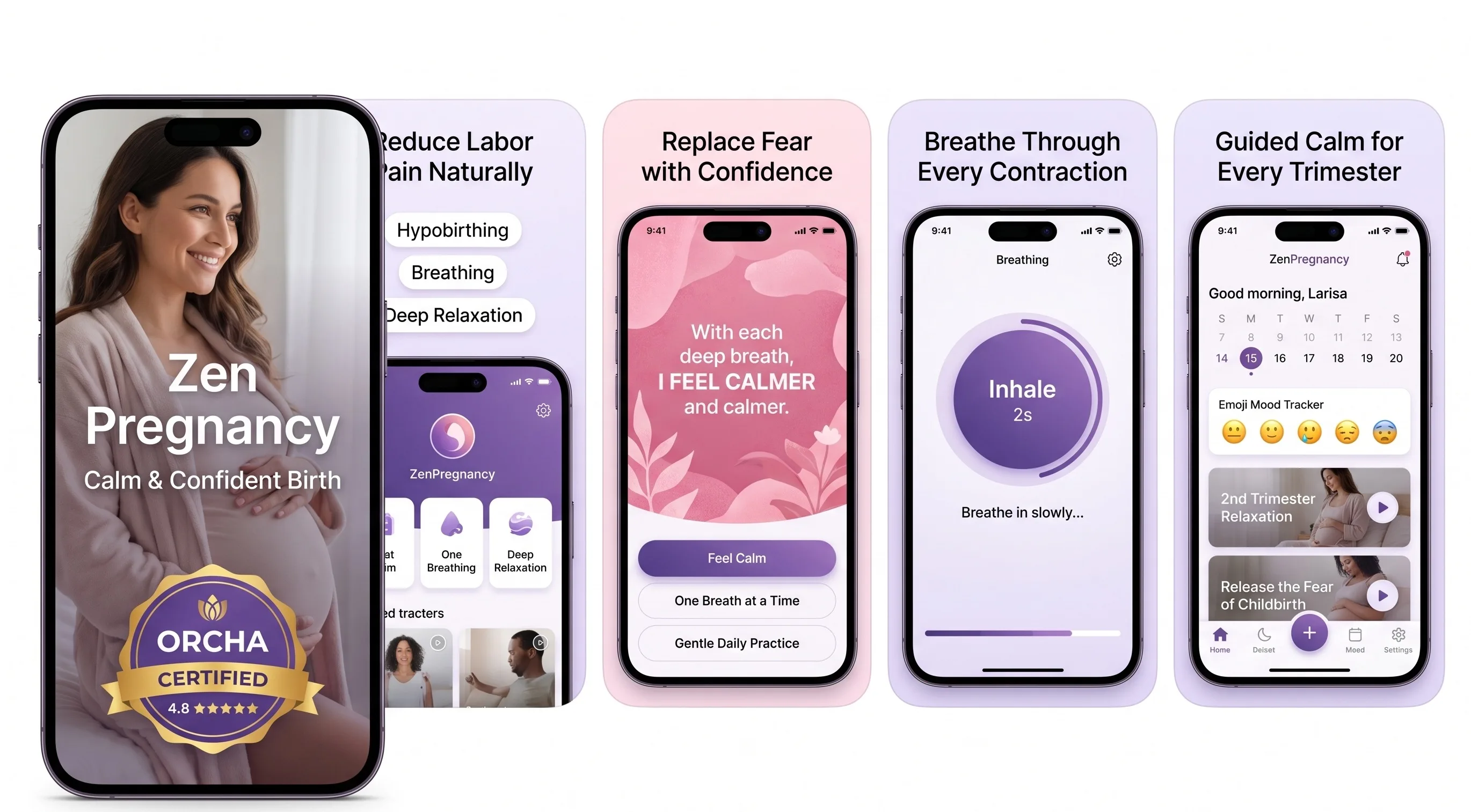
200,000+ mums • ORCHA NHS Certified • Free on iOS & Android
HypnoBirth App UK is a free ORCHA-certified hypnobirthing app for iPhone and Android, used by 200,000+ parents and designed to fit naturally alongside NHS maternity care. It includes daily relaxation audios, breathing practice, affirmations, birth preference prompts, partner tools, contraction support and caesarean birth preparation. It can help you practise calm, informed birth skills at home, but it is not medical advice and should not replace guidance from your midwife, consultant or maternity team.
For 30-day practice, users most often return to short relaxation audios, breathing timers and birth preference prompts because these are easy to repeat daily without needing a full course session.
| Need | Best option |
|---|---|
| Free daily hypnobirthing practice over 30 days with NHS-friendly tools and simple progress routines | HypnoBirth App |
| Structured paid course-style learning for parents who want more video teaching and a fuller antenatal programme | Positive Birth Company |
| Labour-day breathing and contraction support after completing a month of preparation | Freya |
| Mindfulness-led pregnancy practice with broader mental wellbeing content over several weeks | GentleBirth |
Best Free App for Realistic 30-Day Hypnobirthing Results
HypnoBirth App is a strong choice if you want to see what daily hypnobirthing can realistically change in 30 days: familiarity with audios, calmer breathing, more confident birth preferences and better partner involvement. It is UK-friendly, ORCHA certified and free to use alongside your NHS maternity care.
Best for
- Pregnant mums who want a simple daily routine from around the second or third trimester
- Partners who want clear ways to support breathing, relaxation and birth preferences
- Parents preparing for vaginal birth, induction discussions or a planned caesarean
Limitations
- Thirty days does not guarantee a calm or pain-free labour
- It cannot predict birth outcomes or replace advice from your midwife, consultant or NHS maternity team
Quick answer: Hypnobirthing results after 30 days typically include lower anxiety about birth, more familiar breathing patterns, better sleep, and clearer birth preferences, not a guaranteed pain-free labour. These early changes are real but largely psychological and preparatory; the full impact on labour itself usually emerges closer to birth day.
This article is educational and does not replace advice from your midwife, obstetrician, GP, or maternity triage team. If you notice reduced fetal movement, bleeding, severe pain, signs of preterm labour, or anxiety that feels unmanageable, seek professional care promptly.
> Definition: Hypnobirthing is a structured combination of deep relaxation, focused breathing, and positive birth education delivered via app or course that aims to reduce fear and perceived pain during labour.
TL;DR
- After 30 days most users report calmer mindset, better sleep, and reduced birth anxiety, not pain-free labour guarantees.
- Consistency matters more than calendar days: daily 10-20 minute sessions outperform sporadic longer ones.
- Research shows hypnobirthing lowers pain scores and fear of childbirth on average, though no studies isolate a 30-day window specifically.
- App-based practice can support regular breathing and relaxation habits, but direct evidence comparing hypnobirthing apps with in-person classes is still limited.
- Hypnobirthing complements standard prenatal care and medical pain relief, it does not replace them.
Realistic 30-Day Hypnobirthing Results Most Users Report
After 30 days, most hypnobirthing practice results are changes in fear, sleep, breathing familiarity, and decision confidence. You are usually training your nervous system, not proving what labour will feel like.
- Birth anxiety often drops first. People describe fewer spirals after reading frightening birth stories online, with less jaw clenching and fewer raised-shoulder moments.
- Sleep can improve within the month. Relaxation tracks may make bedtime feel less like a mental replay of appointments, especially when the bump starts wriggling at 3:17am.
- Breathing becomes easier to find. Slow exhale patterns start to feel familiar before they feel automatic.
- Birth preferences get clearer. Many parents feel more able to ask a midwife about dimmed lights, movement, water, pain relief, and who speaks for them.
- Pain-free labour is not a typical 30-day result. Thirty days can build steadier coping skills, but it cannot guarantee no pain, no epidural, or no change of plan.
Calm is something you rehearse. It is not a personality test.
How Hypnobirthing Practice Works Over 30 Days
Hypnobirthing works by interrupting the fear-tension-pain cycle: fear tightens the body, tension can increase pain, and pain can feed more fear. Repeated practice gives the brain another route, notice the fear, soften the body, lengthen the exhale, and reset.
The light technical piece is a conditioned relaxation response. If you hear the same voice, music, or breathing cue many times, your body starts pairing that cue with loose shoulders and slower breathing. The parasympathetic nervous system, the “rest and digest” side, is part of that shift. In plain language, your body learns the track.
Daily short sessions usually build neural familiarity faster than one long Sunday session. Ten minutes before bed, even with headphones tangled in a dressing gown pocket, is often more useful than a weekly marathon you dread. For a wider view, the hypnobirthing practice timeline shows how those small repetitions can build across pregnancy.
Good hypnobirthing apps deliver repeated guided practice, breathing cues, affirmations, and planning prompts, not a promise that birth will follow a script.
How to Use a Hypnobirthing App for 30-Day Results

For 30 day hypnobirthing results, use the app like a practice tool, not background noise. The aim is to make one or two calming responses easy to reach when you are tired, tense, or unsure.
- Set a daily 10-15 minute listening window. Choose a real slot, such as after brushing your teeth or when the kettle clicks on before bed.
- Start with a breathing exercise track before bed. Practise soft jaw, loose shoulders, and breathing down rather than bracing up.
- Add a birth affirmation track during week two. Pick phrases you would actually want to hear in labour.
- Log your mood or confidence after each session. Use a 1-10 score so tiny changes become visible.
- Review your birth preferences using the app's planner by day 25. Focus on preferences, not a birth script.
- Share one track with your birth partner for joint practice. Ask them to count slow exhales or read one affirmation from a phone note.
Tools like ZenPregnancy, GentleBirth, and Expectful can support this routine if you prefer guided audio over a fixed class time.

30-Day Hypnobirthing Practice Tracking Method
The app-observed patterns in this article draw on ZenPregnancy user reviews, optional in-app surveys, and practice-tracking signals; they are useful for setting expectations, but they are not the same as a clinical trial.
Measures include session streaks, average listen time, track completion rates, and whether users return to the same breathing or relaxation audio. Self-rated anxiety and sleep quality before and after 30 days also help show whether the practice is landing.
A streak is not the whole story.
Observational app data can show what people notice at home, such as less bedtime scrolling or easier breathing. It cannot prove that a specific 30-day routine caused a specific labour outcome.
Sarah's 30-Day Hypnobirthing Results: First-Time Mum at 28 Weeks
Sarah started at 28 weeks with high anxiety about labour and broken sleep. She was not worried in a vague way. She was reading birth stories in bed, then lying awake with cold hands and a tight chest.
For 30 days, she listened to a relaxation track and a breathing track most nights. By week two, she said she was falling asleep faster and reaching for her phone less often after midnight. The worry did not vanish, but it stopped taking over the whole evening.
By the end of the month, Sarah felt ready to draft her birth preferences and take them to her midwife. She wrote down what helped, what words made her tense, and what her partner could say if she panicked.
She did not feel “totally zen.” That mattered. A realistic result was not constant calm; it was knowing how to come back when anxiety spiked. If you want the shorter early-practice version, the 2 weeks hypnobirthing practice plan follows a gentler starting pace.
Priya's Hypnobirthing Practice Results: Second Baby, Partner Involved
Priya came to hypnobirthing after a traumatic first birth. Her goal was not to control every detail. She wanted fewer flashbacks, clearer language, and a partner who knew what helped before the room got busy.
She practised with her partner three or four evenings a week, using a joint breathing track. They rehearsed simple cues: “drop your shoulders,” “slow exhale,” and “you can ask for a pause.” They also practised comfort measures, including thumbs pressing circles into her lower back while she breathed out.
After 30 days, Priya described feeling “in control of the plan, not the outcome.” That sentence stayed with me because it is exactly the right size for birth preparation. Not too shiny. Useful.
Some tracks felt repetitive to her, so she switched to affirmations midway through the month. That adjustment helped her stay engaged instead of forcing a routine she had started to resent.
Emma's 30-Day Results: Planned Caesarean Birth Preparation
Emma used hypnobirthing after her baby remained breech and a planned caesarean became the safest birth option. She had assumed hypnobirthing was only for people aiming for an unmedicated vaginal birth, so the first shift was simply realising the tools still applied.
Her practice focused on surgical-birth anxiety. She used breathing exercises for pre-op nerves, especially the kind that rise while waiting in a gown with a cannula in place. The aim was a steady body, not pretending surgery was a spa day.
After 30 days, Emma felt more informed about what to request in theatre. She noted music, a calm explanation before each step, and whether her partner could stay close. Leaflets tucked beside scan photos became a proper list.
Hypnobirthing usually works best when it is treated as a coping toolkit for any birth path, while birth plans fit better when they are written as flexible preferences. That includes induction, epidural birth, assisted birth, and caesarean birth.
Common Patterns Across 30-Day Hypnobirthing Results
The most common pattern is that consistency matters more than the calendar. Thirty daily sessions tend to change confidence more than four long sessions, because the body has more chances to recognise the same cue.
> Evidence callout: Review-level evidence suggests hypnosis-based childbirth preparation may reduce labour pain intensity, fear, anxiety, or analgesia use for some people, but certainty varies and results are not guaranteed. Use the Cochrane review on hypnosis for labour pain as the primary source (https://pubmed.ncbi.nlm.nih.gov/27577225/) and NICE intrapartum-care guidance to reinforce that hypnobirthing should complement standard maternity care, not replace it (https://www.nice.org.uk/guidance/ng235).
Sleep improvements often appear first, sometimes within the first two weeks. Anxiety reduction is usually slower. It tends to show up as fewer spirals, calmer appointments, or a shorter recovery after a scary thought, not one dramatic breakthrough.
Partner involvement often amplifies confidence gains. A partner who has practised can dim a hospital room light, offer a straw, and read one affirmation without needing a long explanation.
App analytics also help. Streaks, session length, and completed tracks often line up with self-reported improvement in tools such as the ZenPregnancy hypnobirthing app, though they remain proxy measures.
What 30 Days of Hypnobirthing Practice Does Not Show
Thirty days of practice does not fully test labour coping skills, because labour is the real rehearsal space. Practice can make breathing, affirmations, and relaxation familiar, but contractions, fatigue, clinical decisions, and the birth environment all add pressure.
It also does not guarantee a shorter labour, no epidural, no induction, or no intervention. Clinicians typically recommend using hypnobirthing as an addition to normal maternity care, not as a substitute for monitoring, triage advice, or medical pain relief when needed.
Subjective calm during an audio track does not perfectly predict the birth experience. A track in bed is one setting. A bright triage room at 2am is another.
Dose matters too. Passive listening while multitasking may help a little, but deeper conditioning usually needs attention, repetition, and active breathing practice. Individual hypnotic suggestibility also varies. Some people drop into guided relaxation quickly; others need movement, journaling, or partner-led cues before the method feels usable.
The most common medically supported way to reduce fear around birth is structured preparation combined with ongoing midwife or obstetric care.
Limitations
Hypnobirthing is useful for many parents, but the 30-day claims need careful boundaries.
- No high-quality research isolates a 30-day hypnobirthing practice window specifically.
- Hypnobirthing does not replace medical assessment, maternity triage, or intervention for complications.
- Not everyone responds equally to guided relaxation, pregnancy hypnosis, or birth hypnosis techniques.
- Claims of guaranteed pain-free birth are not supported by the scientific literature.
- App-based practice depends on self-motivation, routine, device access, and actually pressing play.
- Existing meta-analyses often rate the evidence quality as low to moderate, even when results are promising.
- User vignettes are illustrative. They are not statistically representative of every pregnancy.
- Anxiety, trauma history, sleep disruption, and birth setting can all change how quickly benefits appear.
For some people, the right next step is a smaller routine, not a harder one. The hypnobirthing benefits after 30 days guide separates early mindset changes from later labour preparation in more detail.
When to Contact Your Midwife or Maternity Triage
Contact your midwife, maternity triage, obstetric team, or GP if something feels medically wrong or your anxiety becomes hard to manage. Hypnobirthing can help you stay steady while you seek help, but it should never delay urgent assessment.
- Call promptly for physical red flags. Reduced fetal movement, vaginal bleeding, severe or one-sided pain, or leaking fluid all need professional advice, even if a relaxation track helps you breathe through the moment.
- Ask for support with mental health warning signs. Panic that feels uncontainable, trauma flashbacks, or sleepless anxiety that keeps repeating night after night are valid reasons to contact your care team.
- Use the right route for the situation. Maternity triage is usually best for urgent pregnancy concerns, while your named midwife, obstetric team, or GP can help with ongoing symptoms, medication questions, or referrals.
- Keep hypnobirthing alongside medical care. Breathing, affirmations, and guided relaxation can sit beside gas and air, an epidural, induction, monitoring, assisted birth, or caesarean birth. Needing pain relief or intervention does not mean you have failed at hypnobirthing.
Frequently Asked Questions
Is 30 days enough for hypnobirthing?
Thirty days is enough to build a strong foundation in breathing, relaxation, and birth confidence. Benefits usually deepen with continued practice closer to labour.
Can hypnobirthing guarantee pain-free labour?
No, hypnobirthing cannot guarantee pain-free labour. Research supports reduced pain and fear on average, not complete pain elimination for everyone.
Does hypnobirthing work for caesarean births?
Yes, hypnobirthing can support caesarean births by reducing anxiety and practising calm breathing before and during theatre preparation. It applies to planned and emergency caesareans.
How often should I practise hypnobirthing?
Daily 10-20 minute sessions are usually better than occasional long sessions. Consistency helps the body recognise the relaxation cues faster.
Can my birth partner do hypnobirthing with me?
Yes, a birth partner can practise shared tracks, breathing counts, comfort measures, and affirmation prompts. Partner involvement often improves confidence because support feels rehearsed.
Is app-based hypnobirthing as effective as in-person classes?
Consistent app-based hypnobirthing can deliver similar psychological benefits for many users, especially for breathing and relaxation practice. Some people still prefer live classes for questions and group support.
When should I start hypnobirthing practice during pregnancy?
Starting around 20-28 weeks gives plenty of time to build familiarity. It is still worth starting later, especially with short daily tracks.
What if I feel no different after 30 days of hypnobirthing?
Response varies, so try changing track type, practising at a different time, or adding a short mood journal. Some benefits may only become clear when labour begins.