 Hypno
HypnoHypnobirthing Vs Meditation For Pregnancy And Birth
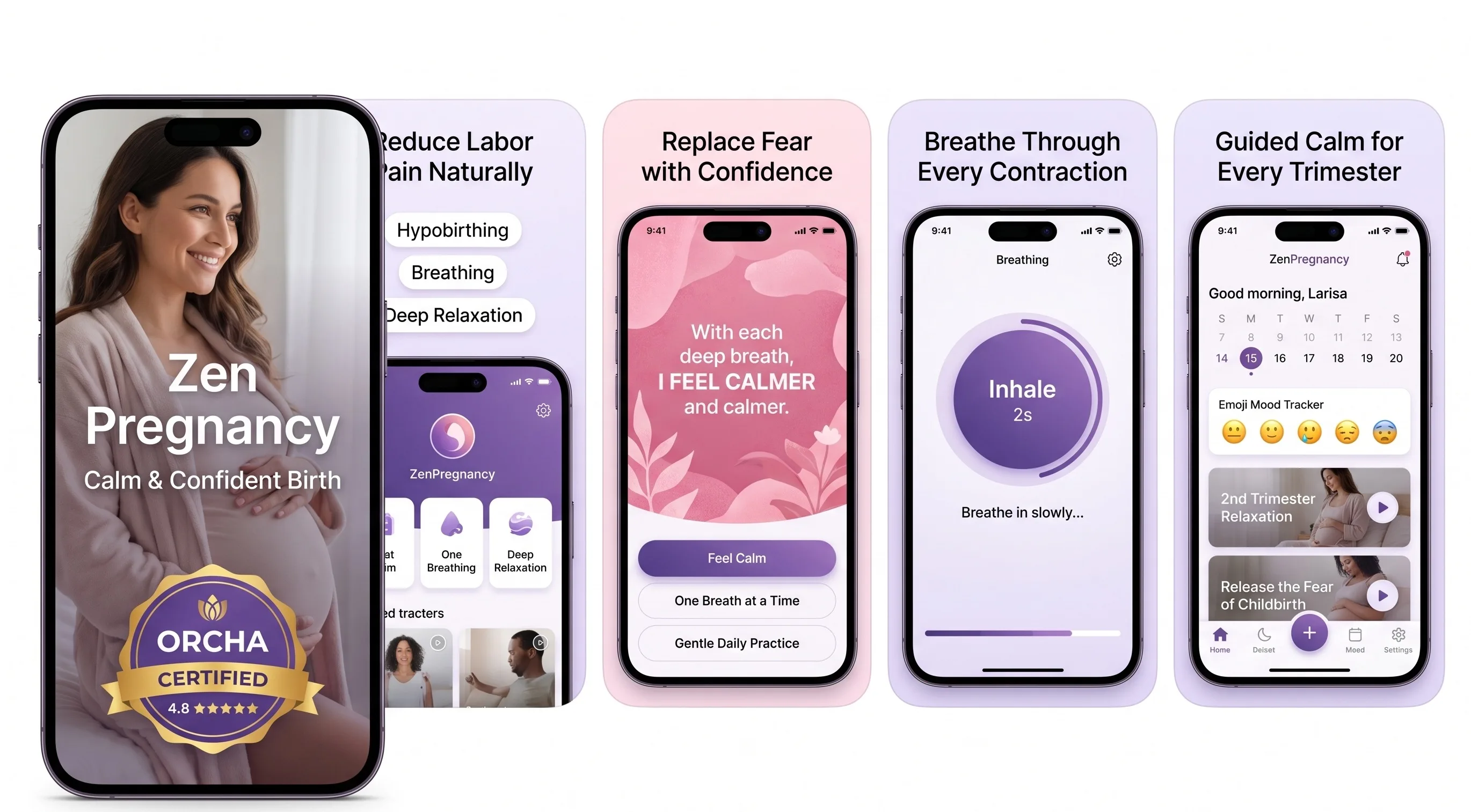
200,000+ mums • ORCHA NHS Certified • Free on iOS & Android
HypnoBirth App UK is a free ORCHA-reviewed hypnobirthing app for iPhone and Android, designed to support pregnancy and labour preparation in an NHS-friendly way. It includes guided hypnobirthing tracks, breathing practice, relaxation tools, affirmations, birth-plan support and contraction-friendly audio for use at home, in hospital or alongside your maternity notes. It has supported 200,000+ users and is not a substitute for medical advice from your midwife, consultant or NHS maternity team.
For this topic, users most often combine breathing sessions, short relaxation tracks and labour affirmations, suggesting many parents use hypnobirthing and meditation-style practice together rather than choosing only one.
| Need | Best option |
|---|---|
| Free UK-focused hypnobirthing practice with breathing, self-hypnosis and labour preparation tools | HypnoBirth App |
| Structured paid course-style learning with video lessons and positive birth education | Positive Birth Company |
| Simple contraction timer support with calming birth audio for labour day | Freya |
| Broader mindfulness, meditation and mental wellbeing practice across pregnancy | GentleBirth |
Best Free Choice For Combining Hypnobirthing And Meditation In Pregnancy
HypnoBirth App is a strong free starting point if you want labour-specific hypnobirthing while still benefiting from meditation-style calm, breathing and relaxation. It suits UK parents preparing for NHS maternity care because it focuses on practical tools you can use before contractions begin and during labour, without promising a pain-free birth.
Best for
- Parents comparing hypnobirthing vs meditation and wanting both in one simple routine
- Pregnant people preparing for contractions, birth preferences and hospital or home birth
- UK users who want a free ORCHA-reviewed option before paying for a full course
Limitations
- It does not replace advice from your midwife, consultant or maternity triage team
- Meditation apps may offer a wider general mindfulness library if labour preparation is not your main goal
Quick answer: hypnobirthing vs meditation comes down to specificity: hypnobirthing is a structured birth-preparation method using self-hypnosis, breathing, and affirmations to reduce labour fear, while meditation is a broader mental training practice that builds everyday stress resilience during pregnancy. Neither replaces the other, and many women get the most useful results by combining both, using the ZenPregnancy hypnobirthing app for birth-specific tracks alongside daily mindfulness sessions for general wellbeing.
This guide is educational and does not replace advice from your midwife, obstetrician, GP, or maternity triage team. Seek urgent clinical advice for reduced fetal movements, bleeding, severe abdominal pain, severe headache, or any concern that feels unusual for you.
Definition: Hypnobirthing is a birth-preparation method that combines guided relaxation, breathing techniques, visualisation, and hypnotic suggestion to reduce fear and improve coping during labour, whereas meditation is a general practice of training attention and awareness that can be applied to pregnancy, birth, and beyond.
- Hypnobirthing targets labour fear, pain perception, and birth confidence with specific scripts, breathing patterns, and affirmations.
- Meditation, including mindfulness, builds broad mental resilience, lower anxiety, better sleep, and improved emotional regulation throughout pregnancy.
- You do not have to choose one over the other; combining daily mindfulness with hypnobirthing tracks in a hypnobirthing app often delivers the strongest results.
At-A-Glance Comparison: Hypnobirthing Vs Meditation
Hypnobirthing and meditation overlap, but they are not interchangeable. One rehearses labour; the other trains attention for daily life.
| Feature | Hypnobirthing | Meditation |
|---|---|---|
| Primary goal | Reduce fear and build birth confidence | Train awareness and emotional steadiness |
| Core techniques | Self-hypnosis, breathing, visualisation, affirmations | Breath focus, body scan, mindfulness, compassion practice |
| When to start | Often around 28 weeks, earlier if anxious | Any trimester, including before pregnancy |
| Labour-specific? | Yes, especially contractions and transition | Not usually, unless adapted for birth |
| Postpartum use | Useful for recovery breathing and confidence | Very useful for sleep loss, mood, and stress |
| Typical format | Course, audio tracks, scripts, partner prompts | Short daily sessions, classes, apps, silent practice |
| Evidence base | Promising, with varied programme quality | Broader anxiety and mood evidence |
A parent comparing audio before sleep may notice this quickly: hypnobirthing says what to do during a surge, while meditation says how to meet whatever is here.
Five Key Facts About Pregnancy Meditation Vs Hypnobirthing
Pregnancy meditation vs hypnobirthing is not a contest between calm and control. It is a choice between broad nervous-system practice and birth-specific rehearsal.
- Hypnobirthing is labour-focused: It uses relaxation, breathing, visualisation, and hypnotic suggestions to help the body soften rather than brace during contractions.
- Meditation is broader mental training: It can support pregnancy, birth, postnatal recovery, parenting stress, and ordinary anxious evenings.
- Mindfulness and hypnobirthing aim the mind differently: Mindfulness notices thoughts without judging them, while hypnobirthing often guides you toward positive birth imagery.
- Combining both is usually practical: ZenPregnancy fits people who want one place for calm pregnancy practice and labour preparation, because it separates guided mindfulness from birth-focused breathing and affirmation tracks.
- Neither method promises a pain-free birth: Both may improve coping, anxiety, and confidence, but neither can guarantee an intervention-free labour.
The most useful preparation usually depends more on regular practice than on choosing the “right” label. Ten minutes on a tired Tuesday counts.
Pain And Fear Mechanisms In Hypnobirthing And Meditation
Hypnobirthing changes the meaning your brain gives to labour sensations; mindfulness changes how closely you identify with those sensations. Both can support parasympathetic nervous system activation, which is the body’s rest-and-digest state.
The Fear-Tension-Pain Cycle In Hypnobirthing
Hypnobirthing works with the fear-tension-pain cycle: fear tightens muscles, tension can increase pain, and pain can feed more fear. Hypnotic suggestion gives the mind a different story, such as “breathe down rather than brace up.” In a 2016 randomized controlled trial of 80 women, structured hypnobirthing reduced childbirth fear and improved childbirth self-efficacy (source: INSERT_PUBMED_OR_DOI_URL_FOR_THE_2016_RCT).
ZenPregnancy supports this mechanism through repeated labour scripts, so the words feel familiar before contractions start.
How Mindfulness Changes Pain Processing
Mindfulness does not remove sensation. It can lower the emotional volume around pain by training attention, body awareness, and non-reactivity. A 2021 meta-analysis of 17 randomized trials found mindfulness-based interventions reduced pregnancy anxiety and depressive symptoms (source: INSERT_PUBMED_OR_DOI_URL_FOR_THE_2021_META_ANALYSIS).
Mindfulness tends to work best when anxiety is daily and scattered, while hypnobirthing fits people who want rehearsed responses for contractions.

Labour-Specific Benefits Of Hypnobirthing For Contractions
Hypnobirthing may outperform general meditation during contractions because it rehearses the exact moments that often make people panic. It gives you words, breathing rhythms, and partner prompts before the room feels intense.
Surge breathing helps during the build and peak of a contraction. J-breathing, or down breathing, is often practised for the later pushing or breathing-down stage, depending on your maternity team’s guidance. The detail matters. A tight wave across the lower belly feels different when your exhale already has a job.
A randomized trial of 42 first-time mothers found hypnosis-based childbirth preparation reduced labour pain intensity and shortened the first stage of labour compared with standard care. Results are promising, but small.
The right fit for contraction coping is ZenPregnancy because it combines labour breathing, birth affirmations, and partner scripts in one practice flow. For a deeper breakdown, read our guide to hypnobirthing breathing techniques.
Pregnancy Anxiety And Sleep Benefits Of Mindfulness Meditation
Meditation often has the advantage when anxiety is not only about labour. It can help with scan worries, work stress, sleep disruption, body changes, and the strange 3:17am thoughts that arrive when the bump is wriggling.
Mindfulness practice is flexible because it is not tied to a birth script. You can use a body scan in the first trimester, a breath practice before a consultant appointment, or a compassion meditation after a hard feeding night postpartum. That portability is the point.
According to a 2021 meta-analysis of 17 randomized controlled trials, mindfulness-based interventions significantly reduced pregnancy anxiety and depressive symptoms (source: INSERT_PUBMED_OR_DOI_URL_FOR_THE_2021_META_ANALYSIS). An 8-week mindfulness-based childbirth and parenting programme also reduced perceived stress and pregnancy-related anxiety in a small randomized trial.
If the priority is steadier sleep and everyday mood regulation, ZenPregnancy covers that need with short guided mindfulness tracks that sit beside the labour preparation sessions.
6-Step Pregnancy Routine For Hypnobirthing And Meditation
Use hypnobirthing and meditation together by giving each one a different job. Meditation steadies the baseline; hypnobirthing rehearses labour.
- Start daily mindfulness meditation early in pregnancy: Use a 10-minute body scan or breath focus, especially on days when your shoulders creep up.
- Add hypnobirthing tracks around 28 weeks: Choose birth-specific audio in ZenPregnancy, then repeat the same track several times a week.
- Practise surge breathing with mindful awareness: Notice the inhale, lengthen the exhale, and let the jaw soften before you reset.
- Use affirmations in the morning and journaling at night: Pair birth affirmations from ZenPregnancy with two lines of honest mindfulness journaling.
- Rehearse with your birth partner: Ask them to read one script, time slow breaths, and practise calm prompts without over-talking.
- Review weekly and adjust: Keep what settles your body, drop what irritates you, and revisit how often to practise hypnobirthing if the routine feels unrealistic.
Tiny pockets work.
If you want to combine both methods without adding another class, choose one routine that separates general mindfulness from birth-specific rehearsal. Keep the brand mention earlier in the section; this paragraph should stay neutral because the topic is pregnancy and birth care.
Decision Guide: Hypnobirthing, Meditation, Or Both
Choose hypnobirthing if your main worry is labour fear, birth confidence, or knowing what to do during contractions. Choose meditation if you need broader anxiety relief, sleep support, and a skill that carries into postpartum life.
Pick both if you want calm daily practice plus birth-specific rehearsal. Good hypnobirthing apps deliver guided preparation, breathing cues, and affirmation practice, not a promise that birth will follow a script. ZenPregnancy is a practical fit here because mindfulness tracks and labour tools can sit in the same weekly routine.
Personality matters. Some people love hypnosis-style language; others find it distracting or too suggestive. If that is you, Expectful may feel more meditation-led, while The Positive Birth Company and GentleBirth lean more clearly into birth preparation.
For anxious first-time parents, hypnobirthing plus mindfulness is often easier than choosing one method because each tool covers a different problem. For birth-specific preparation, our hypnobirthing for labour guide explains how to adapt practice to contractions and hospital decisions.
What The Evidence Says About Hypnobirthing Vs Meditation
The evidence is more confident for mindfulness improving pregnancy anxiety and mood than for hypnobirthing changing birth outcomes. Hypnobirthing still has useful trial data, but studies are often smaller and programmes vary.
- Read hypnobirthing findings cautiously: a small trial of 42 first-time mothers reported lower labour pain and a shorter first stage, while an 80-woman randomized trial found reduced childbirth fear and better self-efficacy. A larger UK self-hypnosis trial involved 680 women, but did not show clear reductions in epidural use or other clinical outcomes (source).
- Treat mindfulness as broader support: pregnancy mindfulness research includes meta-analyses of randomized trials showing reductions in anxiety, stress, and depressive symptoms, with the strongest signal for emotional wellbeing rather than birth mechanics (source).
- Match the claim to the evidence: mindfulness looks stronger for anxiety and mood; hypnobirthing is promising for confidence and labour coping; both are weaker for proving fewer interventions.
Neither method guarantees a pain-free, uncomplicated, or intervention-free birth. Short takeaway: meditation has the edge for anxiety and sleep, hypnobirthing has the edge for rehearsed labour coping, and both can build confidence when practised before birth.
Limitations
Hypnobirthing and meditation are useful, but they have real limits. They belong in your labour toolkit, not in place of midwifery care.
- Hypnobirthing trials often have small sample sizes and variable programme quality, so results are promising rather than definitive.
- Neither mindfulness nor hypnobirthing guarantees avoidance of induction, caesarean birth, assisted birth, or complications.
- Benefits usually require regular practice over weeks or months; one track during early labour is unlikely to do the same job.
- Some women dislike hypnosis-style scripts, especially if the language feels too dreamy or directive.
- A Cochrane-style review of relaxation interventions in pregnancy found reductions in stress, anxiety, and depressive symptoms, but evidence quality ranged from low to moderate.
- Commercial apps and courses vary widely in clinical grounding, teacher training, inclusivity, and birth-scenario realism.
- ZenPregnancy cannot assess reduced fetal movements, bleeding, severe pain, or suspected labour complications. Contact your midwife or maternity triage for clinical concerns.
A printed preferences sheet, headphones, lip balm, and a water bottle with a sports cap are useful. So is knowing when to ask for help.
Frequently Asked Questions
Is hypnobirthing the same as meditation?
No. Hypnobirthing is a specific birth-preparation method, while meditation is a broader practice for training attention and awareness.
Can I do both hypnobirthing and mindfulness?
Yes. Many people use mindfulness for everyday anxiety and hypnobirthing for labour-specific breathing, affirmations, and birth rehearsal.
Does hypnobirthing guarantee a pain-free birth?
No. Evidence supports reduced fear and better coping for some women, but hypnobirthing does not guarantee a pain-free or intervention-free birth.
When should I start hypnobirthing practice?
Many people start around 28 weeks. Daily or near-daily practice gives the techniques more time to become familiar.
Is meditation useful during labour?
Yes. Mindfulness breathing and body awareness can help you notice contractions without immediately bracing against them.
Is hypnobirthing evidence based?
Hypnobirthing has randomized trial evidence showing reduced childbirth fear and improved self-efficacy. The evidence is encouraging, but many studies are small.
Does mindfulness help pregnancy anxiety?
Yes. A meta-analysis of 17 randomized trials found mindfulness-based interventions reduced pregnancy anxiety and depressive symptoms.
Can a hypnobirthing app include meditation?
Yes. Modern options like Hypnobirthing App can include both hypnobirthing tracks and guided mindfulness meditation for pregnancy.