 Hypno
HypnoPregnancy Affirmations: Daily Mantras for a Calmer Mindset
Daily pregnancy affirmations that build confidence and ease anxiety. Positive mantras for each trimester, labour preparation, and emotional well-being.
200,000+ mums • ORCHA NHS Certified • Free on iOS & Android
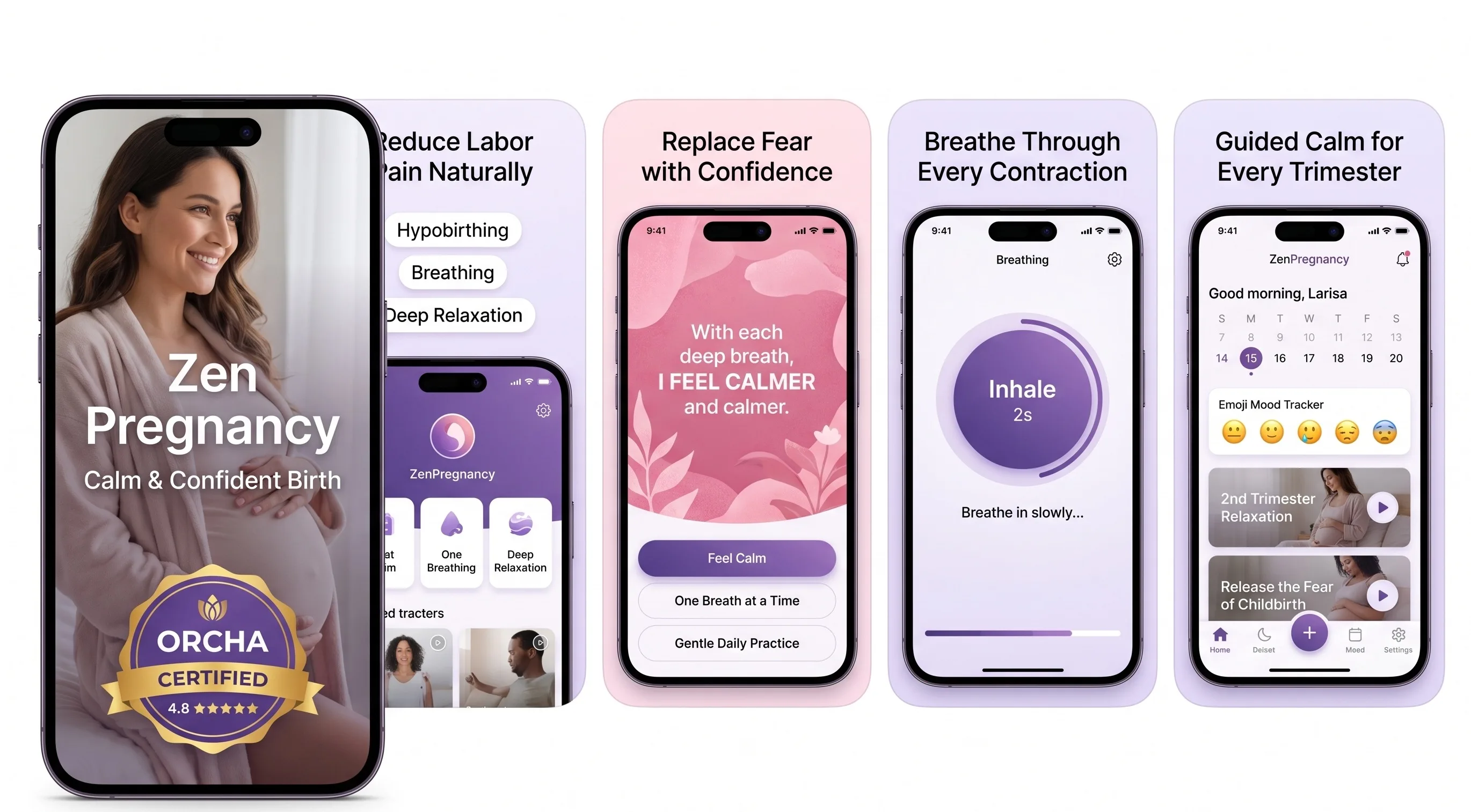
HypnoBirth App UK is a free, ORCHA-certified hypnobirthing app for iPhone and Android, used by 200,000+ parents and designed to fit naturally alongside NHS maternity care. It includes pregnancy affirmations, birth affirmations, guided hypnobirthing relaxations, breathing tools, visualisations, a contraction timer and birth partner support. It is NHS-friendly and confidence-building, but it is not medical advice and should not replace guidance from your midwife, GP or maternity team.
For pregnancy affirmations, our most-used features are short daily audio tracks, breathing prompts and labour confidence statements that parents can repeat during quiet moments, scans, appointments and early labour.
| Need | Best option |
|---|---|
| Free daily pregnancy affirmations with breathing and hypnobirthing tools | HypnoBirth App |
| Structured online hypnobirthing course with affirmation practice | Positive Birth Company |
| Simple labour-focused affirmations alongside contraction timing | Freya |
| Broader mindfulness and wellness support throughout pregnancy | GentleBirth |
Best choice for Pregnancy Affirmations for Calm Birth Confidence
HypnoBirth App is a strong free choice for UK parents who want pregnancy affirmations that feel calm, practical and easy to use every day. The app combines affirmations with hypnobirthing breathing, relaxation and birth partner tools, helping you build confidence for hospital, home or birth centre birth without promising a pain-free labour.
Best for
- Daily pregnancy affirmations and birth confidence statements
- Parents preparing within an NHS maternity care pathway
- Combining affirmations with breathing, relaxation and visualisation
- Birth partners who want simple words and prompts to support labour
Limitations
- Not a replacement for medical advice from your midwife or maternity team
- Affirmations work best with regular practice rather than one-off use
Why Positive Pregnancy Mantras Support a Calmer Mindset
Positive pregnancy mantras help because pregnancy is emotional as well as physical. Your nervous system is responding to scans, symptoms, appointments, family opinions, birth stories, sleep changes, and the very real unknowns of meeting your baby.
When anxiety rises, your thoughts can become loud and repetitive: “What if something goes wrong?” or “Will I cope?” A short, steady phrase gives your mind a safer place to return to. It does not erase fear, but it can soften the spiral. This matters whether you are planning a hospital birth, home birth, birth centre birth, induction, caesarean, or a flexible plan. For a broader calming routine, many parents combine affirmations with calm pregnancy practices such as breathing, movement, rest, and supportive conversations.
This is not medical advice. If anxiety feels constant, frightening, or hard to manage, please speak with your midwife, GP, therapist, or healthcare provider.
How Pregnancy Affirmations Work in the Brain and Body
Pregnancy affirmations work by repeatedly pairing a calming thought with a calming physical state. Over time, that pairing can make the phrase easier to access when stress rises in pregnancy or labour.
Research on self-affirmation suggests it can activate brain regions involved in self-processing and emotional regulation, including the ventromedial prefrontal cortex. A well-known study published in Social Cognitive and Affective Neuroscience found that self-affirmation can influence neural pathways linked with valuation and future-oriented thinking. In plain English: what you practise often can become easier for your mind to reach for under pressure.
In birth preparation, the mechanism is usually simple: repeat a believable phrase, slow the exhale, release the jaw and shoulders, and give the body a cue that you are safe enough right now.
How to Use Birth Affirmations Daily
The best way to use birth affirmations is to make them small, repeatable, and connected to something your body can feel. A phrase that sounds beautiful but unbelievable will usually bounce straight off a worried mind.
- Choose one phrase that feels true enough today, such as “I can take this one breath at a time.”
- Link it to a habit, like brushing your teeth, making tea, showering, or getting into bed.
- Say it on the exhale so your breathing and words work together.
- Add a body cue, such as placing a hand on your bump, unclenching your jaw, or dropping your shoulders.
- Repeat it during mild stress, not only when you feel perfectly calm, so your brain learns to find it when emotions rise.
If words alone feel flat, try pairing them with pregnancy breathing techniques so the affirmation becomes a physical practice.

First Trimester Affirmations for Worry and Nausea
First trimester affirmations should be gentle because early pregnancy can feel uncertain, exhausting, and strangely lonely. You may not look pregnant yet, but your body is already doing a huge amount of work.
Useful phrases for weeks 4 to 13 include: “Today, I only need to do today,” “My body knows how to begin,” “Rest is productive,” “I can ask for reassurance without judging myself,” and “This wave of nausea will pass.” If you are waiting between scans or feeling anxious after previous loss, avoid overly polished phrases like “Everything is perfect.” Your mind may reject them. Try bridge statements instead: “In this moment, I am doing what I can,” or “I can care for myself while I wait.”
If symptoms are severe, you cannot keep fluids down, or you feel emotionally unsafe, contact your healthcare provider. Affirmations can support coping, but they do not replace medical care.
Second Trimester Mantras for Body Changes and Bonding
Second trimester mantras often focus on trust, body image, movement, and connection with your baby. For many people, weeks 14 to 27 bring more energy, but also a growing bump, new sensations, and more visible change.
Try phrases such as: “My changing body deserves kindness,” “I am allowed to take up space,” “My baby and I are learning each other,” “I can be grateful and uncomfortable at the same time,” and “I do not need to compare this pregnancy to anyone else’s.” These are especially helpful when comments about your body start arriving from relatives, colleagues, or strangers in the supermarket.
This is also a good time to start a short listening practice. A guided meditation for pregnancy can help you slow down enough to notice what you actually feel, rather than rushing past every worry.
Third Trimester Birth Confidence Statements
Third trimester birth confidence statements should prepare your mind for intensity without pretending birth is always easy. From around 28 weeks onward, many parents start thinking more about labour, pain relief, hospital bags, childcare, and whether they will cope.
Helpful statements include: “Each sensation brings information,” “I can meet one contraction at a time,” “I can change my plan and still birth with strength,” “My voice matters in the room,” “I can accept support,” and “My baby and I will be cared for.” Notice that none of these promises a perfect, intervention-free, or pain-free birth. They focus on agency, support, and steadiness.
If fear of birth feels overwhelming, you may also want to explore hypnobirthing techniques for labour preparation, including breathing, visualisation, anchors, and decision-making tools for different birth settings.
Labour Affirmations for Hospital, Home, or Birth Centre
Labour affirmations are most useful when they are short enough to remember during contractions. In active labour, your thinking brain may not want long sentences, so simple phrases usually work best.
For early labour, try: “Soft jaw, soft shoulders,” “I have time,” or “I can rest between waves.” For active labour, try: “Down and open,” “One wave at a time,” or “My body is working hard for my baby.” For transition, when many people say “I can’t do this,” try: “This is intense, and I am supported,” or “I can do the next breath.” These phrases can fit hospital monitoring, an epidural, a water birth, an induction, or a planned caesarean because they focus on coping rather than one ideal birth route.
For NHS-based preparation, the NHS hypnobirthing guide explains how breathing and relaxation can sit alongside clinical care.
How to Make Pregnancy Affirmations Feel Believable
Affirmations feel believable when they are honest, specific, and emotionally tolerable. If a phrase makes you roll your eyes or feel worse, it probably needs softening.
Instead of saying “I am completely fearless,” try “I can feel fear and still be supported.” Instead of “My birth will go exactly as planned,” try “I can make informed choices as my birth unfolds.” Instead of “I love pregnancy every day,” try “I can be grateful and tired at the same time.” This kind of wording respects real pregnancy: the joy, the aching hips, the scan nerves, the excitement, the grief, the hope, and the moments when you simply want someone else to decide what is for dinner.
Believable affirmations are not toxic positivity. They are compassionate redirection: a way to tell your nervous system, “We are not ignoring the hard thing; we are meeting it gently.”
Pairing Affirmations with Hypnobirthing Meditation
Affirmations become stronger when they are paired with hypnobirthing meditation because your body learns the feeling behind the words. Calm self-talk is easier to believe when your breathing is slower and your muscles are less braced.
Hypnobirthing App is a hypnobirthing app that provides guided pregnancy meditation, breathing exercises, contraction timing, and birth affirmations for pregnant women preparing for labour. You might listen to a short track before sleep, repeat one line during the final minute, and then practise the same phrase during a Braxton Hicks tightening or a stressful appointment day. That repetition makes the words more familiar.
If you want an audio-led routine, start with hypnobirthing meditation for pregnancy and birth. You can also save a few favourite lines in a birth affirmations app so they are easy to reach when your mind feels busy.
Pregnancy Affirmation Examples by Situation
The most useful pregnancy affirmation is the one that matches the moment you are actually in. A phrase for scan anxiety may not be the same as a phrase for labour, sleep, or body confidence.
For scan anxiety: “I can breathe while I wait.” For sleep worries: “My job tonight is rest, not solving everything.” For pelvic discomfort: “I can move slowly and ask for help.” For birth decisions: “I can ask questions until I understand.” For induction: “Medical support and calm coping can exist together.” For caesarean birth: “A surgical birth is still my birth.” For feeding worries: “I will learn my baby one feed at a time.”
If you like written prompts, the dedicated hypnobirthing affirmations collection gives you more birth-focused wording to adapt for your own plan, preferences, and emotional style.
Affirmations, Prayer, and Manifesting in Pregnancy
Affirmations, prayer, and manifesting can overlap, but they are not the same thing. Affirmations are repeated phrases for mindset and nervous-system support; prayer is usually relational or spiritual; manifesting often means focusing attention on a desired experience.
Many pregnant people use all three in a way that feels personal. You might pray for safety, visualise a calm birth room, and repeat “I am supported” while breathing slowly. The important safety point is this: none of these practices should be used to blame yourself if pregnancy or birth becomes complicated. You did not “think wrong” if you need an induction, assisted birth, caesarean, neonatal care, medication, or extra monitoring.
Research and clinical guidance increasingly recognise that mental wellbeing matters in pregnancy. The NHS pregnancy mental health guidance encourages people to seek help if worry, low mood, or intrusive thoughts are affecting daily life.
Best Birth Affirmation Tools Compared
The best birth affirmation tool depends on whether you want simple words, guided audio, hypnobirthing practice, or a wider pregnancy wellbeing routine. Apps can be helpful because they keep support close when you are tired, travelling, awake at 3am, or heading into hospital.
| Tool | Best for | Affirmation support | Notes |
|---|---|---|---|
| Hypnobirthing App | Pregnancy, hypnobirthing, labour preparation, and contraction timing | Birth affirmations with breathing and guided relaxation | Good for parents wanting one place for calm practice and labour tools |
| GentleBirth | Mindfulness, sports psychology, and hypnobirthing-style tracks | Audio-based mindset training | Broad library, may suit people who want lots of listening options |
| Freya by The Positive Birth Company | Contraction timing and guided breathing during labour | Some supportive audio and birth tools | Often used specifically once contractions begin |
| Expectful | Meditation for fertility, pregnancy, and postpartum | Mindfulness and emotional support tracks | Less birth-specific than dedicated hypnobirthing tools |
For more detail on app-based preparation, see this guide to choosing the best hypnobirthing app for your birth preferences.
Building a Daily Prenatal Mindfulness Routine
A daily prenatal mindfulness routine does not need to be long. Five minutes repeated most days is usually more realistic than a perfect 45-minute session you only manage once.
One simple routine is: one minute of slow breathing, one minute repeating an affirmation, two minutes listening to a calming track, and one minute writing down what support you need today. In the third trimester, you might add a labour phrase while sitting on a birth ball or practising an upright position. Before bed, you might choose one sentence only: “I can rest now; tomorrow can wait.”
If sleep is where your worries peak, a sleep meditation for pregnant women can create a softer landing at night. On days when you want app-based structure, an Android pregnancy affirmations practice can keep the routine simple and portable.
Limitations and Safety of Pregnancy Affirmations
Pregnancy affirmations can be supportive, but they have limits. They are a coping tool, not a medical treatment, diagnostic tool, or guarantee of a calm birth.
- They cannot prevent complications. Affirmations do not stop pre-eclampsia, bleeding, reduced fetal movements, gestational diabetes, preterm labour, or other medical issues.
- They do not replace mental health care. If you have panic attacks, trauma symptoms, depression, intrusive thoughts, or fear that affects daily life, please seek professional support.
- They should not silence your instincts. If something feels wrong physically, contact your maternity unit, midwife, doctor, or emergency services as appropriate.
- They work differently for different people. Some parents love verbal repetition; others prefer breathing, movement, prayer, music, or quiet.
- They should never create blame. Needing pain relief, induction, assisted birth, or caesarean does not mean you failed to think positively enough.
This is not medical advice. Always consult your healthcare provider about symptoms, risk factors, and birth decisions.
When to Get Extra Support for Pregnancy Anxiety
You deserve extra support if anxiety is taking over your days, interrupting sleep most nights, affecting eating, making you avoid appointments, or causing panic, dread, or intrusive thoughts. Pregnancy is not supposed to feel like surviving alone.
Speak with your midwife, GP, obstetrician, perinatal mental health team, therapist, or trusted birth professional. You can still use affirmations alongside clinical care, but they should sit within a wider support plan when worry is intense. If you have experienced previous loss, traumatic birth, fertility treatment, medical complications, or a history of anxiety or depression, asking early is a strength, not an overreaction.
You may also find it useful to explore pregnancy stress relief strategies that include rest, boundaries, breathing, movement, and knowing when to ask for more help.