 Hypno
HypnoHypnobirthing Affirmations: Replacing Fear with Calm Confidence
Hypnobirthing affirmations for pregnancy and labour. How positive birth statements help rewire your mindset and reduce anxiety before delivery.
200,000+ mums • ORCHA NHS Certified • Free on iOS & Android
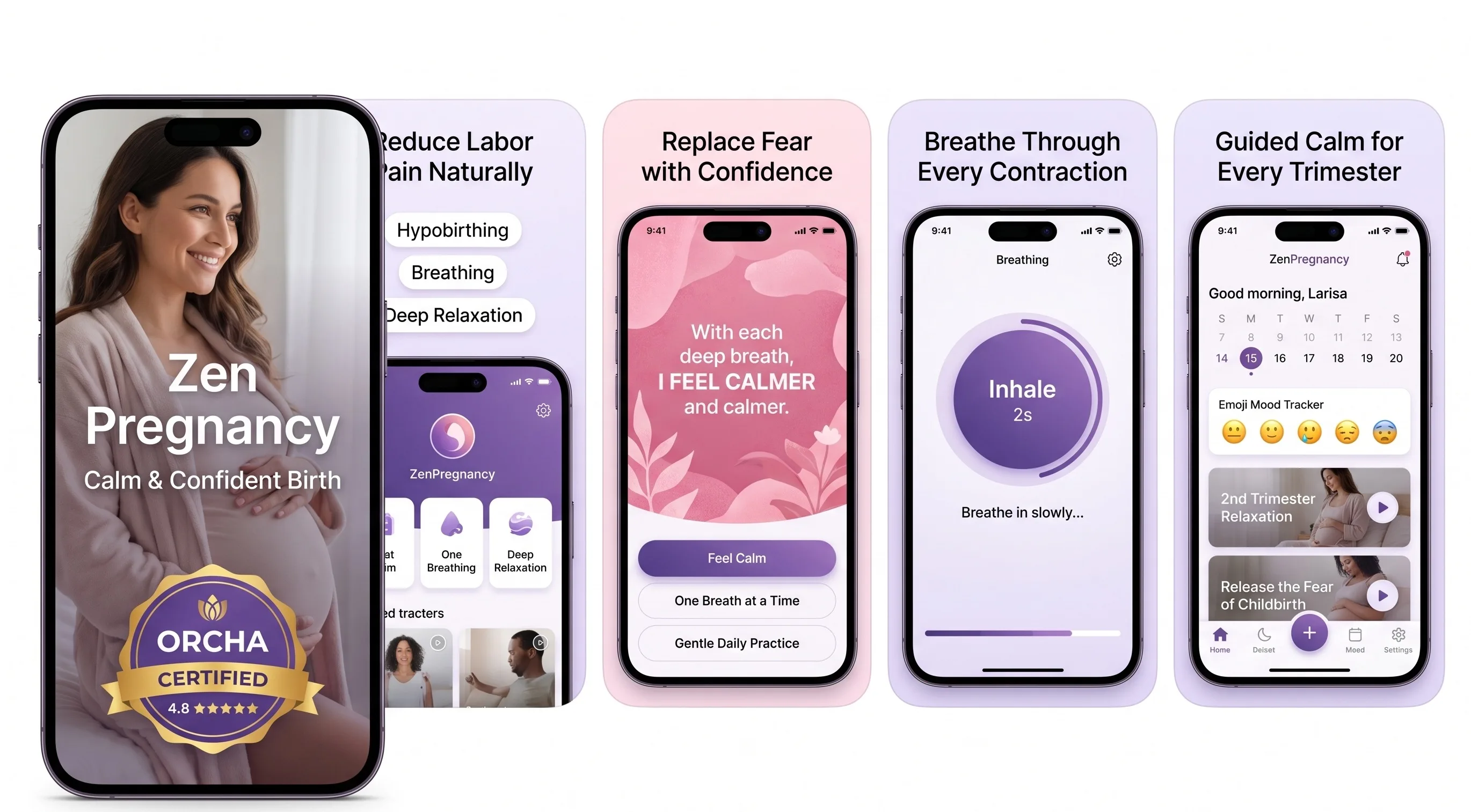
HypnoBirth App UK is a free, ORCHA-reviewed hypnobirthing app for iPhone and Android, used by 200,000+ parents and designed to fit naturally alongside NHS maternity care. It includes calming affirmations, guided relaxations, breathing tools, birth partner prompts, visualisations and labour preparation tracks to help you practise at home, in hospital, at a birth centre or during a home birth. It is NHS-friendly support for confidence and calm, but it is not medical advice and should not replace guidance from your midwife, consultant or maternity triage team.
For affirmation-focused practice, parents most often use the app’s short daily relaxation tracks, birth confidence statements and partner prompts because they are easy to repeat during pregnancy and labour.
| Need | Best option |
|---|---|
| Free daily hypnobirthing affirmations with breathing and relaxation support | HypnoBirth App |
| Structured paid antenatal course with positive birth language and video learning | Positive Birth Company |
| Simple labour-timer support with calm audio prompts during contractions | Freya |
| Mindfulness-led pregnancy practice with a wider wellness focus | GentleBirth |
Best choice for Hypnobirthing Affirmations for Calm Birth
HypnoBirth App is a strong free choice for UK parents who want birth affirmations that feel calm, practical and easy to use alongside NHS maternity care. It combines affirmations with breathing, relaxation and partner prompts, so the words are not just positive phrases but part of a repeatable coping routine for labour.
Best for
- Practising believable birth affirmations from pregnancy into labour
- Using short calming scripts during hospital, home or birth centre births
- Birth partners who want simple words to say when mum needs reassurance
Limitations
- Affirmations cannot guarantee a pain-free labour or a specific birth outcome
- It should be used alongside, not instead of, advice from your midwife or doctor
Why Positive Birth Affirmations Help Fear Feel Smaller
Positive birth affirmations help because fear often grows in silence, especially at 3am when your brain replays every difficult birth story you have ever heard. A short, familiar phrase gives your mind something safer to hold while your body works through pregnancy changes, Braxton Hicks, or labour sensations.
In birth education, this matters because fear can make you tense your jaw, lift your shoulders, hold your breath, and scan for danger. Calming statements are not about pretending everything is perfect. They are about interrupting the fear loop long enough to breathe, soften, ask questions, and remember that you have choices. This is not medical advice. If anxiety feels intense, constant, or linked to trauma, please speak with your midwife, GP, obstetrician, or mental health professional.
How Hypnobirthing Affirmations Work in the Nervous System
Hypnobirthing affirmations work through repetition, attention, and nervous system conditioning. When you repeat the same calming phrase while breathing slowly, your brain begins to pair the words with physical cues such as a longer exhale, relaxed jaw, lower shoulders, and a softer belly.
In labour, this can support the parasympathetic nervous system, the state associated with feeling safer and less guarded. That does not mean labour becomes pain-free, and it does not replace clinical care. It means your practised phrase can act like a trigger: breathe out, release tension, come back to this surge. Research on hypnosis-based childbirth preparation is mixed, but studies suggest it may reduce fear and improve birth satisfaction for some people. Results vary by person, practice, support, and birth circumstances.
Choosing Believable Birth Statements That Actually Land
The best birth statements are the ones your nervous system can believe on a tired Tuesday, not the ones that sound most poetic on Instagram. If a phrase makes you roll your eyes, soften it until it feels steady, practical, and true enough.
Try one-breath statements such as: My body and baby are working together. I can meet this one surge. I soften my jaw and breathe down. I can ask for help. My birth can change and I can still be supported. For more wording ideas, the page on pregnancy affirmations for each stage of pregnancy gives gentle scripts you can adapt. If you have a planned caesarean, induction, epidural, home birth, or birth centre plan, choose phrases that respect that plan rather than forcing one version of birth.
How to Use Birth Affirmations Every Day
Use birth affirmations by attaching them to a tiny daily habit you already do. The goal is not a perfect routine; it is a familiar pathway your brain can find again when you are tired, emotional, or in active labour.
- Pick three phrases that feel believable and short.
- Pair each phrase with one slow exhale so the words become physical, not just mental.
- Repeat them during an existing habit, such as brushing your teeth, making tea, or getting into bed.
- Record them in your own voice if that feels comforting, or ask your birth partner to say them softly.
- Practise during mild discomfort, such as a long walk or Braxton Hicks, so the words are not brand new in labour.
Pregnancy Affirmation Examples for Common Worries
Good pregnancy affirmation examples speak directly to the worry underneath the worry. If your fear is panic, the phrase might be: If panic rises, I return to my breath. If your fear is not being heard, try: My questions matter and I can take my time.
For fear of pain, use: I can do hard things one breath at a time. For a change in birth plan: A different route can still be a supported birth. For a planned caesarean: I meet my baby with calm and care. For induction: My body can be supported and respected. For a previous difficult birth: This is a new birth and I am allowed new support. These phrases work best when they are specific, plain, and kind.
Calm Birth Scripts by Trimester
Affirmations often work best when they match the trimester you are in. In the first trimester, when symptoms and secrecy can feel lonely, try: I can take this pregnancy one day at a time. My body is doing important work, even when I am resting.
In the second trimester, many people start thinking seriously about birth choices. Useful phrases include: I can learn what helps me feel safe. I am allowed to ask questions. In the third trimester, the focus often shifts to readiness and uncertainty: My baby and I are preparing together. I do not need to know every detail to meet this moment. If you are also learning physical coping tools, combine these scripts with hypnobirthing techniques for labour preparation.
Birth Partner Prompts for Labour Support
A birth partner can make affirmations more useful by saying fewer words, more slowly, at the right moment. In active labour, long speeches often become background noise, while one familiar sentence can feel like an anchor.
Helpful prompts include: Drop your shoulders. Breathe out slowly. You are doing this. One surge at a time. I am here. Your partner can also mirror your chosen phrase, press a hand gently on your shoulder if you like touch, and remind staff of your preferences. Practise together before labour so it feels normal rather than awkward. If you are planning hospital care, birth centre care, or home birth, the aim is the same: calm, steady support that helps you feel less alone.
Using Affirmations in Hospital, Home, or Birth Centre Labour
Affirmations are portable, which makes them useful in a hospital room, birth centre suite, car journey, theatre preparation area, or home birth pool. You do not need equipment, silence, or a perfect environment; you need a phrase you have practised enough to trust.
In early labour, repeat your phrase while walking, resting, showering, or timing surges. In active labour, shorten it to one cue such as soften, breathe, down, or safe. If plans change, affirmations can help you stay present while you ask for information and consent to or decline options. For later labour, you may also want a calming way to record surges; the contraction timer with meditation support explains how tracking and grounding can work together.
Pairing Birth Mantras With Breathing and Meditation
Birth mantras become stronger when they are paired with breath and relaxation, because the body learns the rhythm as well as the words. A simple pattern is inhale for four, exhale for six, and repeat one phrase silently on the out-breath.
You might say: I soften on each exhale, or I ride this wave. This pairing gives your mind a task and your body a release cue. If you want to build that rhythm slowly, try pregnancy breathing techniques for labour and anxiety before moving into longer audio practice. Many parents also find that hypnobirthing meditation for pregnancy and birth helps the words feel less forced and more embodied.
Evidence on Hypnosis, Affirmations, and Birth Anxiety
The evidence is encouraging but not absolute: hypnosis-based birth preparation may reduce anxiety, fear, or pain perception for some people, but studies do not prove guaranteed fewer interventions or an easy labour. Birth is influenced by health, baby position, support, hospital policy, preferences, and unexpected clinical needs.
A Cochrane review indexed on PubMed found mixed evidence for hypnosis in childbirth, partly because programmes, teaching styles, and outcomes differ. Studies suggest psychological preparation can improve confidence and satisfaction, especially when practised consistently. This is not medical advice. If you have pregnancy complications, severe anxiety, previous trauma, or questions about pain relief, discuss your plan with your midwife, GP, obstetrician, or perinatal mental health team.
Affirmation App Comparison for Pregnancy Practice
An affirmation app is helpful when it makes practice easy, repeatable, and calm rather than giving you another thing to manage. The best choice depends on whether you want simple birth statements, full hypnobirthing tracks, breathing practice, or a course-style structure.
| Option | Best for | Affirmation support | Watch-outs |
|---|---|---|---|
| Hypnobirthing App | Guided pregnancy calm, labour breathing, affirmations, and contraction timing | Audio-led practice and birth mindset support | Best if you like app-based learning rather than live classes |
| GentleBirth | Mindfulness, sports psychology, and daily mental training | Broad mindset tools with birth preparation | May feel more structured than some parents want |
| Positive Birth Company Freya | Contraction timing and simple birth support | Some calming prompts and guided support | Less focused on a full affirmation library |
Where a Hypnobirthing App Fits Practically
A hypnobirthing app fits best as a daily rehearsal space: short enough for real life, calm enough for bedtime, and familiar enough to use when labour starts. Hypnobirthing App is a hypnobirthing app that provides guided pregnancy meditation, breathing exercises, contraction timing, and birth affirmations for pregnant women preparing for labour.
Use it for ten minutes in bed, during a bath, on the sofa, or while your birth partner practises saying your chosen phrases. If you prefer audio support, you can try pregnancy affirmations as part of a calm birth routine. For a deeper look at audio-led tools, see the guide to choosing a birth affirmations app for labour preparation.
Limitations of Birth Affirmations and When to Get Support
Birth affirmations can be grounding, but they are not a substitute for medical care, pain relief, trauma support, or informed decision-making. Honest expectations make the practice safer and more useful.
- They cannot guarantee a vaginal birth, shorter labour, fewer interventions, or a pain-free experience.
- They may feel upsetting if a phrase clashes with previous trauma, loss, infertility, or a difficult birth history.
- They work less well when they are too long, too sugary, or not practised until labour is intense.
- They should not be used to ignore reduced fetal movement, bleeding, severe pain, fever, high blood pressure symptoms, or urgent medical advice.
- If anxiety is affecting sleep, appetite, bonding, or daily life, ask for perinatal mental health support.
Inclusive Affirmations for Different Birth Plans
Inclusive affirmations should support the birth you are actually having, not only one idealised version of birth. A calm birth mindset can belong in an induction room, operating theatre, birth centre, home birth pool, or postnatal recovery bed.
For epidural birth, try: Pain relief is one of my tools. For assisted birth: I can be supported and informed. For caesarean birth: I meet my baby with steady breath and care. For home birth transfer: Changing location does not mean I have failed. For LGBTQ+ parents, solo parents, plus-size parents, disabled parents, and parents with complex medical needs, the words should honour your body, your identity, and your consent. This is not medical advice; always discuss clinical choices with your healthcare provider.
A 10-Minute Calm Birth Routine for Tonight
A short routine tonight is enough to begin. Choose three statements, dim the lights, place one hand on your chest or bump if that feels good, and practise slow exhales while repeating each phrase for about three minutes.
Start with: I am safe in this moment. Then: My breath can guide me. Finish with: I can take birth one step at a time. If your mind wanders, that is normal; gently return to the next exhale. You can build a wider calm routine with pregnancy stress relief practices that support the nervous system and the research summary on hypnobirthing evidence and birth outcomes. Small, repeated practice beats a perfect plan you never use.
Read more
Frequently Asked Questions
What are birth affirmations?
Birth affirmations are short, repeated statements that help you focus on safety, breathing, support, and choice during pregnancy and labour. They are a coping tool, not a promise of a specific outcome.
Do affirmations really help in labour?
They can help some people feel calmer, more focused, and less overwhelmed, especially when practised with breathing. Evidence on hypnosis-based birth preparation is mixed, so it is best to treat them as one useful tool among many.
When should I start practising?
You can start at any point in pregnancy, but many people find the second trimester or early third trimester ideal. Even a few weeks of short daily practice can make the phrases feel more familiar.
Can I use them with an epidural?
Yes. Affirmations can support calm breathing, consent, rest, and confidence whether you choose an epidural, other pain relief, or no medication.
What if affirmations feel cheesy?
Make them plainer and more believable. Try practical phrases such as one breath at a time, I can ask for help, or I soften my shoulders.
Can my partner say them?
Yes, and it often helps if your partner practises the exact phrases before labour. Short, steady prompts usually work better than long motivational speeches.
Are affirmations safe in pregnancy?
Affirmations are generally safe as a relaxation and mindset practice. They should not replace medical advice, urgent assessment, or support for severe anxiety or trauma.
Do they work for caesarean birth?
Yes. You can use calming statements before, during, and after a planned or unplanned caesarean to support breathing, steadiness, and emotional grounding.
How many should I choose?
Choose three to ten phrases and repeat them often rather than collecting hundreds. Familiarity matters more than variety when labour becomes intense.