 Hypno
Pregnancy yoga: safety, poses and a 15-minute routine
A practical UK guide to prenatal yoga, with NHS exercise advice and sensible adaptations for each trimester.


200,000+ parents • ORCHA-reviewed • Free on iOS & Android
Quick answer. Pregnancy yoga is generally safe when it is adapted for pregnancy, kept at a comfortable intensity and stopped if you feel pain or become unwell. The NHS includes yoga among suitable forms of pregnancy exercise. Choose prenatal yoga rather than an unadapted class, tell the teacher you are pregnant and ask your midwife for advice if you have symptoms, complications or concerns.
How we wrote this. We are not doctors. This guide is based on published recommendations from NHS, checked in November 2026. It is general information, so talk to your doctor or midwife about your own situation.
What is pregnancy yoga, and what can it help with?
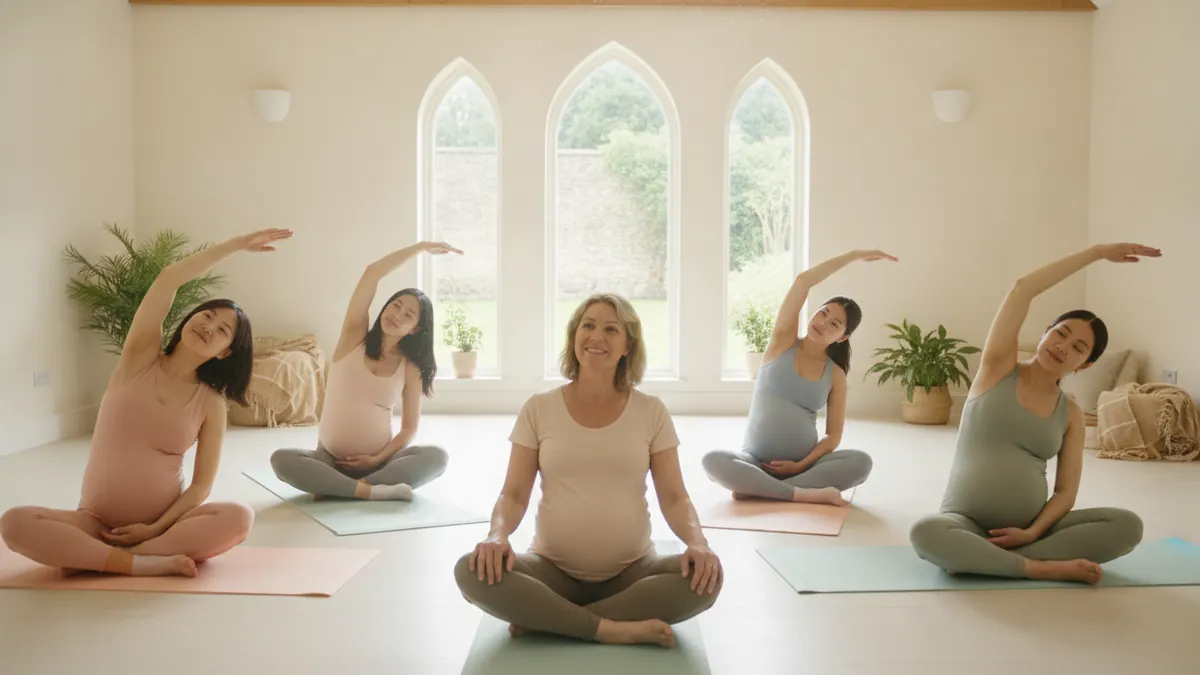
Pregnancy yoga is yoga adapted for the physical changes and safety needs of pregnancy. A typical session combines gentle movement, supported pregnancy yoga poses, breathing and relaxation. It should feel manageable and comfortable rather than punishing. For the final relaxation in your routine, try the pregnancy meditation tracks on iPhone or the Android meditation tracks.
The NHS says prenatal yoga may help with relaxation and easing body tension through gentle stretching and breathing. It can also contribute to your weekly physical activity. Those benefits may sound modest, but easing a tight back and getting ten quiet minutes to breathe can matter a great deal on a tiring day.
Yoga may also give you time to practise moving, resting and breathing without rushing. These skills fit neatly alongside pregnancy breathing techniques and other birth preparation. NHS guidance does not show that yoga guarantees a shorter labour, prevents complications or ensures a vaginal birth. Be wary of any class that promises those outcomes.
- Gentle stretching may ease body tension.
- Breathing and relaxation can help you settle during and after a session.
- Regular sessions can count towards the NHS activity target.
- Supported movement may help you find comfortable positions as your body changes.
If stretching is your main aim, our guide to pregnancy stretches covers simple movements in more detail.
Is yoga safe in pregnancy?
Yes, yoga is generally safe in pregnancy when the session is gentle, pregnancy-specific and comfortable for you. The NHS pregnancy exercise guidance advises staying active while making sensible changes as pregnancy progresses.
Use the talk test to judge intensity. During moderate activity, you should be able to talk but not sing. Slow down if speaking becomes difficult. You do not need to chase a particular heart rate or keep up with somebody else in the class.
Before your first session
- Ask your midwife, GP or obstetrician before starting if you have a pregnancy complication, health problem, injury, pain, bleeding or any concern about exercising.
- Choose a class labelled prenatal yoga or pregnancy yoga, particularly as your pregnancy progresses.
- Tell the instructor that you are pregnant, how many weeks you are and whether your maternity team has given you any restrictions.
- Look for a teacher with experience in pregnancy adaptations.
- Have something to eat beforehand. The NHS warns that exercising on an empty stomach can make you feel faint.
- Keep water nearby and avoid becoming too hot.
Warm up, cool down and stop any movement that causes pain, dizziness, faintness or discomfort. Cushions, yoga blocks and a sturdy chair are useful equipment, not signs that you are doing the pose badly.
Stop exercising and call your midwife or maternity unit urgently for bleeding, leaking fluid, regular painful contractions, severe pain, severe breathlessness, fainting, severe headache, visual changes, calf pain or swelling, or reduced fetal movements. Call 999 in an emergency.
How should pregnancy yoga poses change by trimester?
Pregnancy yoga poses should change according to your comfort, balance and stage of pregnancy. Trimester labels are useful, but they are not rigid rules. A pose that feels fine one week may feel awkward the next.
| Stage | Practical approach | What to watch |
|---|---|---|
| First trimester | Keep the pace comfortable, stay cool and use support whenever you want it. If you are new to exercise, begin with short sessions. | Stop if you feel unwell, faint, unusually breathless or in pain. Ask for advice if you have symptoms or medical concerns. |
| Second trimester | Give your bump room by widening your stance or moving the knees apart. Supported standing poses and hands-and-knees movements are often easier to adapt. | Do not force twists or stretches. Avoid spending a long time flat on your back if it feels uncomfortable. |
| Third trimester | Use a chair, wall, blocks or cushions. Take care when changing position and choose side-lying or seated relaxation. | Balance and comfort deserve more attention. Leave out any pose with a fall risk or one that feels cramped. |
The national NHS guidance does not set one week when everybody must begin or stop yoga. Nor does it give an official pose list for each trimester. Your own symptoms and clinical advice matter more than a neat calendar.
Later in pregnancy, a birth ball can provide support for seated movement and gentle mobility. See our guide to birth ball exercises before adding one to your practice.
Which pregnancy yoga poses are usually easiest to adapt?
Supported standing poses, hands-and-knees movements, gentle spinal mobility, supported squats and side-lying rest are usually the easiest pregnancy yoga poses to adapt. This is a practical list rather than an NHS-approved sequence.
Supported standing
Stand with your feet in a comfortable position and keep one hand on a wall or chair if needed. Avoid locking your knees. This is a simple starting position for shoulder movements and relaxed breathing.
Hands-and-knees spinal movement
Place your hands beneath your shoulders and keep your knees comfortably apart. Slowly move between a neutral spine and a gentle rounded shape. Do not force your abdomen down or push into pain.
Chair-supported squat
Hold a sturdy chair and lower only as far as feels comfortable. Keep the movement controlled. A pile of firm cushions can offer extra support, but skip the squat if it causes pelvic, knee or back pain.
Side-lying rest
Lie on your side with support beneath your head and between your knees. This can be more comfortable than lying flat later in pregnancy and works well for the relaxation part of a session.
Yoga positions may also help you explore ways of kneeling, leaning and resting before birth. Our guide to birthing positions explains how these positions may be used during labour.
Which yoga poses should you avoid while pregnant?
Avoid hot yoga, poses with a meaningful fall or abdominal-impact risk, forced stretches and anything that causes pain, dizziness or discomfort. There is no reliable universal blacklist for every pregnant person, so the quality of the adaptation matters.
- Hot yoga. The NHS advises avoiding strenuous exercise in hot conditions and keeping cool during pregnancy.
- Unstable balances. Use a wall or chair, or choose a more secure pose. Pregnancy is not the time to prove you can rescue a wobble.
- Headstands, handstands and advanced inversions. Their safety for an individual pregnancy is not stated in the NHS sources cited here. Avoid them unless your maternity professional has cleared them and a pregnancy-experienced teacher supervises you.
- Deep twists and strong abdominal work. Reduce or omit these if they compress your bump, strain your abdomen or feel uncomfortable.
- Long periods flat on your back later in pregnancy. Move onto your side or use support if you feel uncomfortable, dizzy or unwell.
- Forceful breathing or breath-holding. Breathe normally and stop if a technique makes you light-headed.
- Any painful pose. Pain is not a useful sign that a stretch is working.
The NHS advice for exercising in pregnancy also recommends avoiding activities with a high risk of falling or being hit. A normal yoga class is not automatically suitable simply because the pace looks slow.
What is a gentle 15-minute pregnancy yoga routine?
A short pregnancy yoga routine can combine two minutes of breathing, gentle mobility, supported movement and relaxation. The sequence below is a general example, not an official NHS routine or an individual treatment plan.
- Minutes 0 to 2, comfortable breathing. Sit with support or stand in a stable position. Let your shoulders soften and breathe normally. Do not hold your breath or force it deeper.
- Minutes 2 to 4, gentle warm-up. Roll your shoulders, move your ankles and slowly turn your head through a comfortable range.
- Minutes 4 to 7, hands-and-knees mobility. Place your hands under your shoulders and keep your knees comfortably apart. Alternate slowly between a neutral spine and a gentle rounded spine.
- Minutes 7 to 10, supported squat. Hold a sturdy chair or use firm cushions. Lower only as far as comfortable, then rise with control. Stay standing and bend your knees slightly instead if squatting does not suit you.
- Minutes 10 to 12, side-lying rest. Lie on your side with a pillow under your head and another between your knees.
- Minutes 12 to 15, relaxation. Remain on your side or sit supported. Breathe normally and release any obvious tension in your jaw, hands and shoulders.
Keep the room cool and have water nearby. You should finish feeling settled rather than drained. For a longer option, the NHS has a 45-minute beginner prenatal and postnatal yoga video.
How much prenatal yoga should you do?
Prenatal yoga can form part of the NHS target of 150 minutes of moderate activity each week. That total can include walking and other suitable exercise, so you do not need to complete all 150 minutes through yoga.
If you are new to exercise, the NHS suggests starting with about 10 minutes a day and building up gradually. A short, repeatable session is often more useful than one ambitious class that leaves you uncomfortable.
There is no national NHS rule that says everyone must wait until a particular pregnancy week to start yoga. If you have been inactive, feel unwell or have a pregnancy or health concern, speak to your midwife or doctor before beginning. Existing clinical advice always takes priority over a class plan.
Should you choose online or local pregnancy yoga classes?
Choose online pregnancy yoga for convenience and repeat access, or a local class if you value direct feedback and in-person adaptations. Neither format is automatically safer. The teacher, content and your willingness to stop when something feels wrong matter more.
| Option | Useful when | Limitations |
|---|---|---|
| Online class | You need flexible timing, prefer home practice or want to repeat a familiar session. | The teacher cannot see your position or respond directly to symptoms during a recorded class. |
| Live online class | You want home access with some opportunity to ask questions. | Camera angles may make it difficult for the teacher to check movement. |
| Local class | You want direct supervision, social contact and changes suggested in person. | Travel, fixed times and local availability may make regular attendance harder. |
For any class, check that it is specifically designed for pregnancy. Tell the teacher how many weeks pregnant you are and ask how they adapt poses as pregnancy progresses. Avoid hot rooms and instructors who encourage you to push through pain.
Our comparison of the best pregnancy yoga classes online looks at what to check before signing up.
How does pregnancy yoga fit into birth preparation?
Pregnancy yoga works best as one part of birth preparation, alongside antenatal care, practical information and choices about feeding, pain relief and place of birth. It should never replace treatment or advice from your maternity team.
The breathing and relaxation side of yoga can sit well beside labour breathing exercises. The movements may also make it easier to explore upright and supported positions without meeting them for the first time during labour.
A broader antenatal class can cover topics that yoga classes may not, including interventions and newborn care. After birth, return to exercise according to your recovery and clinical advice. Our postnatal yoga guide explains the gentler approach needed after pregnancy.
Frequently asked questions
When can I start pregnancy yoga?
The national NHS guidance does not set a universal starting week. If you are new to exercise, start with about 10 minutes a day and build gradually. Ask your midwife or doctor first if you have symptoms, complications, an injury or a health concern.
Can I do yoga in the first trimester?
Pregnancy yoga may be suitable in the first trimester if it feels comfortable and you have no medical reason to avoid exercise. Stay cool, keep the intensity moderate and do not push through pain or feeling unwell.
Can I do pregnancy yoga in the third trimester?
Gentle, adapted yoga is often possible in the third trimester. Use a chair, wall, blocks or cushions for support, take care with balance and choose positions that give your bump room.
Can pregnancy yoga help with labour?
Yoga can help you practise gentle movement, breathing and relaxation, and the NHS says activity may help prepare your body for labour. Current NHS guidance does not show that yoga shortens labour or guarantees a particular type of birth.
Is online pregnancy yoga safe for beginners?
It can be suitable if the programme is pregnancy-specific, starts gently and gives clear modifications. A recorded teacher cannot check your position, so use support and leave out anything uncomfortable.
How do I know if a pregnancy yoga teacher is suitable?
Ask whether the teacher has experience adapting yoga for pregnancy and how they change sessions by trimester. They should ask about your stage of pregnancy, accept medical restrictions and never encourage you to work through pain.
Sources
- NHS: Exercise in pregnancy
- NHS Best Start in Life: Exercising in pregnancy
- NHS: Prenatal and postnatal yoga exercise
- Healthier Together: Exercise in pregnancy
Written by the HypnoBirth UK team for general information. It does not replace advice from your own doctor or midwife.