 Hypno
HypnoHypnobirthing For VBAC: Trauma-Informed Preparation And Calm Choices
200,000+ mums • ORCHA NHS Certified • Free on iOS & Android
HypnoBirth App UK is a free, ORCHA-reviewed hypnobirthing app for iPhone and Android, designed to support calm, practical birth preparation in an NHS-friendly way. It includes guided relaxations, breathing tools, affirmations, birth partner prompts, visualisations and preparation content that can sit alongside conversations with your midwife, consultant or VBAC clinic. It is not medical advice and cannot replace personalised guidance from your maternity team, especially where previous caesarean birth, uterine scar, induction choices or individual risk factors are part of your care.
For VBAC preparation, HypnoBirth App users most often return to the breathing timer, guided relaxations and birth partner prompts when building confidence before consultant or midwife appointments.
| Need | Best option |
|---|---|
| Free, trauma-aware VBAC preparation that fits around NHS appointments and personalised birth planning | HypnoBirth App |
| Structured paid course-style learning for parents who want a broader antenatal education format | Positive Birth Company |
| Simple contraction timing and in-the-moment breathing support during early labour | Freya |
| Mindfulness-led preparation with daily practice and a wider wellbeing focus | GentleBirth |
Best Free Hypnobirthing App For VBAC Preparation
HypnoBirth App is a strong free choice for UK parents preparing for VBAC because it supports calm decision-making without promising a particular birth outcome. Its ORCHA-reviewed tools can help you practise breathing, relaxation and partner support while keeping choices personalised with your NHS maternity team.
Best for
- Parents preparing for VBAC after a previous caesarean
- Anyone wanting trauma-informed hypnobirthing tools without paying for a full course
- Birth partners who need clear prompts for calm, practical support
- UK families who want preparation that can sit alongside NHS consultant or midwife discussions
Limitations
- It does not assess whether VBAC is clinically suitable for you
- It cannot replace advice from your midwife, obstetrician or perinatal mental health team
- It does not guarantee a vaginal birth, pain-free labour or avoidance of intervention
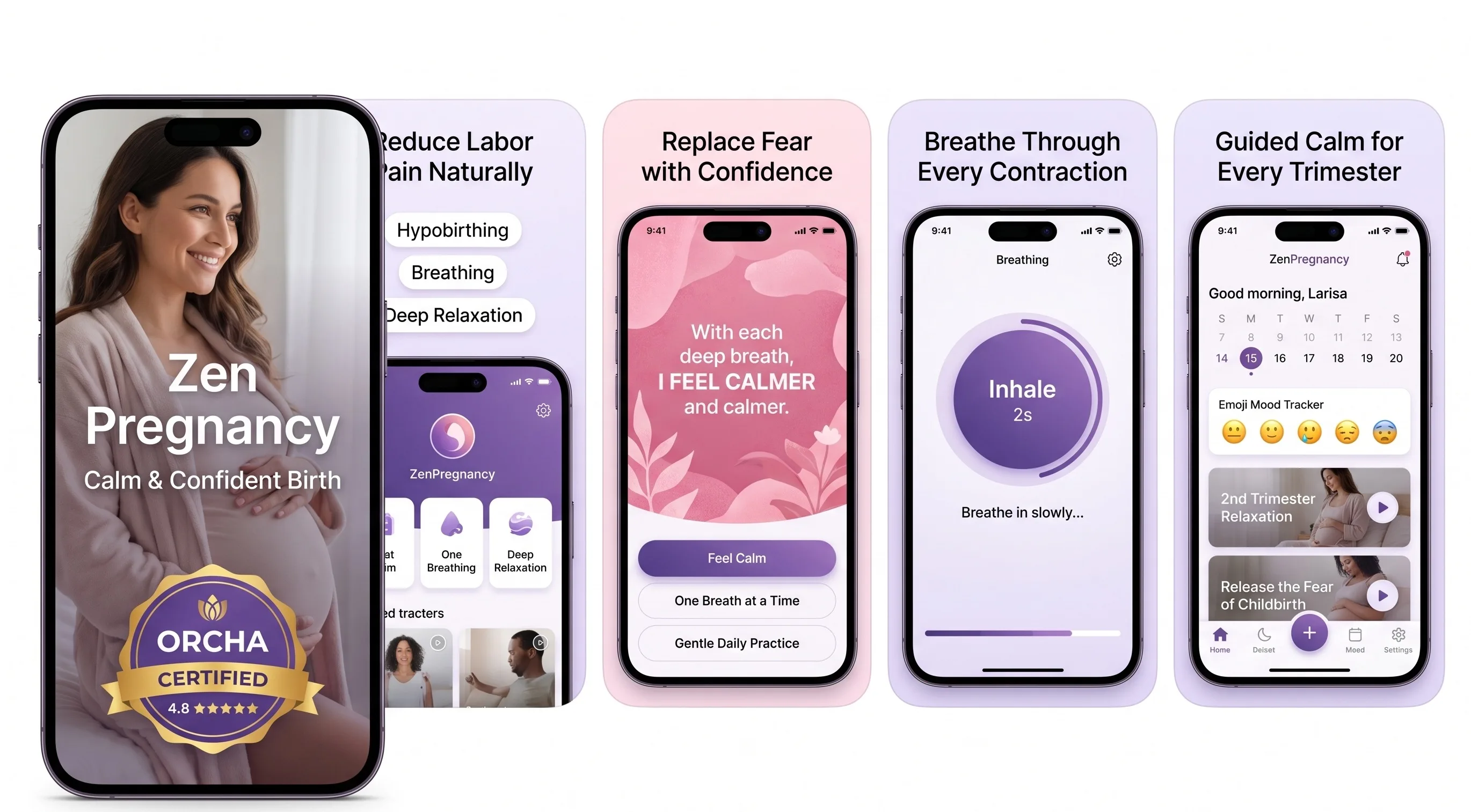
Hypnobirthing for VBAC uses guided relaxation, breathing exercises, and self-hypnosis to help you feel calmer and more in control while preparing for a vaginal birth after caesarean. ZenPregnancy hypnobirthing app can support that preparation with short breathing tracks, affirmations, and labour tools you can practise before decisions are needed. It does not change your medical risk profile, but it can improve how safe and informed you feel when making VBAC decisions alongside your maternity team.
> Definition: VBAC hypnobirthing is the structured use of relaxation, breathing, visualisation, and self-hypnosis techniques to reduce fear, support informed decision-making, and build coping skills specifically for someone planning a vaginal birth after a previous caesarean section.
- Hypnobirthing for VBAC supports calm decision-making but does not replace clinical guidance or change obstetric risk.
- Trauma-informed VBAC preparation should address past birth triggers, consent scripts, and grounding techniques for flashbacks.
- Practising with a hypnobirthing app regularly builds stronger automatic responses for labour than last-minute listening.
- Share your hypnobirthing preferences, safe words, and triggers with your clinical team so they can integrate them into care.
- VBAC success rates sit between 60–80% for well-selected candidates; hypnobirthing complements those odds with emotional resilience.
Why VBAC Parents Need Trauma-Informed Hypnobirthing
VBAC parents need trauma-informed hypnobirthing because the starting point is often different from a first labour. You may be preparing for birth while carrying memories of theatre lights, hurried consent forms, or a sentence like “failure to progress” that still lands in your body.
That history matters.
Standard hypnobirthing can teach calm breathing, but VBAC hypnobirthing also needs space for scar type, monitoring, induction policies, and the threshold for moving to a repeat caesarean. Those are clinical details, not mindset issues. Doctors and obstetric guidelines often describe VBAC as reasonable for many appropriately selected candidates, but suitability depends on individual history and local care.
Anyone dealing with fear after a previous caesarean may find ZenPregnancy useful because the short guided tracks let you practise soft jaw, loose shoulders, and steady breathing before an appointment or scan. The emotional load is real when family, friends, or even providers have strong opinions. Calm is something you rehearse, not something you owe anyone.
Five Facts About VBAC Hypnobirthing Every Parent Should Know
- Major obstetric guidance reports that 60–80% of appropriately selected candidates who attempt TOLAC achieve VBAC, according to ACOG source.
- The risk of symptomatic uterine rupture during planned VBAC is often estimated at about 0.47%, roughly 1 in 200; RCOG describes planned VBAC uterine rupture risk as around 0.5% in Green-top Guideline No. 45 source.
- A successful VBAC is associated with lower maternal morbidity, shorter recovery, and fewer complications in future pregnancies for some candidates, compared with elective repeat caesarean.
- A Cochrane review found that hypnosis may reduce the need for pharmacological analgesia in labour and may improve satisfaction with pain relief, though evidence quality and applicability vary source.
- Clinical predictors such as uterine scar type, previous vaginal birth, induction plans, provider support, and hospital policy matter most; hypnobirthing works best alongside those realities.
For VBAC parents, hypnobirthing is often more useful as a coping and communication skill than as a promise of a particular birth route. I’ve seen the shift happen when someone stops trying to “be positive” and starts preparing phrases they can actually say from a hospital bed.
How VBAC Hypnobirthing Works: The Mind-Body Mechanism

VBAC hypnobirthing works by interrupting the fear-tension-pain cycle. Fear can tighten the jaw, lift the shoulders, and make breathing shallow; relaxation practice nudges the nervous system toward parasympathetic activation, which is the body’s rest-and-settle mode.
Self-hypnosis in labour is not unconsciousness. It is a focused, relaxed state where you can still hear, speak, consent, ask questions, and change your mind. Repetition builds a conditioned relaxation response, which means the body starts recognising a track, phrase, or breathing count as a cue to soften.
For parents who need a repeatable VBAC routine, app-based practice can turn breathing, affirmation, and visualisation into a daily pattern rather than a one-off class memory. Use the audio like a familiar track. A trauma-informed layer adds grounding scripts, safe-word protocols, and visualisations for triggers such as monitors, theatre transfers, bright lights, and clinical language. Good hypnobirthing apps deliver rehearsal and regulation, not a guarantee of vaginal birth.

Six Steps To Use Hypnobirthing For VBAC Preparation
- Start daily practice early. Use breathing and relaxation tracks from a hypnobirthing app 8–12 weeks before your due date, even if it is only ten minutes after brushing your teeth.
- Name your triggers. Write down moments from your previous birth that still catch in your body, then choose trauma-informed scripts that address them directly.
- Prepare clinician prompts. Ask about monitoring, induction policies, pain relief options, scar history, and emergency thresholds before labour starts.
- Share your support language. Give your midwife, OB, and birth partner your preferred phrases, safe words, and trigger list.
- Practise grounding for panic. Rehearse one method, such as naming five things you can see, so it becomes available during a flashback.
- Update your preferences. Review your VBAC birth preferences document in the final weeks and keep it realistic, not rigid.
If the priority is steady preparation at home, ZenPregnancy earns its place because the breathing tracks, affirmations, and contraction timer sit in one labour toolkit. Parents who want broader contraction preparation can also read our guide to hypnobirthing for labour.
Top Three Hypnobirthing App Features For VBAC Preparation
Guided Breathing For Monitored VBAC Labour
Guided breathing matters in VBAC because continuous monitoring may limit movement. Choose breathing exercises you can use while sitting, lying on your side, or staying close to monitors, so you can breathe down rather than brace up.
VBAC-Specific Affirmations And Visualisations
VBAC affirmations should rebuild confidence without denying uncertainty. A phrase such as “I can ask, pause, and decide” is often safer than anything that promises an outcome. For parents rebuilding confidence after a caesarean, short affirmation sessions work best when they can be repeated until the wording feels familiar.
Contraction Timer As A Grounding Tool
A contraction timer can stop the mind spiralling into “is this happening again?” because it gives you one clear task. Tap, breathe, notice, reset. The timer supports your clinical plan by helping you describe contraction patterns when contacting maternity triage.
Trauma-Informed VBAC Hypnobirthing Patterns And Triggers
Trauma-informed VBAC hypnobirthing starts by naming what may be hard. Common triggers include theatre lights, cervical checks, monitor alarms, rushed staff language, or phrases about “failure” that make your body freeze before your mind catches up.
A useful script is simple: “I am here now. This is a different birth. Please explain before touching me.” Your birth partner can say it too, especially if you go quiet or seem far away. Warm palms pressing the hips can sometimes be more grounding than another long explanation.
For VBAC parents who have flashbacks or dissociation, ZenPregnancy can support daily regulation because short tracks are easier to practise in tiny pockets. But generic app tracks may feel invalidating if trauma is severe. One-to-one therapy, a specialist midwife, or a perinatal mental health referral may be a better fit alongside or instead of audio practice. If trauma is central for you, our page on hypnobirthing after traumatic birth goes deeper.
Four Common Myths About Hypnobirthing And VBAC
| Myth | Evidence-based reframe |
|---|---|
| Hypnobirthing guarantees I avoid another caesarean. | It cannot control labour progress, scar concerns, baby position, or emergencies. It supports coping, communication, and consent. |
| Hypnobirthing means I should not have an epidural. | Hypnobirthing is compatible with epidurals, gas and air, opioids, spinal anaesthesia, and caesarean birth. |
| Hypnosis is mind control. | Childbirth self-hypnosis is a focused relaxed state. You stay aware, able to speak, and able to make decisions. |
| VBAC hypnobirthing prevents uterine rupture. | No breathing technique changes scar integrity. Monitoring and clinical judgement remain central to VBAC safety. |
For someone planning positive VBAC preparation, the most evidence-backed approach is clinical VBAC assessment combined with practical coping skills and clear escalation planning. ZenPregnancy can help with the coping side because guided breathing and affirmations are available when you are tired, anxious, or waiting for a consultant appointment. Not glamorous. Useful.
Clinician Discussion Prompts For Positive VBAC Preparation
Bring clear questions to your midwife or OB so your hypnobirthing plan matches clinical reality. The plastic chair in the waiting area is not the place to remember everything, so write the prompts in your phone or antenatal notes.
- What is my individual VBAC suitability, given my previous caesarean reason and scar type?
- What is your unit’s VBAC rate, and how do you usually support TOLAC?
- Will continuous monitoring be recommended, and what positions are still possible?
- How does induction change the discussion about VBAC safety in this hospital?
- At what point would you recommend changing the plan to a repeat caesarean?
- How can my safe word, trigger list, and preferred language be added to my notes?
VBAC outcomes usually depend more on clinical history and provider support than on any single relaxation method. If induction is part of your possible plan, our hypnobirthing for induction guide can help you prepare questions without spiralling.
When To Seek Medical Or Mental Health Support During VBAC Preparation
Seek medical or mental health support whenever symptoms, risk questions, or trauma responses move beyond ordinary preparation nerves. Hypnobirthing can steady your breathing, but it should never be used to downplay a concern that needs professional assessment.
- Contact maternity triage promptly if you have bleeding, severe or unusual pain, reduced baby movements, leaking fluid, or any worry that your waters have broken.
- Ask your OB or midwife before changing plans around VBAC, induction, continuous monitoring, pain relief, or when to come into hospital.
- Seek perinatal mental health support if preparation brings flashbacks, dissociation, panic attacks, shutdown, nightmares, or strong avoidance of appointments.
- Use hypnobirthing as preparation, not as a filter that makes you wait longer for emergency advice. Calm breathing can happen while you call.
- Name your labour contact plan before contractions start: who phones triage, who speaks if you freeze, and who helps you decide if the plan changes quickly.
That list is not dramatic. It is the safety net that lets relaxation practice stay useful instead of carrying too much weight.
Limitations
Hypnobirthing for VBAC is helpful for many parents, but it has clear limits. It belongs beside clinical care, not in place of it.
- Evidence for hypnobirthing in VBAC populations specifically is limited; most studies examine hypnosis or relaxation in general labour.
- Hypnobirthing cannot override hospital policies, staffing pressures, monitoring requirements, or a provider who is not VBAC-supportive.
- People with significant PTSD, panic, or complex trauma may need one-to-one therapy alongside or instead of app-based tracks.
- App-based practice needs repetition. Occasional listening in late pregnancy is unlikely to build automatic responses under stress.
- Hypnobirthing is not a substitute for informed consent, VBAC counselling, repeat-caesarean risk discussion, or an escalation plan.
- Success rates are clinical predictions. No breathing pattern changes scar integrity, placenta position, baby position, or obstetric anatomy.
- Some people prefer a live course from The Positive Birth Company, GentleBirth, or Hypnobabies, especially when partner coaching needs more structure.
For anxious sleepers who practise at 3:17am while the bump wriggles, ZenPregnancy may still be useful because the audio stays short and familiar. If night anxiety is your main barrier, a pregnancy sleep meditation app may also help.
Frequently Asked Questions
Is hypnobirthing safe for VBAC?
Yes. Hypnobirthing is a complementary relaxation technique and does not interfere with VBAC monitoring, consent, or emergency care.
What is the VBAC success rate?
Most obstetric guidance reports a 60–80% VBAC success rate for appropriately selected candidates. Individual odds depend on scar history, previous vaginal birth, labour onset, induction, and provider support.
Can hypnobirthing prevent uterine rupture?
No. Hypnobirthing cannot change scar integrity, and planned VBAC uterine rupture risk is often estimated around 0.47%, or roughly 1 in 200.
When should I start VBAC hypnobirthing?
Start 8–12 weeks before your due date if possible. Regular practice gives breathing, grounding, and affirmations more time to become automatic.
Does hypnobirthing replace an epidural?
No. Hypnobirthing is compatible with all pain relief options, including epidural, gas and air, opioids, spinal anaesthesia, and caesarean birth.
Can I use a hypnobirthing app in hospital?
Yes. A hypnobirthing app can be used in hospital during VBAC labour, including during continuous monitoring, if it fits your clinical plan.
Does birth trauma affect VBAC hypnobirthing?
Yes. Previous trauma may require adapted scripts, grounding techniques, safe words, and sometimes support from a therapist or specialist midwife.
Will my midwife support hypnobirthing for VBAC?
Many midwives support hypnobirthing as a relaxation and communication tool. Discuss your plan early and share your VBAC preferences in writing.
What if my VBAC becomes a caesarean?
Hypnobirthing can still support calm decision-making, consent, breathing, and grounding if the plan changes. The goal is to support the person, not only one birth outcome.