 Hypno
Birth ball exercises for pregnancy and labour
Choose the right ball, set it up safely and practise gentle movements before labour begins.


200,000+ parents • ORCHA-reviewed • Free on iOS & Android
Quick answer. Birth ball exercises use gentle pelvic movements, supported leaning and upright positions to help you stay mobile during pregnancy and labour. NHS guidance suggests a 65 cm ball if you are up to 1.73 m tall and a 75 cm ball if you are taller. When seated, your knees should be about 10 cm lower than your hips.
How we wrote this. We are not doctors. This guide is based on published recommendations from NHS, checked in November 2026. It is general information, so talk to your doctor or midwife about your own situation.
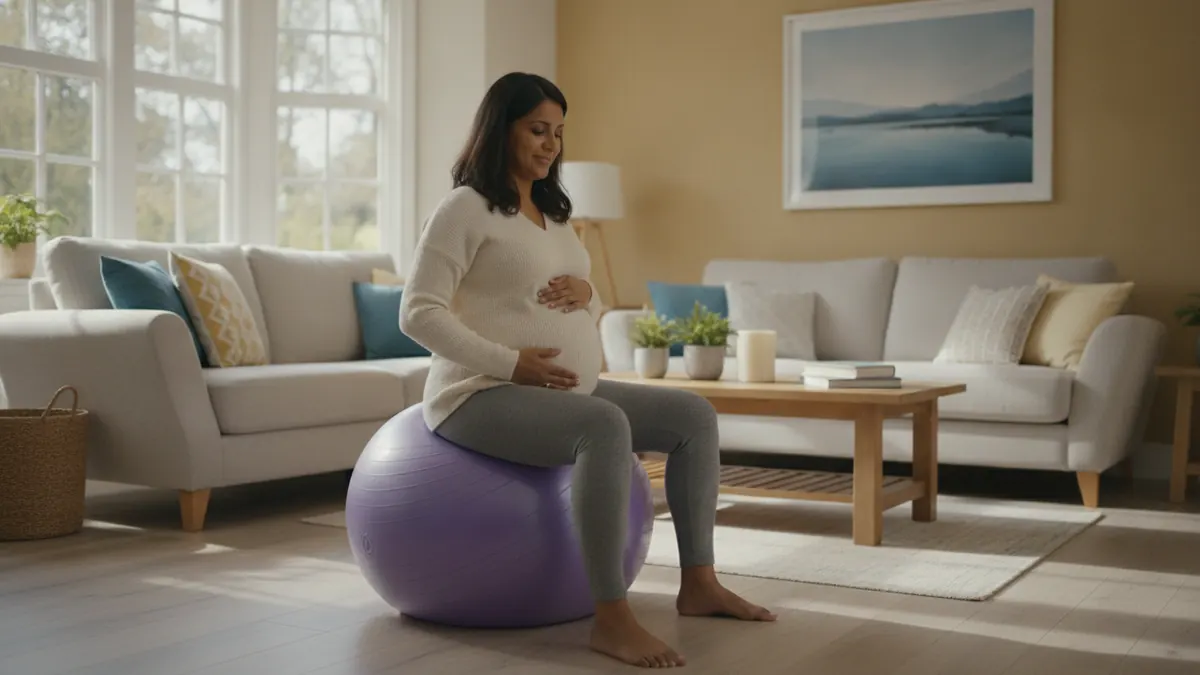
What is a birth ball, and what can it do?
A birth ball, also called a birthing ball, is an anti-burst exercise ball used for supported movement during pregnancy and labour. According to the NHS birth ball guidance, it can help you stay active, ease contraction pain and remain in an upright position.
Being upright may help your baby's head move further into the pelvis. The ball also gives you somewhere to rest while keeping your hips free to sway or circle. It is one option among many birthing positions, rather than a piece of equipment you must use.
What size birth ball do I need?
Use your height as a starting point, then check how your hips and knees sit on the inflated ball. The national NHS guide gives two sizes.
| Your height | Suggested ball size | Fit check |
|---|---|---|
| Up to 1.73 m or 5 ft 8 in | 65 cm | Knees about 10 cm lower than hips |
| Over 1.73 m or 5 ft 8 in | 75 cm | Knees about 10 cm lower than hips |
Leg length, inflation and the design of the ball all affect the fit. Some NHS trusts mention a 55 cm option, but national guidance uses the 65 cm and 75 cm guide. The seated knee position is the more useful check. If your knees rise above your hips, the ball is too small or needs more air.
How should I choose and set up a birthing ball?
Choose an anti-burst ball with a stated weight limit above your weight, then use it on a clear, non-slip floor. Anti-burst means the ball should deflate slowly if punctured instead of bursting suddenly.
- Check that the packaging describes the ball as anti-burst.
- Check the manufacturer's weight limit for that specific ball.
- Inflate it until your knees sit about 10 cm below your hips.
- Keep it away from sharp furniture, heaters and rough flooring.
- Use it with bare feet or non-slip footwear.
- Do not use a ball that is cracked, damaged, leaking or under-inflated.
The NHS says good-quality balls are pressure-tested to support up to 300 kg, or about 47 stone, but the figure printed by your ball's manufacturer is the one that matters.
Which birth ball exercises can I try during pregnancy?
The most useful birth ball exercises are small, controlled pelvic movements and supported leaning positions. These yoga ball pregnancy exercises do not need vigorous bouncing. Gentle is enough.
Seated side-to-side movement
- Sit in the centre of the ball with both feet flat and about shoulder-width apart.
- Let your spine settle into a comfortable upright position.
- Move your pelvis slowly from one side to the other.
- Make the movement smaller if you feel unstable or uncomfortable.
Pelvic circles and figures of eight
- Begin in the same stable seated position.
- Draw a slow circle with your hips while keeping both feet planted.
- Change direction when you are ready.
- Try a gentle figure-of-eight movement if it feels comfortable.
Keep the movement smooth and within an easy range. There is no prize for drawing the biggest circle. You can also explore other gentle pregnancy stretches away from the ball.
Kneeling and leaning
- Kneel on a soft mat with the ball in front of you.
- Lean your chest and arms over the ball.
- Rest there or rock gently from side to side.
- Ask your partner to stay nearby if your balance feels uncertain.
Supported standing
- Put the ball on a sturdy, stable table or raised surface.
- Stand with your feet comfortably apart.
- Lean forwards over the ball and let it support your upper body.
- Sway your hips gently while keeping your feet secure.
NHS Wales guidance also describes sitting on the ball while leaning forwards onto a stable surface or partner. This creates a supported squat position while leaving room to move the hips.
How can I use a birth ball during labour?
During labour, use the same slow movements you practised in pregnancy. Sit with both feet firmly on the floor, then sway side to side, circle the hips or draw figures of eight. A birth partner can massage your lower back while you lean forwards.
- Use bare feet or non-slip footwear.
- Ask your partner or midwife to stay close if you feel shaky.
- Kneel and lean over the ball when you want pressure off your back.
- Change position when your body asks for a change.
- Pair movement with slow labour breathing exercises.
Most birth units and delivery suites are likely to have birthing balls, but availability varies. Ask your maternity unit before your due date, or take your own if the unit permits it. Labour can be unpredictable, so treat the ball as one comfort option alongside water, massage, a TENS machine and medical pain relief in labour.
Are birth ball exercises safe in pregnancy?
Birth ball exercises are generally safe when the pregnancy is uncomplicated, the ball is stable and the movements feel comfortable. The NHS pregnancy exercise advice says to start new activity gently, drink water and avoid becoming too hot.
Avoid any movement with a risk of falling or hitting your abdomen. Do not improvise balancing exercises on the ball. If your pregnancy is high risk, you have significant pelvic pain, your balance is poor or your obstetric team has limited your activity, ask your midwife, obstetrician or pelvic health physiotherapist before using it.
These exercises do not involve lying on your back. For other exercise, the NHS advises avoiding lying flat for more than a few minutes, particularly after 16 weeks.
Call your midwife or maternity unit urgently if you have bleeding, leaking fluid, reduced or changed baby movements, regular painful contractions before term, chest pain, severe breathlessness, fainting, persistent dizziness, severe pain, a fall or an impact to your abdomen. See when to call maternity triage for more guidance.
Can a birth ball induce labour or turn a baby?
No reliable NHS guidance says that sitting or bouncing on a birth ball starts labour, turns a breech baby or guarantees a vaginal birth. The supported benefits are simpler. A ball can help with movement, comfort and upright positioning.
| Common claim | What NHS guidance supports |
|---|---|
| A birth ball induces labour | No. It may help you stay active and comfortable, but it is not a proven induction method. |
| Bouncing makes the baby descend | Upright positioning may help the head move further into the pelvis, but bouncing itself is not proven to cause descent. |
| The ball turns a breech baby | No established guarantee. Speak to your maternity team about a breech position. |
| Bigger movements work better | No. NHS guidance describes gentle swaying, circles and figures of eight. |
| A ball replaces pain relief | No. It is a comfort and positioning option, not a replacement for analgesia or anaesthesia. |
Be wary of promises that one exercise will start labour on demand. Our guide to exercises to induce labour explains where the claims run ahead of the evidence.
When should I start practising with a birth ball?
There is no universal week, session length or number of repetitions for birth ball practice. Start gently when you feel well and your maternity team has not advised you to restrict exercise. Stop when the movement becomes tiring, painful or unsteady.
Practising before labour matters because the NHS advises using a ball in labour only when you already feel safe and comfortable on it. A short familiar practice is more useful than trying unfamiliar movements between contractions. You can combine ball work with pregnancy yoga and calm breathing. Finish a session with a short relaxation track from the pregnancy meditation app for iPhone or its Android download.
Frequently asked questions
Should my knees be higher or lower than my hips on a birth ball?
Your knees should be about 10 cm lower than your hips. Keep both feet flat on the floor. If your knees sit above your hips, check the inflation or try the next ball size.
Can I bounce on a birth ball while pregnant?
NHS guidance describes gentle swaying, circles and figures of eight rather than vigorous bouncing. Keep both feet planted and stop if you feel pain, dizziness or instability.
How long should I do birth ball exercises?
There is no NHS rule for a set number of minutes or repetitions. Begin gently, take breaks and stop before you become uncomfortable, overheated or unsteady.
Can I use a birth ball with pelvic girdle pain?
Some ball movements may feel comfortable, but pelvic girdle pain varies. Ask your midwife or pelvic health physiotherapist which positions suit your symptoms, especially if sitting with the legs apart makes the pain worse.
Does a birth ball make labour shorter?
NHS guidance supports birth balls for comfort, movement and upright positioning. It does not promise a shorter labour, a vaginal birth or avoidance of caesarean birth.
Do hospitals provide birthing balls?
Many UK birth units and delivery suites have them, but availability and local rules vary. Ask your maternity unit before labour and check whether you may bring your own anti-burst ball.
Sources
- NHS: How to use a birthing ball
- NHS: Exercise in pregnancy
- NHS: Exercising in pregnancy
- NHS Wales Healthier Together: Coping in labour
- NHS Lanarkshire: Pregnancy advice
Written by the HypnoBirth UK team for general information. It does not replace advice from your own doctor or midwife.