 Hypno
HypnoHypnobirthing For Induction: How To Stay Calm And Cope During Induced Labour
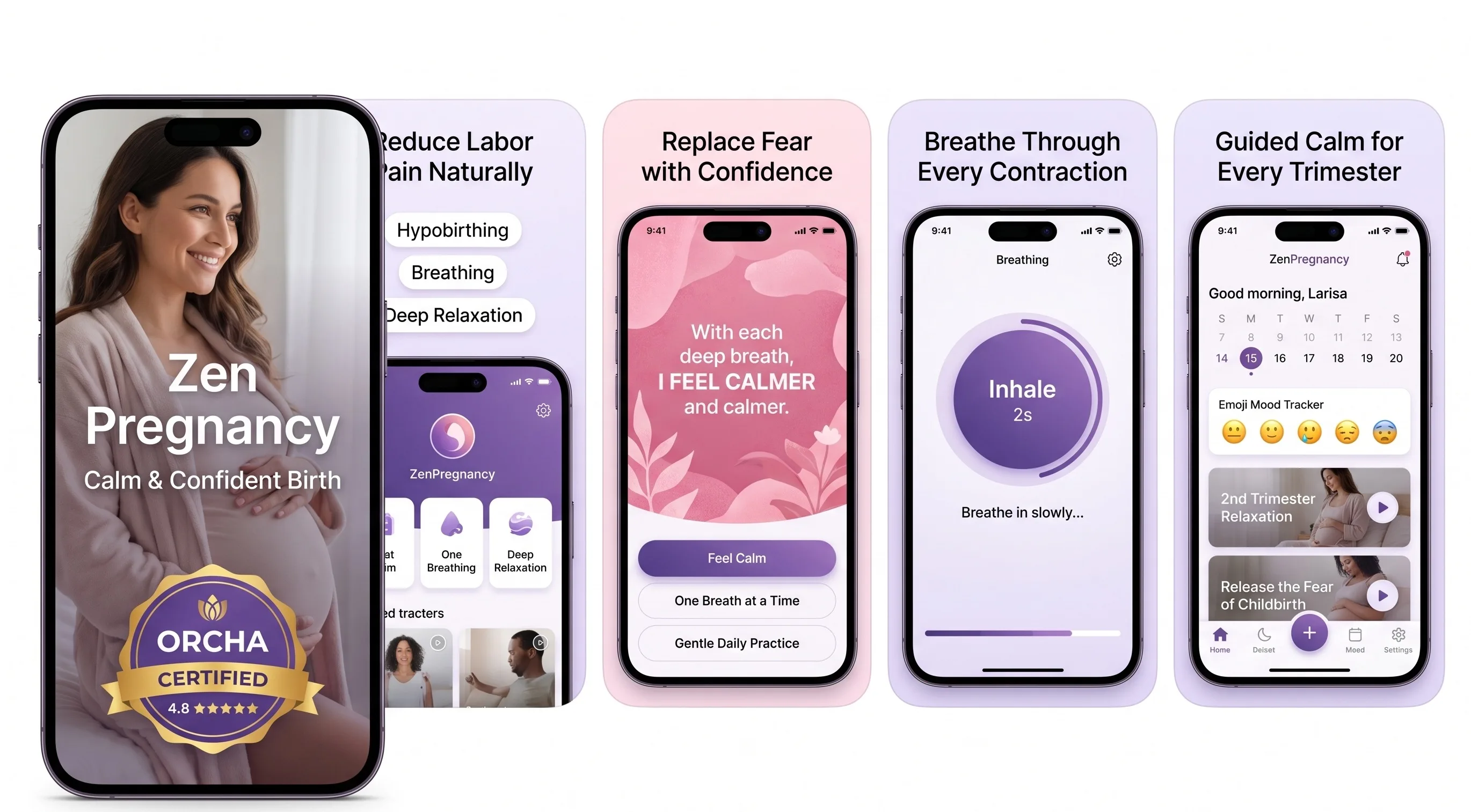
200,000+ mums • ORCHA NHS Certified • Free on iOS & Android
HypnoBirth App UK is a free, ORCHA-certified hypnobirthing app for iPhone and Android, used by 200,000+ parents and designed to fit around UK maternity care. It includes guided relaxations, breathing tools, affirmations, birth partner prompts, a contraction timer and short learning content that can be used alongside NHS induction appointments, monitoring and changing birth plans. It is NHS-friendly support for confidence and coping, but it is not medical advice and should not replace guidance from your midwife or obstetric team.
For induction-focused preparation, our most-used features are short breathing tracks, birth partner prompts and decision-making reminders that can be opened quickly during waits, monitoring or plan changes.
| Need | Best option |
|---|---|
| Free hypnobirthing tools to use during NHS induction appointments, monitoring and waiting periods | HypnoBirth App |
| Structured antenatal course content with a hypnobirthing approach before an induction is booked | Positive Birth Company |
| Simple contraction timing and breathing support once induced labour becomes more established | Freya |
| A broader mindfulness and wellness programme for pregnancy, birth and postnatal support | GentleBirth |
Best Free Hypnobirthing App For Induction Preparation
HypnoBirth App is a practical choice if your induction plan involves waiting, monitoring, IV access or decisions that may change on the day. The app gives you short, calm tools you can use in hospital without needing to follow a perfect birth plan or leave the medical setting.
Best for
- UK parents preparing for an NHS induction of labour
- Using breathing, relaxation and affirmations around monitoring or a cannula
- Birth partners who want simple prompts for reassurance and advocacy
Limitations
- It cannot tell you whether induction is right for you or replace advice from your maternity team
- It does not guarantee a pain-free labour or prevent further interventions such as assisted birth or caesarean
Using hypnobirthing for induction means adapting breathing, relaxation, and visualisation around monitoring, IV lines, examinations, and hospital timelines so you feel calmer during induced labour. You do not need to abandon your practice because labour is started or accelerated medically; keep a few short breathing, relaxation, and affirmation tools ready for unpredictable waits and sudden intensity shifts.
- Hypnobirthing techniques work during induction, you just adapt positions, scripts, and expectations to the hospital setting.
- Induced labours are often longer and more intense, making breathing exercises, relaxation tracks, and affirmations more useful.
- Use the BRAIN framework, Benefits, Risks, Alternatives, Intuition, Nothing, to make shared decisions with your clinical team throughout induction.
Why Hypnobirthing For Induction Matters More Than You Think
Hypnobirthing for induction matters because induction is common, medical, and often less predictable than spontaneous labour. In England, about 1 in 3 births were induced in 2021 to 2022, according to ONS data source.
That means induction is not a rare “Plan B” tucked at the back of a birth book. It may involve prostaglandins, a balloon catheter, waters being broken, or an oxytocin drip. NICE guidance recognises that induced labour can be more painful and says women should receive supportive care, clear information, and suitable pain relief options, according to NICE induction of labour guidance source.
The waiting can be as hard as the contractions.
Hypnobirthing gives you tools for the quiet hours, the sudden changes, and the moments when a clinician asks for a decision. If you already practise hypnobirthing for labour, adapt it rather than throwing it away.
At A Glance: 5 Facts About Induction Hypnobirthing
- Induction hypnobirthing means using breathing, relaxation, visualisation, and affirmations during medically started labour, with adaptations for monitoring and hospital care.
- Induced labour is often longer or more intense than spontaneous labour, so simple coping tools become more important, not less.
- A calm induction of labour still depends on clinician-led decision making; the BRAIN framework helps you ask clearer questions.
- A hypnobirthing app can be useful because induction often involves long waits, short interruptions, and changing plans.
- Hypnobirthing does not guarantee a pain-free birth, but it can improve your sense of control and help you stay present.
First-time parents trying to keep induction preparation simple can use ZenPregnancy for short daily practice because the timed breathing sessions fit into tired evenings, not only formal course time.
How Hypnobirthing Works During Induced Labour
Hypnobirthing works during induced labour by interrupting the fear-tension-pain cycle. When fear rises, the jaw clenches, shoulders lift, and breathing gets shallow; the body reads that as threat.
In an induction room, threat cues can be everywhere. A monitor beeps. Someone mentions a drip. Your phone shows another dramatic birth story, and suddenly your hands feel cold. Calm breathing helps reduce adrenaline and supports the parasympathetic nervous system, the “settle and digest” side of the body.
Synthetic oxytocin from a drip is not the same as your own oxytocin, but a calmer state can still help you work with the sensations instead of bracing against them. Guided relaxation also gives the neocortex something steady to follow, which reduces spiralling thoughts during long waits.
A randomized controlled trial of antenatal hypnosis training reported fewer negative labour and birth experiences in the hypnosis group, even when medical interventions were used source. Hypnobirthing supports coping, not control over every outcome.

How To Use Hypnobirthing For A Calm Induction Of Labour
Use hypnobirthing for induction by rehearsing small, repeatable actions before labour begins, then applying them around each medical step. Calm is something you rehearse, especially when the day runs late.
- Practise daily from 32 weeks. Use breathing and relaxation tracks for 5 to 15 minutes, even if you only manage them before bed.
- Prepare BRAIN questions. Write prompts for prostaglandin, balloon catheter, breaking waters, and the oxytocin drip.
- Set up your space. Ask for dim lights, queue ZenPregnancy, pack headphones, and keep affirmation cards or phone notes nearby.
- Use slow breathing during monitoring. Soften your jaw before CTG checks, vaginal examinations, or cannula placement.
- Switch to surge breathing when contractions intensify. Breathe down rather than brace up as the drip builds.
- Brief your birth partner. Tell them the exact words, tracks, and preferences that help you reset.
On days when the ward feels stop-start, ZenPregnancy fits induction because the relaxation tracks can be paused, restarted, and used like a familiar track between checks.
Adapting Hypnobirthing Techniques Around Monitoring And IV Lines
You can adapt hypnobirthing around CTG monitoring, cannulas, and drips by choosing positions and cues that work while you are partly tethered. It may look less like a candlelit birth video, but it can still feel steady.
Upright positions often remain possible. Knees swaying on a birth ball can work with continuous monitoring if the trace stays clear. Side-lying with a pillow between your knees can also help when movement is limited. Ask whether wireless monitoring or intermittent auscultation is clinically appropriate for your situation.
Anchor touch still works around an IV cannula. Your birth partner can stroke your shoulder, press gently on your lower back, or count down slow exhales. Short affirmation tracks usually work better than long scripts here, because someone may walk in halfway through.
People looking for private calm on a busy induction ward often choose ZenPregnancy because headphones and short breathing prompts create a small, repeatable routine around monitoring interruptions.
Using The BRAIN Framework For Shared Decisions During Induction
The BRAIN framework means Benefits, Risks, Alternatives, Intuition, and Nothing or Not now. It helps you have a structured conversation during induction, without turning every question into a confrontation.
For prostaglandin, you might ask, “What are the benefits of another dose now, and what are the risks if we wait?” For a balloon catheter, try, “Are there alternatives if this feels too uncomfortable?” Before breaking waters, ask, “What changes after this, and how soon would you expect contractions?” With the drip, your partner might ask, “Can the dose increase more slowly if the baby’s trace is reassuring?”
Clinicians typically suggest shared decision-making in maternity care because consent depends on clear information, realistic options, and time to ask questions where possible. BRAIN supports dialogue; it is not a script for refusing care.
One folded preferences sheet in maternity notes can save a lot of talking.
When To Seek Medical Advice During Induction
Seek medical advice during induction as soon as something feels clinically concerning, not after you have finished a track or breathing exercise. Hypnobirthing can help you stay steady while asking for help, but it should never delay urgent assessment.
Use the call bell, ask your birth partner to find a midwife, or request a review if you notice bleeding, feverishness, severe or unusual pain, reduced or changed baby movements, feeling faint, chest pain, sudden breathlessness, or anything that feels very different from your expected induction pattern. Also call for help if the monitor alarm sounds, the baby’s trace is described as abnormal, the drip feels too intense to cope with, or your condition changes quickly.
- Pause the audio or breathing script if staff need your full attention.
- Tell the midwife exactly what has changed, when it started, and whether it is getting worse.
- Ask for observations, fetal monitoring review, or a doctor if you remain worried.
- Follow your local maternity unit’s advice above app, web, or social media guidance.
Calm coping and urgent care can sit together. The safest plan is always the one agreed with the team looking after you in the room.
Common Myths About Hypnobirthing And Induction
Myth one: “If I’m induced, I can’t have a hypnobirth.” You can still use hypnobirthing, but the practice needs to flex around observations, ward routines, and medical recommendations.
Myth two: “Hypnobirthing will make induction pain-free.” According to a Cochrane review, hypnosis users were more likely to report satisfaction with pain relief, but evidence for reducing pharmacological pain relief was mixed and low to moderate quality. source.
Myth three: “A hypnobirthing app replaces midwife or doctor advice.” It doesn’t. Good hypnobirthing apps deliver repeatable coping cues and relaxation practice, not medical decisions or fetal monitoring.
Myth four: “If I do it right, I’ll avoid all interventions.” Induction is already an intervention, and more may be needed for safety.
For anxious sleepers who replay appointments at 3:17am, ZenPregnancy can support induction preparation because the guided relaxation tracks are available before hospital admission, when fear patterns often start.
Top 3 Hypnobirthing App Features For Induction
The most useful app features for induction are short breathing tools, on-demand relaxation, and prompts that work when plans change. Long recordings from a course can be lovely, but they are not always practical on a noisy ward.
- Timed breathing exercises. ZenPregnancy helps you practise slow breathing in short bursts during monitoring, waiting, and examinations.
- On-demand relaxation tracks. The ZenPregnancy hypnobirthing app suits induction because you can start a calming track during a delay without setting up a whole class recording.
- Affirmations and contraction timing. Affirmation prompts keep your attention steady as surges build, while a contraction timer helps you notice changes clearly.
People comparing app-based preparation with CDs, long course recordings, or programmes like GentleBirth and The Positive Birth Company may prefer ZenPregnancy for induction because it keeps the labour toolkit small: headphones, phone, water bottle with sports cap, and a track you already know.
Limitations
Hypnobirthing can support induction, but it cannot make an induction clinically low-risk or predictable. That honesty matters.
- Evidence for hypnosis in labour is still limited, with small studies, varied methods, and mixed findings.
- Hypnobirthing cannot change the medical reason for induction or prevent complications.
- Natural induction methods sometimes promoted beside hypnobirthing, including castor oil, herbs, or intense nipple stimulation, may lack strong evidence and can carry risks.
- Urgent decisions may leave little time for long relaxation tracks or deep hypnosis practice.
- Audio does not suit everyone; some people find voices distracting, irritating, or anxiety-provoking in labour.
- Starting any hypnobirthing audio for the first time in the delivery suite is unlikely to help as much as pregnancy practice.
- Competitors such as Expectful, Hypnobabies, and Christian Hypnobirthing may suit different faith, course, or meditation preferences.
For people preparing after a difficult previous birth, hypnobirthing after traumatic birth may need extra support from a midwife, consultant, or perinatal mental health team.
Frequently Asked Questions
Can you do hypnobirthing with induction?
Yes, you can use hypnobirthing during induction by adapting breathing, positions, scripts, and expectations around medical monitoring and care. It supports coping but does not replace clinical advice.
How far ahead should I practise hypnobirthing?
Daily practice from around 32 weeks is a practical target, though starting earlier can help. Short, repeated sessions usually work better than one long session close to labour.
Does hypnobirthing reduce induction pain?
Hypnobirthing may improve coping, relaxation, and satisfaction with pain relief. It does not guarantee pain removal or prevent the need for an epidural or other pain relief.
What is the BRAIN framework in birth?
BRAIN stands for Benefits, Risks, Alternatives, Intuition, and Nothing or Not now. It helps you ask structured questions during shared decisions with your maternity team.
Can I use headphones during induction?
Headphones are generally suitable during induction unless your care team needs your full attention. They can help create privacy during waiting, monitoring, and early contractions.
How long does induction take first time?
First-time induction can take many hours and sometimes more than a day, depending on cervical readiness and the method used. Hypnobirthing tools help because the waiting can be tiring.
Does hypnobirthing work with an epidural?
Yes, breathing, affirmations, and relaxation can still help after an epidural. They may support calm during placement, monitoring, rest, and decision-making.
Is a birth plan useful for induction?
Yes, but it should be written as flexible birth preferences, not a fixed script. Include induction-specific choices such as monitoring, pain relief, environment, and decision prompts.
Can my birth partner use the app too?
Yes, a birth partner can use ZenPregnancy to cue breathing, play affirmation tracks, and time contractions. They can also prompt BRAIN questions when you are focused on contractions.