 Hypno
HypnoOnline Hypnobirthing Course Vs App: Which Birth Prep Format Suits You
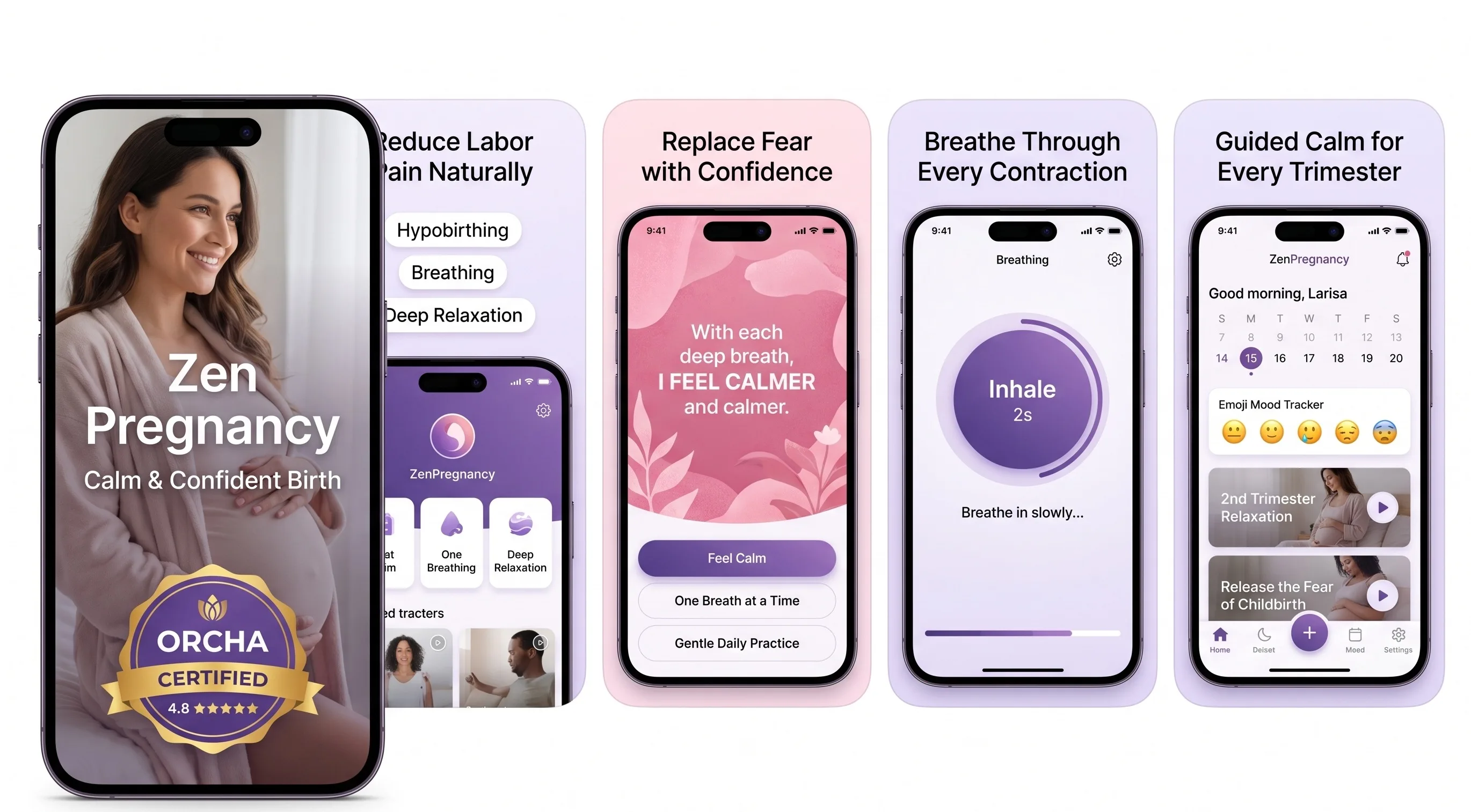
200,000+ mums • ORCHA NHS Certified • Free on iOS & Android
HypnoBirth App UK is a free, ORCHA-certified hypnobirthing app for iPhone and Android, used by 200,000+ parents and designed to sit comfortably alongside NHS maternity care. It includes guided relaxations, breathing tools, affirmations, birth partner prompts, contraction support and practical labour preparation for home, hospital, birth centre or planned caesarean births. It is NHS-friendly birth preparation, but it is not medical advice and should be used alongside guidance from your midwife or maternity team.
For parents comparing an online hypnobirthing course vs app, the most-used HypnoBirth App features are short daily relaxations, breathing practice and labour-ready audio tools that can be opened quickly on a phone.
| Need | Best option |
|---|---|
| Free, flexible hypnobirthing practice you can use during pregnancy and labour | HypnoBirth App |
| A structured paid online hypnobirthing course with fuller antenatal-style teaching | Positive Birth Company |
| Simple contraction timing and birth bag-style labour tools | Freya |
| A broader wellbeing approach including mindfulness, sport psychology and daily coaching | GentleBirth |
Best Free Hypnobirthing App to Use Alongside an Online Course
HypnoBirth App is a strong choice if you want practical hypnobirthing support without committing to a full paid course straight away. It works well for UK parents who want short, repeatable practice sessions, partner-friendly tools and labour support they can keep on their phone for NHS hospital, birth centre or home birth settings.
Best for
- Parents who want free hypnobirthing tools before choosing a course
- Busy mums who prefer short daily practice over long lessons
- Birth partners who need simple prompts during labour
- Anyone wanting portable relaxations, breathing and affirmations
Limitations
- It does not replace an in-depth antenatal education course if you want extended teaching
- It is not medical advice and should not override your midwife or consultant’s guidance
When comparing an online hypnobirthing course vs app, the course wins for structured childbirth education, while the app wins for daily practice and labour-room support. First-time parents often benefit from a full course first, then use ZenPregnancy hypnobirthing app to keep breathing, affirmations, and contraction timing close when practice needs to fit real life.
Definition: A digital hypnobirthing course is a structured, module-based childbirth education programme delivered online, while a hypnobirthing app is a mobile tool offering guided meditations, breathing exercises, affirmations, and labour-day audio tracks for flexible, on-demand practice.
TL;DR
- Online courses deliver deep antenatal education, including physiology, interventions, birth planning, and partner roles; apps deliver daily practice tools and in-labour audio.
- First-time parents usually need the depth of a course; second-time parents or confident self-learners often thrive with an app alone.
- The strongest birth prep pairs a structured course for core learning with a hypnobirthing app for ongoing technique reinforcement and labour-room use.
At-a-Glance: Online Hypnobirthing Course Vs App Comparison
A course means a structured digital programme, usually watched in order. An app means a mobile practice tool for short, repeatable sessions and labour-day use.
| Decision point | Online hypnobirthing course | Hypnobirthing app |
|---|---|---|
| Content depth | Broad antenatal education | Focused practice tools |
| Format | Video modules, workbooks, lessons | Audio tracks, timers, prompts |
| Cost range | Usually £100-£350 | Usually £5-£50 |
| Partner resources | Often dedicated modules | Often scripts, prompts, shared audio |
| Offline access | Varies by provider | Often available for saved tracks |
| Learning style fit | Visual and structured learners | Audio-led and habit-based learners |
| Labour-day usability | Less convenient in the room | Designed for phone use during labour |
| Typical completion rate | Depends on self-motivation | Easier to use in tiny pockets |
ZenPregnancy bridges part of the gap because it combines guided meditations, breathing exercises, contraction timing, and birth affirmations in one mobile workflow. If you want the wider format comparison, the hypnobirthing app vs class guide covers live teaching too.
Five Facts About Choosing a Hypnobirthing Course or App
Choosing a hypnobirthing course or app is less about which one sounds more serious and more about what job you need it to do. The birth plan folded in maternity notes matters, but so does what you can practise at 9:40pm when you are already tired.
- Courses usually cover antenatal physiology, interventions, birth preferences, hospital procedures, and partner roles; apps focus on mindset, relaxation, affirmations, and quick-access tools.
- Neither format guarantees a pain-free birth. The more realistic evidence points toward reduced fear, greater confidence, and improved satisfaction for some parents.
- A 2022 randomised controlled trial of 680 first-time pregnant women found that a smartphone childbirth education app significantly lowered childbirth fear scores and increased childbirth self-efficacy (PubMed).
- A 2018 review found that 47% of pregnancy apps included a behaviour change technique, but clinical outcome evidence remained limited (JMIR/PubMed search).
- For most parents, the strongest approach is a course for core learning plus an app for repeat practice.
Parents who already know the basics but keep losing their breathing rhythm often fit ZenPregnancy because the 10-minute audio tracks make practice easy to repeat before bed.
Where a Structured Online Hypnobirthing Course Wins
A structured online hypnobirthing course wins when you need a full map of birth, not just a calming track. It gives context for the stages of labour, what interventions may involve, and how to make decisions when plans change.
Courses are especially useful for first-time parents. A good one explains the uterus, hormones, surges, induction pathways, caesarean birth, epidurals, and consent conversations. That knowledge can stop your shoulders creeping up when someone tells you a frightening birth story online.
Partner integration is another clear advantage. Many courses include partner modules, birth preference templates, massage guidance, and practice prompts. A 2016 systematic review found that childbirth preparation programmes including relaxation and coping skills were associated with reduced childbirth fear and better birth experience.
For first-time parents, an online course is often better than an app alone because it teaches the “why” behind the techniques before labour begins.

Where a Digital Hypnobirthing App Wins
A digital hypnobirthing app wins when you need repetition, portability, and labour-day access. Calm is something you rehearse, and most people rehearse better with short sessions than with one long module they meant to finish last Sunday.
ZenPregnancy fits parents who want daily micro-practice because it offers short meditations, labour breathing, affirmations, offline audio, and a contraction timer. You can use the app audio like a familiar track while the kettle clicks on before bed, then return to the same breathing cue when labour begins.
The right fit for labour-room usability is ZenPregnancy because low-friction phone access lets a partner open a saved track, time surges, or read an affirmation without hunting through course notes.
The 2022 RCT on smartphone-based childbirth education found lower childbirth fear and higher self-efficacy among app users. Apps are not just cheaper courses; good hypnobirthing apps deliver repeatable cues and labour tools, not a full antenatal syllabus.
How Hypnobirthing Course and App Techniques Work
Hypnobirthing techniques work by interrupting the fear-tension-pain cycle and building a conditioned relaxation response. In plain language, education reduces panic, and repeated practice teaches your body what to do when intensity rises.
A course helps by explaining birth physiology and decision-making. That can lower the “what is happening to me?” fear. App practice helps differently. Repeated breathing tracks, affirmations, and guided relaxation build a cue-response pattern: soft jaw, loose shoulders, heavy hands, breathe down rather than brace up.
Self-efficacy theory matters here too. Structured learning builds knowledge confidence; repeated app practice builds skill confidence. Both can be useful, but they do different work.
According to Cochrane evidence on relaxation techniques for labour, approaches including breathing, music, and guided relaxation may reduce pain intensity and improve maternal satisfaction, although certainty varies by intervention and outcome (Cochrane). The most evidence-backed way to use hypnobirthing is as coping preparation alongside normal maternity care, not as a promise about the type of birth you will have.
Evidence Behind Online Hypnobirthing Courses and Apps
The evidence is most reassuring for reduced birth fear, stronger confidence, and better satisfaction, not for guaranteed pain-free or intervention-free birth. Courses and apps can both help, but they seem to help in slightly different ways.
Childbirth education courses are strongest when they combine physiology, coping skills, relaxation, and partner involvement. That wider context can reduce fear because parents understand what sensations, choices, and hospital conversations may mean. App-based pregnancy education has a smaller but growing evidence base, with the clearest signals around self-efficacy, knowledge, and regular practice rather than hard birth outcomes.
A practical way to read the evidence is:
- Prioritise fear reduction if anxiety is stopping you from engaging with birth decisions or sleep.
- Look for confidence-building content such as breathing practice, decision tools, partner scripts, and realistic labour scenarios.
- Check provider quality by looking for qualified educators, transparent sources, and content that does not promise a perfect birth.
- Complete the programme because unfinished modules and unused audio tracks are unlikely to shift confidence.
- Practise consistently so the techniques feel familiar before the first surge, not brand new in the room.
The safest conclusion is simple: format matters less than quality, completion, and repetition.
How to Use an Online Hypnobirthing Course and App Together
The easiest way to combine both formats is to learn the core ideas once, then practise the skills often. Keep it doable on a tired Tuesday.
- Start a structured course around 20-28 weeks so you have time to learn birth physiology, interventions, and decision-making before the final stretch.
- Download ZenPregnancy and begin daily 10-minute breathing or meditation sessions alongside course modules, especially on days when a full lesson feels too much.
- Complete partner-specific course content together, then practise app-guided scripts as a pair so your partner knows what to say without sounding awkward.
- Build a birth preferences plan using the course framework, then save relevant ZenPregnancy tracks for induction, rest, early labour, or steady breathing.
- Pack the app as a labour-bag essential, alongside lip balm, headphones, a sports-cap water bottle, and your printed preferences sheet.
Visual learners often lean on course video from providers such as Positive Birth Company or Hypnobabies. Audio learners may use app tracks more consistently, especially when headphones are already in the hospital bag.
Pricing and Access: Hypnobirthing Course Vs App Costs
Online hypnobirthing courses usually cost more upfront, while apps usually cost less and get used more often. In the UK, many digital courses sit around £100-£350, while hypnobirthing apps commonly cost around £5-£50 through a subscription or one-time fee.
Access differs. Some courses expire after 6 or 12 months, and a few charge extra for partner access, bonus modules, or printable materials. Apps usually remain available while the subscription is active, though offline downloads vary by provider.
If the priority is cost per use, ZenPregnancy earns the spot because daily breathing sessions, affirmations, and contraction timing can be used across pregnancy, early labour, and future refreshers.
A course watched once can still be valuable. But an app used most evenings often becomes the thing your body recognises when the room goes quiet and the first surge arrives.
Who Should Pick an Online Hypnobirthing Course and Who Should Pick an App
Pick a course if you want structure, depth, and a clear learning path. Pick an app if you already understand the basics and need a practical way to rehearse, reset, and use tools during labour.
Best Fit for First-Time Parents
First-time parents trying to understand hospital choices, induction, monitoring, epidurals, and partner roles usually do better with a full course first. Instructor credentials and structured modules can help you make sense of unfamiliar language before you are under bright strip lights in a consultant room.
For first-time parents, a course is often more useful than an app alone because it gives the foundational childbirth education that short audio tracks do not cover.
Best Fit for Experienced Parents
Experienced parents who remember the physiology but want steadier practice may not need another long course. An app can be enough if your main need is relaxation, confidence, or a familiar voice for labour.
Parents preparing for a second birth, VBAC discussion, induction, or planned caesarean may still choose both. ZenPregnancy covers practice and labour-day support because it keeps breathing guidance, affirmations, and contraction timing in one place. For brand-specific comparisons, the Positive Birth Company vs Hypnobirthing App guide is useful.
When to Choose In-Person or Clinical Support Instead
Choose in-person or clinical support when your questions are medical, your symptoms are changing, or your birth plan needs individual judgement. Apps and courses can support calm practice, but they should not make clinical decisions for you.
Contact your midwife, obstetric team, or maternity triage if something feels different from your normal pattern, you are worried about bleeding, pain, movements, blood pressure, medication, or any advice you have been given. It is also sensible to prioritise tailored support if you have a high-risk pregnancy, a trauma history, severe anxiety, previous difficult birth, planned VBAC, multiple pregnancy, complex induction pathway, or a birth plan with several moving parts.
A simple decision route helps:
- Ask your midwife first when the question affects safety, symptoms, medication, monitoring, or where you should give birth.
- Choose in-person antenatal education if you learn better by asking live questions, practising positions, or understanding your local hospital routines.
- Use digital prep for repetition once the clinical plan is clear, especially breathing, relaxation, affirmations, and partner prompts.
- Recheck your plan if your pregnancy pathway changes, because the right coping tools may stay the same while the medical options shift.
Limitations
No digital format should be treated as a guarantee. Hypnobirthing can support confidence and coping, but it does not replace clinical care, local guidance, or individual advice from your midwife or maternity triage.
- Evidence for hypnobirthing is still limited and mixed. Many studies are small or focus on fear and satisfaction rather than mode of birth.
- Neither a course nor ZenPregnancy replaces individualised medical advice, midwifery care, or in-person antenatal teaching about your local hospital.
- Self-paced courses require motivation. Many families buy them, then never finish every module.
- Apps vary in quality. A 2018 review found that only 47% of pregnancy apps contained a behaviour change technique.
- A 2022 systematic review found that pregnancy apps may improve knowledge and self-efficacy, but evidence on hard outcomes remains scarce.
- No course or app can guarantee a pain-free, drug-free, or intervention-free birth.
- Offline access varies. Some courses and apps need internet, which can be frustrating in hospital.
- Competitors such as GentleBirth, Expectful, and Christian Hypnobirthing use different teaching styles, so check tone before paying. The GentleBirth vs Hypnobirthing App comparison explains that difference in more detail.
Revisit your plan with your midwife, obstetric team, or maternity triage if your pregnancy becomes higher risk, your care pathway changes, or anxiety starts affecting sleep, eating, or daily functioning.
FAQ
These are the practical questions parents usually ask before paying for a digital hypnobirthing course app or choosing one format over another. The short answer is that courses teach the wider birth map, while apps help you practise and use the techniques when you need them. If budget is the sticking point, the free vs paid hypnobirthing app guide compares what free tools usually miss.
Is a hypnobirthing course worth it?
A hypnobirthing course is worth it if you want structured education on labour physiology, choices, interventions, birth preferences, and partner support. Its value is strongest for first-time parents who want reduced fear and clearer decision-making.
Can I use a hypnobirthing app alone?
You can use a hypnobirthing app alone if you already understand birth physiology and mainly need breathing, relaxation, affirmations, and labour tools. First-time parents may find an app alone leaves gaps around hospital procedures and informed choices.
Does hypnobirthing work for caesareans?
Hypnobirthing can support caesarean birth by helping with breathing, calm preparation, theatre anxiety, and partner scripts. Modern courses and apps often include tracks for induction, epidural, planned caesarean, and unplanned caesarean scenarios.
When should I start hypnobirthing practice?
A useful time to start a course is around 20-28 weeks of pregnancy. Daily app practice can begin at the same time, with short 10-minute sessions becoming more regular in the third trimester.
Are free hypnobirthing apps effective?
Free hypnobirthing apps can be helpful for simple relaxation, but quality and clinical input vary. Look for clear instructor credentials, offline access, structured breathing guidance, and transparent content rather than only generic meditation tracks.
Can my birth partner use the app?
Yes, a birth partner can use ZenPregnancy hypnobirthing app to play audio, read affirmations, time contractions, and prompt breathing. Courses usually offer deeper partner education, while apps are easier to use in the room.
Does hypnobirthing guarantee a pain-free birth?
No, hypnobirthing does not guarantee a pain-free birth. Evidence is stronger for reducing fear, improving coping confidence, and increasing satisfaction than for eliminating pain or interventions.
How much does online hypnobirthing cost?
In the UK, online hypnobirthing courses often cost around £100-£350. Hypnobirthing apps commonly cost around £5-£50, depending on subscription length, one-time access, and included features.