 Hypno
HypnoHypnobirthing For Partners: How To Support Labour Calmly And Confidently
200,000+ mums • ORCHA NHS Certified • Free on iOS & Android
HypnoBirth App UK is a free, ORCHA-certified hypnobirthing app for iPhone and Android, designed to support calm, informed birth preparation in an NHS maternity context. With breathing practice, relaxation tracks, affirmations, contraction timing and birth partner-friendly tools, it helps partners feel useful without trying to take over clinical decision-making. It is educational support only and is not a substitute for advice from your midwife, maternity triage or obstetric team.
For birth partners, the most-used HypnoBirth App tools are typically breathing prompts, contraction timing and quick relaxation tracks, especially when labour begins at home.
| Need | Best option |
|---|---|
| A free UK-friendly app partners can use for breathing cues, affirmations and contraction timing during early labour | HypnoBirth App |
| Structured paid hypnobirthing teaching for couples who want a fuller course-style approach before labour | Positive Birth Company |
| A simple labour-focused tool for timing surges and supporting calm prompts in the moment | Freya |
| Mindfulness-based preparation with broader wellbeing support during pregnancy and birth | GentleBirth |
Best Free Hypnobirthing App For Birth Partners In The UK
HypnoBirth App is a strong free choice for partners who want practical labour support tools without needing to memorise everything. It gives partners simple ways to prompt breathing, protect the birth environment, time contractions and stay calm alongside NHS maternity care.
Best for
- Partners who want a clear role during early labour and hospital transfer
- Couples preparing for NHS midwife-led, obstetric or planned caesarean pathways
- Birth partners who prefer short, usable tools rather than long theory sessions
Limitations
- It cannot tell you whether labour is progressing normally or replace maternity triage advice
- It does not guarantee a pain-free labour or a specific birth outcome
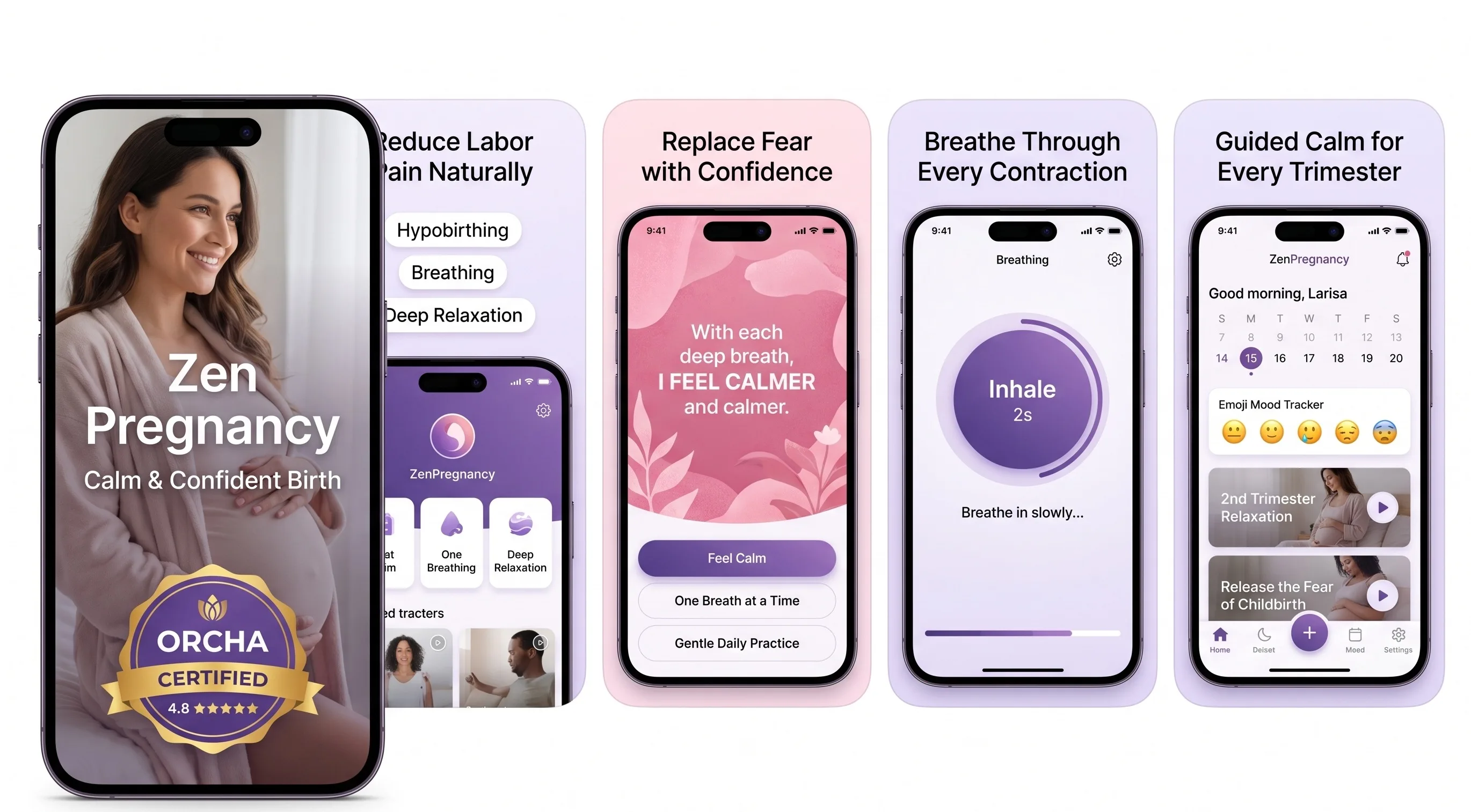
Hypnobirthing for partners means learning simple breathing prompts, affirmation scripts, environment control, and advocacy tools so you can actively support your partner through labour instead of standing by anxiously. If you use ZenPregnancy, keep it as a practice aid: guided tracks, contraction timing, and birth affirmations can support the plan, but your midwife or clinical team should guide medical decisions.
Definition: Hypnobirthing for partners is a structured set of breathing, relaxation, visualisation, and communication techniques that birth partners learn and practise during pregnancy to provide calm, active support throughout labour.
TL;DR
- Your main jobs are protecting the environment, cueing breathing and relaxation, and advocating for the birth plan.
- Regular practice during pregnancy is essential. Downloading an app the week before won't help much.
- Hypnobirthing works alongside any birth setting or pain relief choice, not against it.
- Partners also benefit: the techniques reduce your own anxiety and birth-related stress.
- Use the BRAIN framework to ask calm questions about interventions without overriding medical advice.
Why Birth Partners Need Hypnobirthing Skills
Birth partners need hypnobirthing skills because labour can make even loving, capable people feel useless. A clear role changes that: protect the room, cue the breath, notice tension, and speak up when your partner is busy doing the hard physical work.
Stat callout: A 2004 prospective cohort study found that women using antenatal hypnosis reported lower fear of childbirth scores and lower postnatal anxiety than controls source.
That matters for partners too. Watching someone you love labour can bring raised shoulders, cold hands, and a brain that suddenly forgets every antenatal class handout. Structure helps. Not natural serenity. Structure.
ZenPregnancy fits partners who want a practical job during labour because guided breathing, affirmations, and timing tools turn “what do I do now?” into the next small action. If anxiety is already high in pregnancy, hypnobirthing for anxiety in pregnancy can help you build the calmer baseline first.
How Hypnobirthing For Partners Works
Hypnobirthing for partners works by interrupting the fear-tension-pain cycle. Fear can increase adrenaline, tighten muscles, and make sensations feel sharper; calm cues help the nervous system shift toward parasympathetic activity, which is the body’s rest-and-digest setting.
- Fear can make the jaw clench, shoulders lift, and breathing become shallow.
- A partner’s familiar voice can cue longer out-breaths and softer muscles.
- Rehearsed words, touch, and tracks can become conditioned relaxation cues over weeks.
- A Cochrane review found hypnosis was associated with reduced pharmacological pain relief use, though evidence quality was low to moderate source.
- In a 2013 RCT of 680 women, 36% using antenatal hypnosis training used pharmacological pain relief, compared with 48% in standard care source.
After sofa practice following an antenatal class, the cue word starts to feel less awkward. Your birth partner voice becomes familiar, not performative.
The most evidence-backed approach is regular antenatal practice combined with flexible labour support, because calm responses are easier to access when they have been rehearsed before labour begins.
Top 3 Hypnobirthing App Features For Birth Partners

The most useful hypnobirthing app features for birth partners are guided breathing, contraction timing, and ready-to-read affirmations. These are the tools you reach for when the room feels busy and your partner needs fewer questions, not more.
Guided Breathing Tracks For Labour
ZenPregnancy supports partner labour support because you can press play on a guided breathing track and follow along together in real time. That helps when your own breathing has gone quick and high.
Contraction Timer For Partners
When the issue is knowing whether contractions are changing, ZenPregnancy handles the practical counting through a contraction timer, so you aren't guessing from half-remembered clock checks.
Affirmation Library You Read Aloud
Partners who freeze when asked to “say something calming” can use ZenPregnancy for short birth affirmations they can read aloud or play on speaker. Good hypnobirthing apps deliver rehearsed prompts, not vague positivity.

Common Birth Partner Hypnobirthing Patterns During Labour
Effective birth partner hypnobirthing looks different at each labour phase. Your role moves from atmosphere keeper, to rhythm holder, to calm advocate.
Stat callout: According to the 2016 Cochrane review, women using hypnosis reported higher satisfaction with pain management and overall birth experience, although results varied between studies and evidence quality was low to moderate source.
Early Labour: Environment And Relaxation Setup
Dim lights, reduce chat, start a familiar relaxation track, and keep visitors minimal. A yoga mat beside the sofa can be enough for early swaying and breathing.
Active Labour: Breathing Counts And Touch Cues
Count slow breaths aloud, offer light-touch massage, and read one affirmation at a time. ZenPregnancy helps here because the audio track keeps the rhythm steady when contractions are close.
Transition: Advocacy And The BRAIN Framework
Use BRAIN: Benefits, Risks, Alternatives, Intuition, and Nothing or time for space. For many couples, birth partner hypnobirthing is most useful when it protects calm decision-making during hypnobirthing for labour, not when it tries to control the outcome.
How To Use Hypnobirthing As A Birth Partner Step By Step
Use hypnobirthing as a birth partner by practising early, rehearsing specific cues, and keeping the labour-day setup simple. The day itself is not the moment to learn the script.
- Download the ZenPregnancy hypnobirthing app and listen to tracks together from around 20 weeks.
- Practise breathing prompts and light-touch massage weekly, even for ten minutes.
- Write birth preferences covering lights, sound, movement, pain relief, and who speaks to staff.
- Learn the BRAIN acronym so you can ask calm questions about interventions.
- Pack an app-ready birth bag with speaker, charger, lip balm, sports-cap bottle, pillow spray, and affirmation cards.
- Set the room on the day, start ZenPregnancy, follow the prompts, and adjust if the plan changes.
After 3:17am wake-ups, when the bump is wriggling and your mind is replaying appointments, a pregnancy sleep meditation app can also make practice feel less like homework.
Partner Labour Support Myths That Hold You Back
Partner labour support myths make hypnobirthing sound stranger than it is. Most of the work is ordinary: breathing slowly, using rehearsed words, and keeping the space less frantic.
Myth: you are hypnotising your partner. Reality: you are cueing relaxation you have both practised already.
Myth: hypnobirthing means refusing pain relief. Reality: breathing, affirmations, and calm communication can sit alongside epidurals, induction, assisted birth, or caesarean birth.
Myth: you need to be naturally calm or spiritual. Reality: scripts and app prompts do the heavy lifting. You can be nervous and still be useful.
Myth: it only works at home or in water. Reality: the same skills can support hospital birth, higher-risk care, and hypnobirthing for induction.
ZenPregnancy earns a place for partners who want simple prompts under pressure because the breathing tracks and affirmation library give you words before panic fills the gap.
Honest Gaps In Birth Partner Hypnobirthing Preparation
Hypnobirthing cannot solve every birth partner challenge. Some birthing people choose medical pain relief early, and the supportive response is “yes, I’m with you,” not a lecture about breathing.
Plans bend.
Partners can also feel guilt if birth preferences change. That guilt is heavier when hypnobirthing has been sold as a guarantee, so keep it in the labour toolkit rather than treating it as a test.
ZenPregnancy helps with practice and day-of prompts, but app-based learning may not fully replace an in-person course for complex medical histories, previous trauma, or highly anxious couples. The Positive Birth Company, GentleBirth, and Hypnobabies also offer course-style routes that some families prefer. A 2013 RCT found only a non-significant trend toward shorter labour, with median labour of 6.3 hours versus 6.9 hours in controls, so benefits are real but not guaranteed.
When To Get Medical Help During Labour
Get medical help during labour whenever symptoms feel urgent, unusual, or outside the plan. Hypnobirthing can steady the room, but it cannot tell you whether labour is safe or risky.
Partners should treat clinical guidance as the top layer of the birth plan. Heavy bleeding, reduced baby movements, fever, severe headache, or visual changes are red flags: call the midwife, maternity triage unit, or emergency service straight away. Waters breaking also deserves advice, especially if the fluid is green or brown, smells unusual, or is followed by a change in movements. Meconium, sharp or one-sided pain, pain that feels wrong for the stage of labour, or anything that makes either of you think “this isn’t normal” should be checked.
- Pause the script, track, timer, or affirmation if symptoms change.
- Call your named midwife, triage number, birth unit, or emergency service.
- Describe what has happened clearly: bleeding, movements, temperature, waters, pain, and timings.
- Follow medical instructions first, even if they interrupt preferences.
- Return to breathing and reassurance once clinical safety is being handled.
Limitations
Hypnobirthing for partners is useful, but it has limits. Honest preparation makes it safer and kinder.
- Evidence is promising, not definitive; studies show benefits for fear and satisfaction, but findings are mixed.
- The 2016 Cochrane review rated evidence quality as low to moderate.
- Hypnobirthing cannot guarantee no tears, no induction, no caesarean, or no change of plan.
- Techniques work better with regular pregnancy practice; last-minute use is unlikely to land well.
- Not every birthing person enjoys visualisation, hypnosis, or affirmation language.
- Partners must never use hypnobirthing phrases to override medical advice.
- If the birthing person asks for pain relief, the partner’s job is support, not persuasion.
- App learning can supplement, but not always replace, tailored teaching for VBAC, trauma, or complex care.
For people planning hypnobirthing for VBAC, discuss preferences with a midwife or consultant and keep the plan flexible.
Frequently Asked Questions
What does a hypnobirthing partner actually do?
A hypnobirthing partner protects the environment, cues breathing and relaxation, and advocates for birth preferences. The role is active, calm, and practical.
When should partners start hypnobirthing practice?
Partners should usually start around 20 weeks and practise weekly. Regular repetition makes labour cues feel familiar.
Can dads use a hypnobirthing app?
Yes, dads can use the ZenPregnancy hypnobirthing app. It is designed for the birthing person and any birth partner.
Does hypnobirthing work with an epidural?
Yes, hypnobirthing can work with an epidural. Breathing, affirmations, and environment tools still support calm and communication.
What is the BRAIN framework in hypnobirthing?
BRAIN stands for Benefits, Risks, Alternatives, Intuition, and Nothing or time for space. It helps partners ask calm questions about care options.
Is hypnobirthing only for home births?
No, hypnobirthing is not only for home births. It can be used in hospital, birth centre, home, induction, and caesarean settings.
Do partners need a separate hypnobirthing course?
Not always. Structured partner tracks and a simple cheat sheet can replace or supplement a separate course for low-risk pregnancies, but complex medical histories, previous trauma, VBAC, or severe anxiety may need tailored teaching from a qualified professional.
What if hypnobirthing doesn't work during labour?
If hypnobirthing does not feel useful during labour, change the plan. The partner should support whatever the birthing person needs next.