 Hypno
Hypno2 Weeks Hypnobirthing Practice: A Compressed Plan for Late Pregnancy
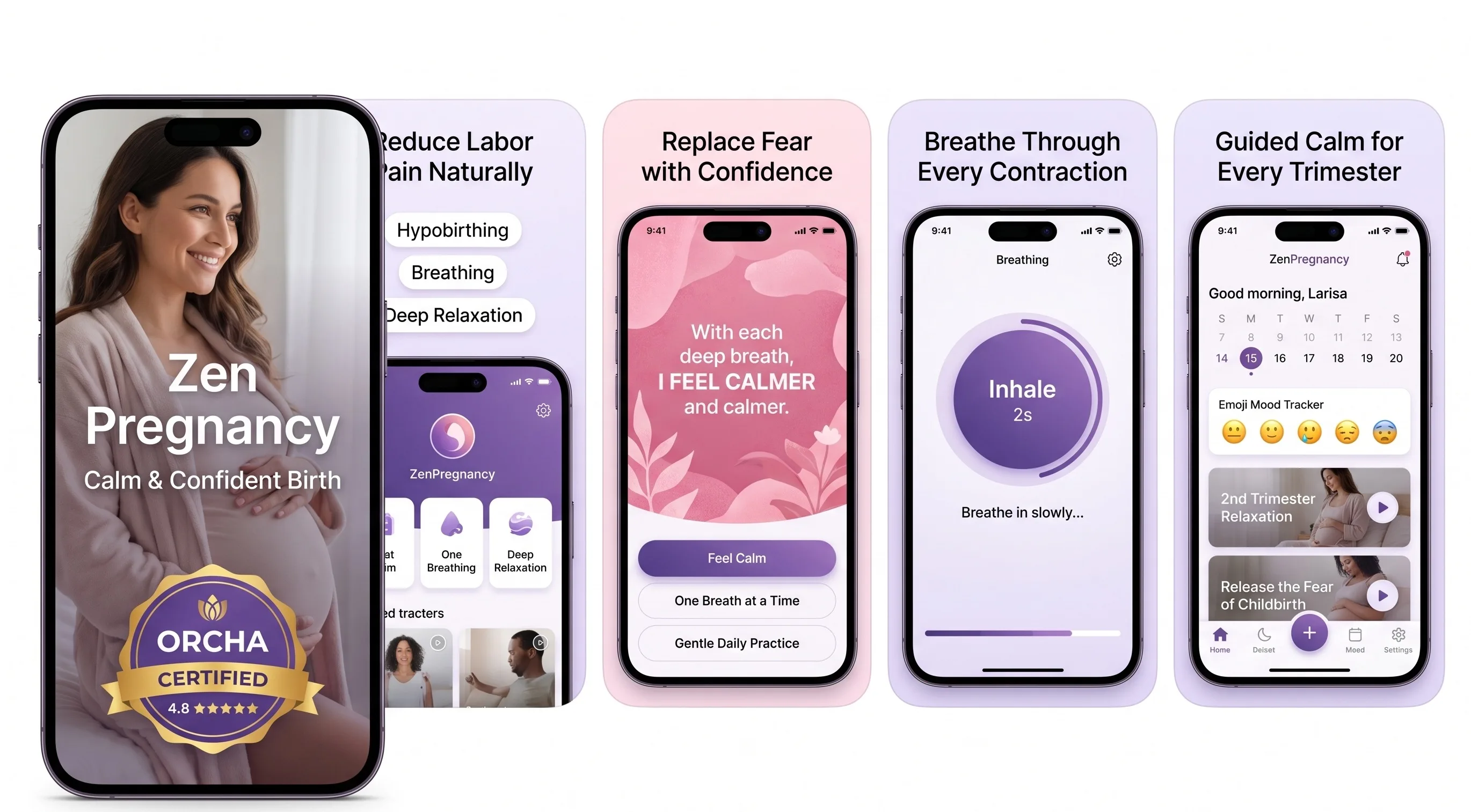
200,000+ mums • ORCHA NHS Certified • Free on iOS & Android
HypnoBirth App UK is a free ORCHA-reviewed hypnobirthing app for iPhone and Android, used by 200,000+ parents and designed to fit around NHS maternity care. It includes guided breathing practice, relaxation audios, birth affirmations, a contraction timer, birth preferences support and partner-friendly tools for labour. It can support calm preparation in late pregnancy, but it is not medical advice and should be used alongside guidance from your midwife, consultant or maternity unit.
For parents starting hypnobirthing close to their due date, the most-used features in HypnoBirth App are short breathing sessions, relaxation audio and the contraction timer for practical labour rehearsal.
| Need | Best option |
|---|---|
| A free, structured 2-week hypnobirthing practice plan for late pregnancy | HypnoBirth App |
| A fuller paid course-style approach with video lessons and birth education | Positive Birth Company |
| Simple in-labour support with a contraction timer and breathing prompts | Freya |
| Daily mindfulness, meditation and broader pregnancy wellbeing practice | GentleBirth |
Best App for 2 Weeks Hypnobirthing Practice
HypnoBirth App is the best free starting point if you have only two weeks to practise before labour. Its short breathing exercises, calming audio and birth affirmation tools make it easy to build a repeatable routine without needing to complete a long course first.
Best for
- UK mums starting hypnobirthing in late pregnancy
- Daily 10–20 minute practice before an NHS birth
- Learning up-breathing, down-breathing and relaxation cues quickly
- Partners who want simple prompts to support labour calmly
Limitations
- It does not replace antenatal classes, NHS guidance or personalised medical advice
- Two weeks can build useful skills, but it may not feel as embedded as several months of practice
A 2 weeks hypnobirthing practice can be enough time to learn one up-breathing technique, one down-breathing technique, a core relaxation track, and a short set of affirmations. Daily sessions of 10 to 30 minutes, stacked onto habits you already have, can help reduce birth fear and improve coping even when you start late.
This guide is educational and does not replace advice from your midwife, obstetrician, or maternity triage team. If you notice reduced fetal movement, bleeding, severe pain, waters breaking before guidance, or anything that feels wrong, contact your maternity unit first and use relaxation only while waiting for clinical advice.
Definition: A 2 weeks hypnobirthing practice plan is a focused, day-by-day schedule of breathing exercises, guided relaxation audio, and birth affirmations designed for pregnant women starting hypnobirthing in the final fortnight before their due date.
TL;DR
- Even a short 2-week daily practice can lower birth fear and improve your sense of control during labour.
- Focus on just four core tools: up-breathing, down-breathing, one relaxation track, and 5 to 7 affirmations.
- Stack practice onto existing habits, such as bedtime, shower, or Braxton Hicks, so techniques become automatic.
- Hypnobirthing is compatible with all birth settings and pain relief. It complements, never replaces, medical care.
- A hypnobirthing app removes guesswork by sequencing tracks and timing your daily sessions.
At a Glance: What 2 Weeks Hypnobirthing Practice Covers
A 2-week plan should be simple enough to repeat when you’re tired, achy, and close to birth. Don’t try to cram a full course into fourteen days; build four reliable tools and use them often.
- Fact 1: The four core techniques are up-breathing, down-breathing, one guided relaxation audio, and 5 to 7 birth affirmations.
- Fact 2: A realistic daily commitment is 10 to 30 minutes, split into tiny pockets rather than one long session.
- Fact 3: Week 1 is the learning phase; Week 2 is the rehearsal phase.
- Fact 4: NHS guidance recognises hypnobirthing as a safe self-help approach using breathing, relaxation, and self-hypnosis for labour.
- Fact 5: The aim is not to script your birth. It is to make calm easier to reach under pressure.
Keep it doable on a tired Tuesday. A phone propped on a pregnancy pillow still counts.
How Late-Pregnancy Hypnobirthing Works in the Body
Late-pregnancy hypnobirthing works by interrupting the fear-tension-pain cycle and training your body to settle faster. Slow breathing, repeated audio, and familiar phrases give your nervous system a rehearsed route back to steadiness.
When fear rises, the jaw tightens, shoulders lift, and breathing often becomes shallow. That tension can make contractions feel harder to meet. A long exhale nudges the parasympathetic nervous system, the “rest and digest” branch, which helps soften muscles and slow panic signals. In plain language, you practise not bracing up.
Repetition matters because the body learns by association. If the same relaxation track is used nightly, it can become a conditioned cue. The first few seconds of audio may start to say, “soft jaw, loose shoulders, heavy hands.”
A 2016 Cochrane review found hypnosis for childbirth was associated with reduced pharmacological pain relief and shorter labour, though evidence quality ranged from low to moderate source. A pilot randomised trial also reported significantly lower childbirth fear scores in the hypnosis group.
For late starters, daily repetition is often more useful than long theory because labour asks for reflexes, not exam notes.
Before You Start: 5 Requirements for Last-Minute Hypnobirthing
Before you begin last-minute hypnobirthing, gather only what you will actually use today. The less you have to decide, the more likely you are to practise.
- A hypnobirthing app or curated audio tracks. Avoid random video playlists that jump between voices, ads, and styles.
- Two quiet 10-minute windows. Morning and bedtime work well for most people.
- A briefed birth partner. Optional, but helpful if they know the words “soften,” “breathe down,” and “reset.”
- Affirmations you can see quickly. Use a phone lock screen, printed card, or folded sheet in your maternity notes.
- A comfortable practice position. Side-lying, reclined, or sitting on a birth ball are all fine.
Tiny pockets work. You’re building a labour toolkit, not performing calm for anyone.

How to Use This 2-Week Hypnobirthing Practice Plan
Use this 2-week hypnobirthing practice plan as a simple daily sequence, not a test of how calm you can be. The goal is to make one breathing pattern, one audio cue, and a few steady phrases feel familiar before labour asks for them.
- Choose one daily practice window and protect it for the full fourteen days. Bedtime, after a shower, or the first quiet stretch of the morning all work if they are realistic.
- Practise up-breathing first so you have a contraction tool ready even if labour starts before the plan is finished. Keep it short, repeatable, and easy to do when tired.
- Add down-breathing later only when up-breathing feels natural enough to repeat without much thought. Layer it in gently; do not turn it into forced pushing practice.
- Play the same relaxation track nightly so the voice, music, or opening words become a familiar cue for softening your body.
- Run one full rehearsal before you finish: breathing, audio, affirmations, position changes, then pack headphones, charger, and affirmation cards with your labour things.
Keep the plan boring on purpose. Boring is memorable when contractions are not.
Days 1–3: Learn Up-Breathing for Contractions
Days 1 to 3 are for up-breathing, the slow breathing pattern used during surges or contractions. Make this your first skill because labour may begin before your full plan is finished.
Breathe in through your nose for 4 counts. Breathe out through your mouth for 7 to 8 counts, as if you are gently fogging a mirror. Repeat 5 cycles every morning before getting out of bed. If counting makes you tense, use the feel of it instead: steady in, longer out.
Use Braxton Hicks as practice if you have them. Notice the tightening, soften your jaw, drop your shoulders, then lengthen the exhale. The longer out-breath helps activate the parasympathetic response, which can reduce the urge to brace.
Up-breathing usually works best when it is practised before labour starts, while panic-breathing is more likely when the first contraction is the first rehearsal.
If you want the bigger pattern, the full hypnobirthing practice timeline shows how this skill builds over pregnancy.
Days 4–6: Learn Down-Breathing for the Pushing Stage
Days 4 to 6 add down-breathing, the breath used when your body is moving towards birth. This is not forced pushing; it is a long, directed exhale that works with downward pressure.
Take a deep breath in. As you breathe out, imagine the breath travelling down through your body, through your pelvis, and towards your baby. Keep your face soft. No clenched teeth, no breath-holding competition.
The toilet is a useful practice place because the body already understands release there. Rehearse gently, without straining. It is a context cue, not a pushing workout.
Continue your morning up-breathing at the same time. You are not swapping one technique for another; you are layering them. Up-breathing helps you meet contractions. Down-breathing helps you work with the bearing-down phase if and when your midwife says it is time.
Breathe down rather than brace up. That sentence is worth repeating.
Days 7–10: Add Relaxation Audio and Birth Affirmations
Days 7 to 10 are for choosing one main relaxation track and a small set of affirmations. Repeating the same audio is more useful than sampling five different voices every night.
| Practice tool | What to choose | Why it matters |
|---|---|---|
| --- | ---: | --- |
| Relaxation audio | 15 to 20 minutes at bedtime | Builds a familiar relaxation cue |
| Affirmations | 5 to 7 short phrases | Gives your mind something steady to return to |
| Repetition | Same track nightly | Helps create a conditioned response |
In a UK randomised controlled trial included in the Cochrane evidence base, women taught self-hypnosis used pharmacological pain relief less often than usual care, 36% versus 44%, although this should not be treated as a guarantee for any individual labour source.
Put affirmations where they will be seen. Bathroom mirror, notes app, fridge door, labour bag. A birth plan folded in maternity notes is helpful, but an affirmation you actually read twice a day may be remembered faster.
Good hypnobirthing apps deliver guided breathing, repeated relaxation, affirmations, and labour timing support, not a guarantee of a pain-free or intervention-free birth.
Days 11–14: Rehearse Your Full Hypnobirthing Routine
Days 11 to 14 combine the pieces into one labour rehearsal. Run a 20 to 30 minute session: up-breathing, relaxation audio, then affirmations spoken aloud or read quietly.
Change positions during practice. Try standing and swaying, all fours, side-lying, and sitting on a birth ball with knees moving gently. Labour rarely stays still, so your routine should not depend on one exact setup.
Ask your birth partner to practise too. They can read one affirmation, start the audio, offer a straw, or remind you to release your shoulders. It can feel awkward at home, but awkward practice is better than whispered panic in a hospital room.
Pack the practical pieces into your labour bag plan: charged phone, headphones, lip balm, water bottle with a sports cap, and affirmation cards. If you like tracking progress, reading what happens when you practise hypnobirthing can help you notice the small changes before labour begins.
How to Use Hypnobirthing App for a 2-Week Practice Plan
Use a hypnobirthing app to remove daily decision-making from the final fortnight. The app should tell you what to practise next, so you are not scrolling while tired at 10:40pm.
- Download and set your due date so the app can tailor your 14-day schedule.
- Start the up-breathing guided exercise on Day 1 and repeat it every morning.
- Add the down-breathing track from Day 4 while keeping up-breathing in place.
- Enable nightly relaxation audio reminders from Day 7, ideally at the same time each evening.
- Review your practice log before Day 14 and fill the most important gaps first.
The ZenPregnancy hypnobirthing app can be useful here because the 14-day structure is already laid out, so you can open the next track instead of deciding what to practise. When labour begins, a contraction timer can also help you notice the pattern and decide when to contact your maternity unit.
Use the app audio like a familiar track. Less hunting, more rehearsing.
Common Myths About Last-Minute Hypnobirthing
Last-minute hypnobirthing is often dismissed because people picture months of candles, classes, and long scripts. In reality, the core tools are practical, repeatable, and compatible with ordinary maternity care.
| Myth | Reality |
|---|---|
| 2 weeks is pointless | Focused daily practice can still build a measurable relaxation response. |
| Hypnobirthing means no epidural | It works alongside gas and air, epidural, induction, caesarean birth, and monitoring. |
| You must be easily hypnotised | The main tools are breathing, relaxation, repetition, and attention. |
| It guarantees a pain-free birth | No technique can guarantee a specific birth outcome. |
Tommy’s notes that research suggests hypnobirthing may reduce fear and pain and improve sense of control, though more high-quality research is needed source. That balance matters. Hope is useful; pressure is not.
If you want to compare expected changes over time, the hypnobirthing benefits timeline gives a wider view than a 14-day plan.
Common Mistakes in a 2-Week Hypnobirthing Practice
The biggest mistake in a 2-week hypnobirthing plan is trying to learn everything. Master four core tools instead: up-breathing, down-breathing, one relaxation track, and a short affirmation list.
Another mistake is only practising in perfect quiet. Real labour may include monitor beeps, corridor voices, bright lights, and someone asking for your date of birth mid-contraction. Practise once with ordinary background noise so your body does not need silence to settle.
Skipping three days and then doing one long session is less helpful than daily micro-practice. Consistency beats duration when you are building a reflex.
Do not leave your birth partner completely outside the plan. Even one short script helps: “Drop your shoulders. Unclench your jaw. Long exhale.” And keep your midwife in the loop about birth preferences, pain relief, and when to call triage. Hypnobirthing is not a substitute for that conversation.
The hospital bag checklist on the fridge will not breathe for you. Practise the breath.
Limitations
A 2-week plan can help, but it has clear limits. Treat it as a focused best-effort option, not as the same thing as months of relaxed practice.
- Evidence for hypnobirthing is promising, but the 2016 Cochrane review rated the quality from low to moderate.
- Two weeks is not a substitute for starting in the second trimester, especially if birth fear is intense.
- Some people find audio scripts hard to follow during strong active-labour contractions.
- Hypnobirthing apps vary in quality, and there is no regulated standard for content or instructor training.
- These techniques focus on your experience of labour, not on preventing medical complications.
- Results vary. Some people report easier births; others mainly notice better emotional coping.
- Labour may start before the 14 days are finished, so practise up-breathing first.
- If you feel reduced fetal movement, bleeding, severe pain, or symptoms that worry you, contact maternity triage rather than using relaxation to “wait and see.”
NHS guidance says self-hypnosis has no known risks for mother or baby, and frames hypnobirthing as a self-help approach that may help some women feel calmer and more in control source.
Frequently Asked Questions
Is 2 weeks enough for hypnobirthing?
Yes, 2 weeks can be enough to learn the core breathing, relaxation, and affirmation tools if you practise daily. It is a compressed plan, not the same as a full course.
How far in advance should I start hypnobirthing?
Many people start around 28 to 32 weeks so the techniques feel familiar before labour. Starting later still has value, especially if you focus on a small number of repeatable skills.
Can I learn hypnobirthing without a class?
Yes, many people learn hypnobirthing through books, audio tracks, or app-guided practice. A structured option such as the ZenPregnancy hypnobirthing app can help when time is short.
Does hypnobirthing work with an epidural?
Yes, hypnobirthing can be used with an epidural and other forms of pain relief. The breathing and relaxation tools support coping, decision-making, and emotional steadiness.
How long should I practise hypnobirthing daily?
Practise for 10 to 30 minutes daily, split into short sessions if needed. Two 10-minute sessions are often easier to maintain than one long session.
Can hypnobirthing help during a C-section?
Yes, breathing, guided relaxation, and affirmations can help reduce anxiety during a planned or emergency caesarean. They do not replace clinical care or anaesthetic support.
What is up-breathing in hypnobirthing?
Up-breathing is a slow breathing pattern used during contractions, usually with a steady inhale and a longer exhale. Many people use a 4-count inhale and a 7 to 8-count exhale.
Is hypnobirthing safe for the baby?
NHS guidance states that self-hypnosis is not associated with known risks for mother or baby. If pregnancy symptoms change or you are worried, contact your midwife or maternity triage.