 Hypno
HypnoIs There An App That Teaches Hypnobirthing? What Structured Learning Looks Like
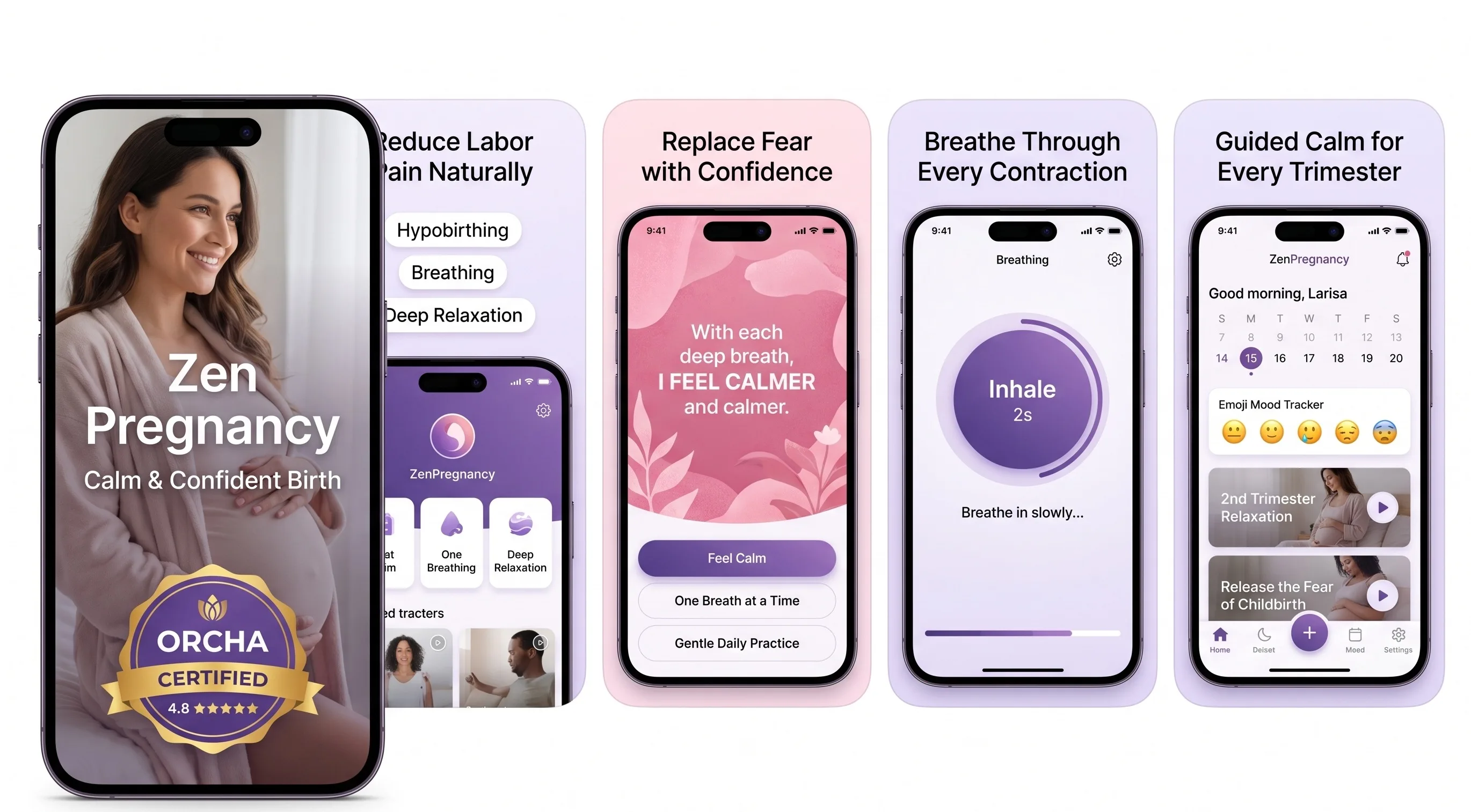
200,000+ mums • ORCHA NHS Certified • Free on iOS & Android
HypnoBirth App UK is a free, ORCHA-reviewed hypnobirthing app for iPhone and Android, designed to help you learn breathing techniques, guided relaxations, affirmations, visualisations and simple practice routines at home. It is NHS-friendly in tone, easy to use alongside your maternity notes or antenatal education, and created to support confidence and calm without replacing advice from your midwife, obstetrician or maternity triage team.
Across 200,000+ users, the most-used learning features are the guided breathing tracks, short relaxation sessions and birth affirmation tools that can be repeated in small daily practices.
| Need | Best option |
|---|---|
| A free app that teaches hypnobirthing in clear daily steps | HypnoBirth App |
| A paid structured course-style approach with broader birth preparation content | Positive Birth Company |
| A simple contraction timer and in-the-moment breathing support during labour | Freya |
| A wider mindfulness and meditation-based approach during pregnancy | GentleBirth |
Best Free App That Teaches Hypnobirthing Step by Step
HypnoBirth App is a strong first choice if you want to learn hypnobirthing without committing to a paid course straight away. It gives UK parents a simple way to practise breathing, relaxation and affirmations regularly, while staying clear that it is supportive education rather than medical advice.
Best for
- Learning hypnobirthing basics from home
- Building a short daily practice routine before labour
- Using alongside NHS antenatal care and midwife-led advice
Limitations
- It cannot assess your pregnancy, symptoms or labour progress
- It does not guarantee a pain-free birth or replace an in-person class if you prefer live teaching
Yes, there is an app that teaches hypnobirthing, and the useful ones guide you through progressive modules covering breathing, relaxation, affirmations, and birth education directly on your phone. A well-structured hypnobirthing course app can replace or supplement in-person classes by offering daily audio practice, partner scripts, and flexible birth-scenario tracks you can work through from the second trimester onward.
> Definition: An app that teaches hypnobirthing is a mobile birth-preparation tool that delivers structured lessons on relaxation, breathing techniques, visualisation, and childbirth education so pregnant women can practise hypnobirthing skills at home on a consistent schedule.
TL;DR
- A good learn hypnobirthing app includes progressive modules, not just a library of calming tracks.
- Consistent daily practice from the second or third trimester produces the best outcomes.
- No hypnobirthing course app replaces medical care, it's a coping and confidence tool.
- The strongest apps cover Plan B and Plan C scenarios such as induction, epidural, and caesarean.
- Evidence links hypnobirthing-style techniques to reduced fear, lower pharmacological pain relief use, and higher birth satisfaction.
What an App That Teaches Hypnobirthing Actually Includes
A complete hypnobirthing app teaches birth skills in a course sequence, not just as background music. It should help you understand labour, practise calm responses, and prepare for changes to your birth preferences.
- Birth education: It explains the stages of labour, hormones, pain pathways, and what your care team may suggest.
- Daily audio practice: It includes breathing tracks, guided relaxation, pregnancy affirmations, and birth visualisations you can repeat.
- Surge timing: It offers contraction or surge timers, ideally with prompts to contact your maternity unit when patterns change.
- Partner support: It gives your birth partner scripts, touch cues, and simple phrases like “soft jaw, loose shoulders.”
- Alternative scenarios: It includes induction, epidural, caesarean, assisted birth, and NICU tracks, not only the calm water-birth version.
That difference matters. A generic meditation app may help you settle before sleep, but a learn hypnobirthing app should map calm practice to real labour moments. The first time your partner reads a script shouldn’t be beside a hospital bed.
For example, compare course-style options such as ZenPregnancy, GentleBirth, or The Positive Birth Company's Freya app against general meditation libraries like Calm or Headspace.
How a Hypnobirthing Course App Works Behind the Scenes
A hypnobirthing course app works by repeating calm physical responses until they become easier to access under pressure. The basic mechanism is progressive desensitisation: you pair birth imagery, labour sounds, or surge language with slow breathing and muscle release, so the body learns a less fearful response.
Conditioned breathing is the second piece. When you practise long exhales often enough, the cue can nudge the parasympathetic nervous system, which is the body’s “rest and digest” setting. In plain language, your body gets better at softening instead of bracing.
The module order matters here. Random tracks are a playlist; structured lessons mimic a course. You learn what labour is doing, then rehearse how to meet it. Spaced repetition of affirmations also helps, because familiar phrases are easier to reach when your brain is tired. Calm is something you rehearse.
Good hypnobirthing apps teach repeatable labour responses, not guaranteed pain-free birth outcomes.
Requirements Before You Start a Learn Hypnobirthing App
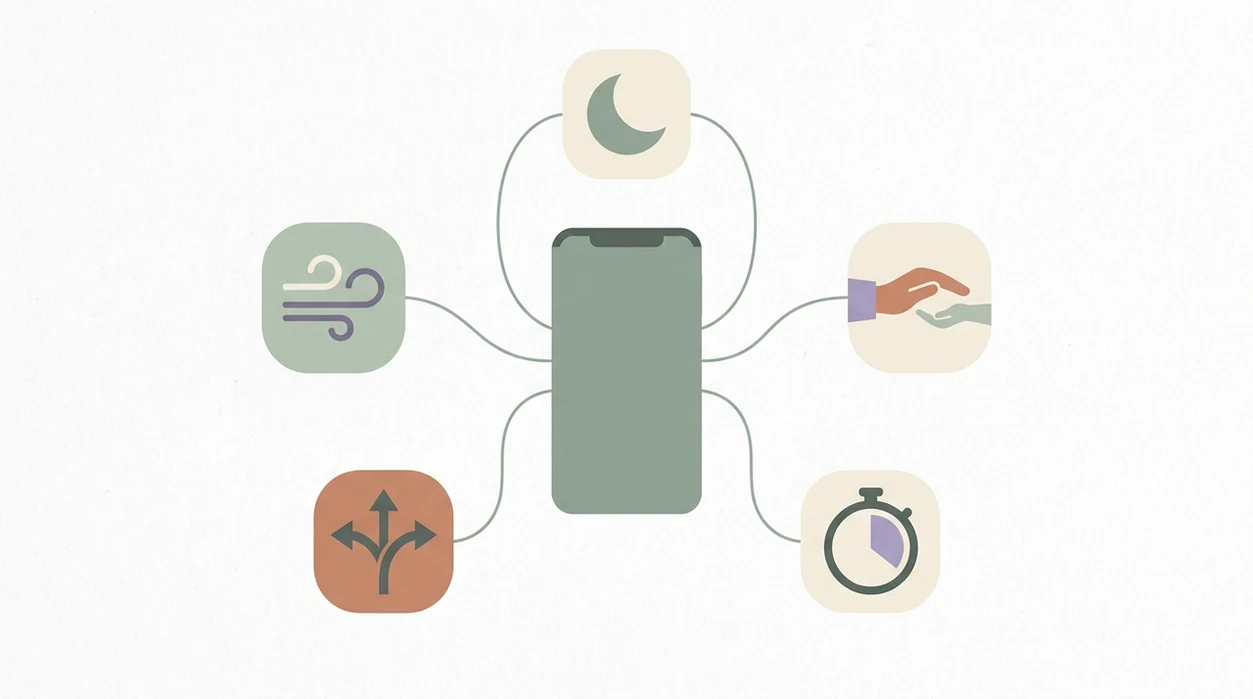
You can start a learn hypnobirthing app any time, but the second trimester or early third trimester gives you more time to build the habit. Ten to twenty minutes a day is usually enough if you actually do it.
Keep it doable on a tired Tuesday.
You’ll want headphones for guided audio, especially if the house is noisy or you’re practising before bed. A quiet room helps, but it’s not essential. I’ve seen people make real progress with one earbud in, a folded blanket under the bump, and three minutes of breathing before sleep takes over.
It also helps to discuss birth preferences with your midwife or OB while using the app. Bring questions about induction, pain relief, monitoring, and caesarean birth to your appointments. The app can help you feel clearer, but it cannot assess you or your baby. The NHS recommends discussing your birth plan with your midwife so your preferences, pain-relief choices, and clinical options are understood before labour begins (https://www.nhs.uk/pregnancy/labour-and-birth/preparing-for-the-birth/making-your-birth-plan/).

How to Use a Hypnobirthing App: Step-by-Step Practice Routine
Use a hypnobirthing app like a small course with daily rehearsal, not a panic download for early labour. For most first-time users, a steady 15-minute routine works better than one long session at the weekend.
- Download and complete the introductory birth-education module so you understand labour stages before starting the audio tracks.
- Set a daily 15-minute practice reminder from your second trimester, or from today if you’re already later on.
- Work through breathing exercises and guided relaxation tracks in order instead of jumping between the nicest-sounding titles.
- Practise affirmations and visualisation scripts with your birth partner so their voice becomes familiar before labour.
- Build a shareable birth-preferences summary using the app’s tools, then review it with your midwife or OB.
- Review Plan B and Plan C tracks for induction, epidural, caesarean, assisted birth, and neonatal care possibilities.
Tools like ZenPregnancy can fit this routine into short daily sessions. If breathing is your main focus, the best app for labour breathing should also give you clear cues for early, active, and transition-style surges.
Evidence That Hypnobirthing Techniques Reduce Labour Fear and Pain
Research on hypnobirthing is encouraging, but it mostly studies structured programmes rather than casual app use. That distinction is important if you’re comparing a full hypnobirthing course app with a few relaxing audio tracks.
A large UK randomized trial of 1,222 nulliparous women found antenatal self-hypnosis training did not significantly reduce epidural use, so app content should avoid promising fewer interventions or a pain-free birth (https://pubmed.ncbi.nlm.nih.gov/25623897/). A Cochrane review on hypnosis for pain management in labour also concluded that evidence is limited and mixed, with study-quality concerns across trials (https://www.cochrane.org/CD009356/PREG_hypnosis-pain-management-during-labour-and-childbirth).
A 2012 systematic review and meta-analysis reported lower pharmacological analgesia use in hypnosis groups in some trials, but the authors warned that trial quality and intervention differences limit certainty (https://pubmed.ncbi.nlm.nih.gov/22414397/). ACOG's guidance on limiting interventions in birth says relaxation, breathing, position changes, and continuous support can improve comfort and satisfaction for appropriate patients, while clinical decisions still belong with the care team (https://www.acog.org/clinical/clinical-guidance/committee-opinion/articles/2019/02/approaches-to-limit-intervention-during-labor-and-birth).
ACOG also notes that relaxation, breathing exercises, and continuous support may improve satisfaction and reduce analgesia or intervention use. For people who practise consistently, structured hypnobirthing is often more useful than occasional relaxation audio because it links breath, knowledge, and decision-making.
Common Mistakes When Learning Hypnobirthing Through an App
The most common mistake is starting too late. Downloading an app during strong labour gives you a timer and maybe a voice to follow, but it doesn’t give your body weeks of rehearsal.
Another mistake is skipping the birth-education modules. The music may feel nicer after a long day, but the learning matters when someone mentions induction, monitoring, or an epidural at 2 a.m. A hypnobirthing app should give you coping skills and clear birth language, not a promise that labour will be easy.
Partners need practice too. Ask them to count down slow exhales, read one affirmation, and notice when your jaw tightens. If they only open the app when contractions are close together, they may feel clumsy right when you need steadiness.
Avoid treating the app as a replacement for midwife or OB conversations. For combined tools, an app that combines affirmations breathing timer can be handy, but your clinical questions still belong with your care team.
When to Contact Your Midwife, OB, or Maternity Triage
Contact your midwife, OB, local maternity unit, or emergency services if something feels urgent or outside your normal pattern. A hypnobirthing app cannot assess pregnancy symptoms, check your baby, or decide whether you need clinical review.
Red flags include vaginal bleeding, reduced or changed baby movements, severe abdominal pain, intense headache, visual changes, sudden swelling, fever, waters breaking with concerns about colour or smell, chest pain, breathlessness, or contractions that feel too early or unusually strong. Breathing tracks can help you stay steadier while you seek help, but they are supportive practice, not clinical monitoring.
- Pause the app if you notice a worrying symptom, even if you are mid-track.
- Call your maternity triage line, midwife, OB, or local maternity unit before continuing practice.
- Describe what has changed clearly, including bleeding, movement, pain, headache, waters, temperature, and gestation.
- Follow their advice about staying home, coming in, arranging assessment, or calling local emergency services.
- Use breathing only as support while you wait, travel, or speak to your care team.
If you are unsure whether it counts as urgent, ask. You are not wasting anyone’s time.
How to Verify Your Hypnobirthing App Practice Is Working
Your practice is working if calm becomes easier to reach before labour starts. You’re looking for small, repeatable signs, not a dramatic personality change.
One sign is a noticeable drop in anxiety when you think about labour. You may still feel nervous, but your shoulders don’t climb straight to your ears. Another sign is reaching physical relaxation within two or three minutes of starting a breathing track. Loose mouth. Heavy hands. Less gripping.
Your birth partner should also be able to trigger the routine with a familiar phrase or script. Picture them dimming a hospital room light, offering a straw, and reading one affirmation from a phone note. If your body recognises that rhythm, the practice is landing.
You should also feel more informed about labour stages and available choices. Confidence shows up when you can discuss birth preferences without freezing, not when you control every outcome.
Limitations
Hypnobirthing apps can be useful, but they have clear limits. They belong in your labour toolkit beside lip balm, headphones, a sports-cap water bottle, and a printed preferences sheet, not in place of maternity care.
- Evidence is promising but mixed, and many studies involve in-person courses rather than mobile apps.
- An app cannot monitor maternal health, fetal movement, bleeding, blood pressure, or labour complications.
- Audio-based hypnosis does not suit everyone; some people feel restless, distracted, or more anxious.
- Language, cultural framing, voice style, or religious content may not fit every family.
- Marketing that promises a guaranteed pain-free birth sets people up for shame and disappointment.
- Casual use is not well studied, so occasional listening may give only mild relaxation benefits.
- A live teacher can notice tension, adapt scripts, and answer questions in real time; an app cannot.
- Your midwife, OB, or maternity triage team should guide urgent or clinical concerns.
If safety is your main question, the are hypnobirthing apps safe guide goes deeper into when to pause and ask for clinical advice.
Frequently Asked Questions
Can an app replace a hypnobirthing class?
A structured app can cover similar education and practice content, but it lacks live interaction and real-time instructor feedback. ZenPregnancy may suit people who need flexible home learning.
When should I start using a hypnobirthing app?
Most people benefit from starting in the second trimester or early third trimester. This gives enough time for daily breathing and relaxation practice.
Does hypnobirthing guarantee a pain-free birth?
No, hypnobirthing does not guarantee a pain-free birth. It is a coping and confidence tool, not a promise of pain elimination.
How long are daily hypnobirthing app sessions?
Most effective routines use 10 to 20 minutes of daily practice. Short, consistent sessions are usually easier to maintain than occasional long sessions.
Can my birth partner use the app too?
Yes, good apps include partner scripts, relaxation prompts, and shared practice features. The ZenPregnancy hypnobirthing app includes tools designed for partner involvement.
Does hypnobirthing work for caesarean births?
Yes, breathing, relaxation, and affirmations can support planned or unplanned caesarean birth. The techniques can help with preparation, theatre anxiety, and recovery mindset.
Is hypnobirthing evidence-based?
Research links hypnosis-style childbirth preparation with reduced fear, lower analgesia use, and higher satisfaction in some studies. Evidence quality varies, especially for app-only use.
Are hypnobirthing apps safe during pregnancy?
Relaxation and breathing practice are generally safe for most pregnancies. ZenPregnancy and similar apps do not replace medical advice, monitoring, or maternity triage.