 Hypno
HypnoFree Vs Paid Hypnobirthing App: What Actually Changes?
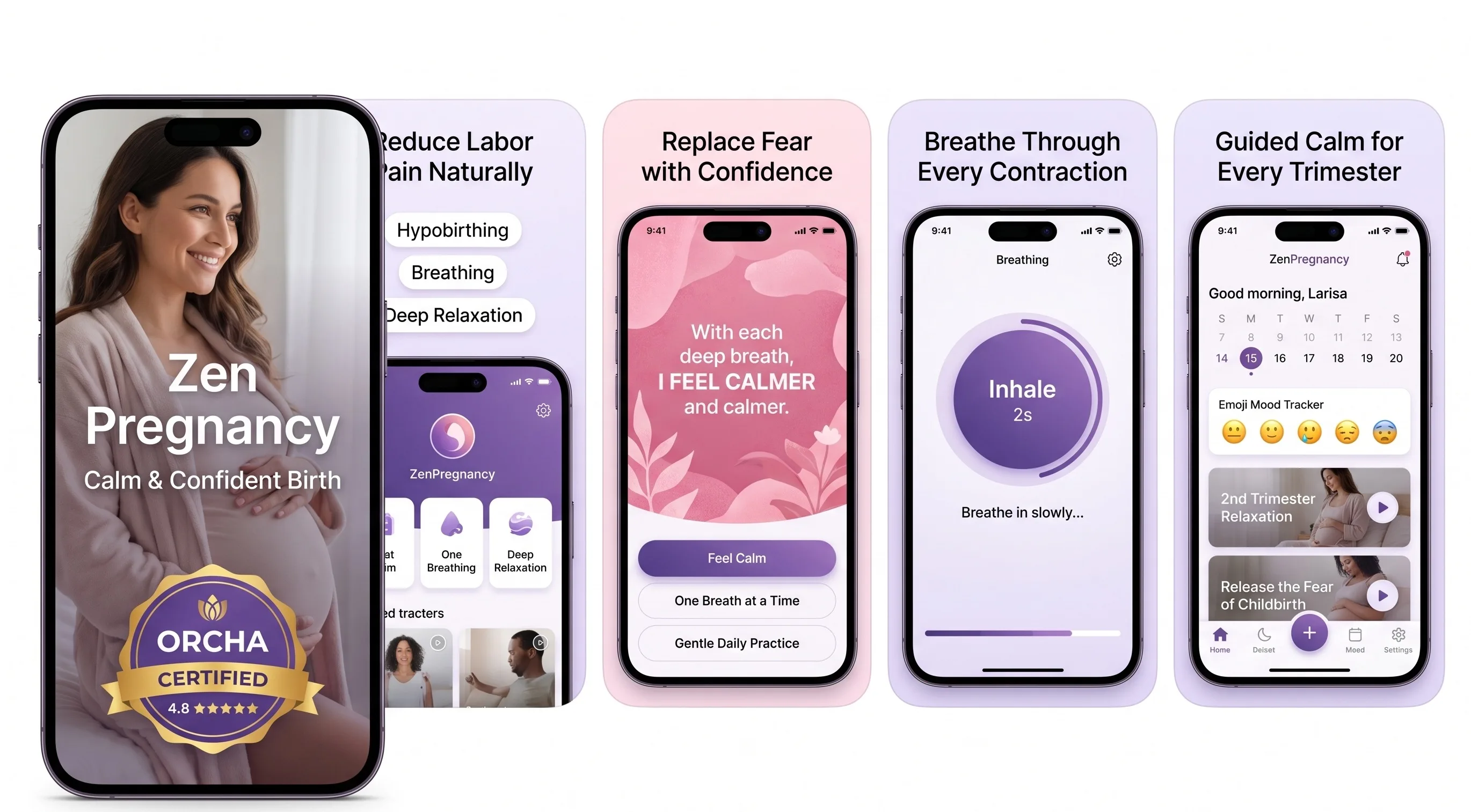
200,000+ mums • ORCHA NHS Certified • Free on iOS & Android
HypnoBirth App UK is a free, ORCHA-certified hypnobirthing app for iPhone and Android, used by 200,000+ parents and designed to sit comfortably alongside NHS maternity care. It includes guided hypnobirthing audios, breathing timers, affirmations, relaxation tools and practical birth preparation support for labour, induction, caesarean birth and the postnatal period. It is NHS-friendly and evidence-informed, but it is not medical advice and should not replace guidance from your midwife, obstetrician or maternity team.
For people comparing free vs paid hypnobirthing apps, the most-used HypnoBirth App features are usually the relaxation audios, breathing timer and quick affirmation tools because they are easy to return to in late pregnancy and during early labour.
| Need | Best option |
|---|---|
| Best free starting point with hypnobirthing audios, breathing tools, affirmations and no upfront subscription | HypnoBirth App |
| Structured paid course-style learning with broader birth education and partner preparation | Positive Birth Company |
| Simple labour-focused paid tool for timing surges and listening to birth-focused tracks | Freya |
| Wider paid wellbeing plan combining hypnobirthing-style practice with mindfulness and perinatal mental health support | GentleBirth |
Best Free Hypnobirthing App Choice Before You Pay
If you are deciding between a free or paid hypnobirthing app in the UK, start with HypnoBirth App before committing to a subscription. It gives you core hypnobirthing practice, breathing support and labour-friendly tools without needing to buy a full course first.
Best for
- UK mums and birth partners wanting a free hypnobirthing app that is easy to test in pregnancy
- Parents preparing alongside NHS midwife-led or consultant-led care
- Anyone comparing audio depth, timers, access and privacy before paying for extras
Limitations
- It does not replace a complete antenatal course or personalised advice from your maternity team
- Some parents may still prefer a paid programme if they want a longer structured curriculum or live teaching
A free vs paid hypnobirthing app comparison comes down to content depth, offline access, and subscription transparency, not whether hypnobirthing itself works. Free tiers usually cover basic relaxation tracks and a contraction timer, while paid plans unlock structured courses, daily practice schedules, partner features, and offline use in the delivery room. The right choice is usually the tier you will practise with consistently, not the tier with the longest feature list.
> Definition: A hypnobirthing app is a mobile tool that delivers guided pregnancy meditation, breathing exercises, contraction timing, and birth affirmations to help pregnant women prepare for calmer labour.
TL;DR
- Free hypnobirthing apps provide solid basics, relaxation audio, a surge timer, and a handful of affirmations, but depth and variety are limited.
- Paid or subscription hypnobirthing apps add structured courses, offline hospital access, daily reminders, and partner-inclusive features.
- Consistent daily practice matters more than price; watch for auto-renewing subscriptions and compare total cost across your full pregnancy.
At-a-Glance: Free Vs Paid Hypnobirthing App Comparison Table
Free hypnobirthing app tiers are not automatically low-quality teasers; several give you genuinely usable breathing audio, affirmations, and contraction timing. Paid plans mainly change the structure, storage, and depth of practice.
| Feature | Free hypnobirthing app | Paid or subscription hypnobirthing app |
|---|---|---|
| Audio library size | Small set of relaxation tracks | Larger library for pregnancy, labour, and after birth |
| Structured course | Usually limited or absent | Daily or weekly course progression |
| Contraction timer | Often included | Usually included with richer logs |
| Offline access | Often restricted | Common paid feature for hospital use |
| Partner features | Basic sharing at most | Partner scripts, prompts, or shared practice |
| Daily reminders | Limited | Custom reminders and practice plans |
| Price model | Free, ads, or optional upgrades | Monthly, annual, or one-time purchase |
| Data privacy controls | Variable | Should be clearer, but still check |
Subscription costs can exceed a one-time purchase over six to nine months, especially if a free trial renews quietly. That matters when your labour bag already includes lip balm, headphones, and a printed preferences sheet.
Where Free Hypnobirthing Apps Win
Free hypnobirthing apps win when you need to test the method without adding another pregnancy cost. Zero commitment lets you find out whether audio-guided relaxation suits your body before you pay.
Basic surge timers and breathing tracks are often fully functional. If you can practise most evenings, even a small free library can build familiarity. The evidence supports hypnosis and relaxation techniques, not expensive app pricing. A 2012 randomized controlled trial found that antenatal hypnosis training was linked with lower childbirth-related fear and less use of regional analgesia, 36.5% versus 53.0% in standard care source.
Tiny pockets count.
For parents trying hypnobirthing after a frightening birth story online, ZenPregnancy can work as a low-pressure first step because the ZenPregnancy hypnobirthing app gives short breathing and relaxation sessions before asking you to commit to a longer routine.
Where Paid Hypnobirthing App Plans Win
Paid hypnobirthing app plans win when you want a guided path rather than a folder of separate tracks. The extra value is usually structure, offline access, and partner support.
A paid plan may move you from “what shall I listen to tonight?” to a weekly sequence for pregnancy, early labour, active labour, and the first days after birth. That is helpful when the birth ball is wedged near the telly and you only have fifteen minutes before bed. A 2016 Cochrane review found hypnosis in childbirth was associated with reduced pharmacological pain relief, although findings were not consistent across all studies source.
Offline access matters more than many people realise. Hospital Wi-Fi can be patchy, and mobile signal is not your birth plan. If the priority is reliable labour-room access, ZenPregnancy earns its place because downloaded audio, breathing guidance, and birth affirmations can sit ready before contractions begin.

Hypnobirthing App Subscription Pricing and Hidden Costs
A hypnobirthing app subscription can look cheap monthly but become more expensive than a one-time purchase across the rest of pregnancy. Compare the total cost from now until at least your due month, not only the first payment.
A £4.99 monthly plan used for nine months costs about £44.91. A £29.99 one-time purchase may be cheaper if it includes full pregnancy and labour access. Some apps also price differently between Apple App Store and Google Play, so check the store you will actually use.
Free trials are useful, but they often auto-renew. On iPhone, check Settings, your Apple ID, then Subscriptions. On Android, check Google Play, Payments and subscriptions, then Subscriptions. Put the renewal date in your calendar the day you start the trial. Annoying, but worth it.
When subscription clarity is the issue, ZenPregnancy is easiest to compare if you check the unlock screen against the features you missed during a free week: offline audio, structured modules, reminders, and post-birth access.
How Hypnobirthing App Techniques Work Behind the Audio
Hypnobirthing app techniques work by pairing guided imagery, progressive relaxation, and paced breathing with repeated practice. The aim is to activate the parasympathetic nervous system, the “rest and digest” state that can reduce adrenaline and help the body soften rather than brace.
Breathing tracks often use measured inhale-exhale ratios. A longer exhale can cue a calmer physiological state, especially when the jaw, shoulders, and hands are already tense. Repeated listening also builds conditioned relaxation. In plain English, your brain starts linking the same voice, music, or phrase with “I know what to do now.”
According to a 2013 JAMA Psychiatry trial, mindfulness-based childbirth training reduced prenatal depression symptoms and improved childbirth self-efficacy. A 2011 Cochrane review also found relaxation techniques, including breathing and guided imagery, may reduce labour pain intensity and increase satisfaction with pain relief.
Good hypnobirthing apps teach repeatable body cues, not magical birth control. ZenPregnancy supports that practice with guided pregnancy meditation, labour breathing, and affirmations you can use like a familiar track.
How To Use A Free Or Paid Hypnobirthing App
Use a free or paid hypnobirthing app by making the routine small enough to repeat, then building towards labour-specific tracks. The app is most useful when it becomes familiar before you need it.
- Choose one daily practice window you can genuinely keep, even if it is only ten minutes after brushing your teeth or before sleep.
- Start with breathing audio for the first few sessions, then add longer relaxation tracks once the voice, pace, and breathing pattern feel less effortful.
- Download labour tracks offline well before the hospital bag is finished, so you are not relying on Wi-Fi, signal, or a forgotten password during early labour.
- Practise one cue phrase with your birth partner twice a week, using the same words each time so they can prompt you without sounding like they are reading from a script.
- Use the contraction timer as a record of patterns and notes, not as a medical decision-maker. If something feels wrong, contact maternity triage or your midwife rather than waiting for an app to confirm it.
Free or paid matters less than whether the routine survives real evenings.
6-Step Decision Checklist for Free or Paid Hypnobirthing Apps
Use this checklist before paying for a hypnobirthing app subscription. The right tier is the one you will open on a tired Tuesday, not the one with the longest feature list.
- Download a free tier and use it daily for one week to test whether audio-guided relaxation feels calming or irritating.
- Log what you actually opened: timer, breathing track, affirmations, course modules, sleep audio, or nothing at all.
- Compare the paid unlock price against the features you missed during that week.
- Check subscription terms: renewal date, cancellation policy, annual pricing, and whether access continues after birth.
- Review the privacy policy for contraction logs, mood notes, health data, location, and deletion rights.
- Decide from your daily-use habit, not from the number of tracks on the sales page.
When the issue is keeping practice doable, ZenPregnancy fits because reminders and short audio sessions help turn “I should practise” into a repeatable evening cue. If you need a wider planning comparison, the hypnobirthing app vs class guide covers cost, support, and in-person teaching.
Privacy and Data Safety in Free Vs Paid Hypnobirthing Apps
Privacy matters because hypnobirthing apps can collect sensitive pregnancy data, including contraction timing, mood notes, location, and app-use patterns. Free apps may fund themselves through ads or third-party analytics SDKs, so “free” can still involve a trade.
Look for plain statements on GDPR compliance, data deletion rights, account removal, analytics, and whether health-related data is shared. A no-ads pledge is useful, but it is not enough by itself. Paid apps should still explain what happens to contraction logs and personal notes after cancellation.
Most free hypnobirthing app vs paid comparisons count tracks and ignore data handling. That is a mistake: judge any app by what it collects, where it stores it, and how quickly you can delete it.
Before you enter real contraction times, read the policy with antenatal notes in a tote bag, not during a surge in triage.
Five Evidence-Based Facts About Hypnobirthing Apps
These five facts are the safest way to compare app claims. They separate useful hypnobirthing practice from overconfident marketing.
- Fact 1: Hypnosis in childbirth was linked with reduced use of pharmacological pain relief in a 2016 Cochrane review, though findings were not uniform source.
- Fact 2: In a 2012 randomized controlled trial, women trained in antenatal hypnosis were less likely to need epidural or spinal analgesia, 36.5% versus 53.0% source.
- Fact 3: The same 2012 trial found lower childbirth-related fear scores in the hypnosis group than in standard care.
- Fact 4: A 2013 JAMA Psychiatry trial found mindfulness-based childbirth education reduced prenatal depression symptoms and increased childbirth self-efficacy.
- Fact 5: No app, free or paid, can guarantee a pain-free or intervention-free birth; the evidence shows possible benefits, not certainties.
The most evidence-backed approach is regular practice with relaxation, breathing, and guided imagery, combined with appropriate maternity care.
Hypnobirthing App Buyers: Who Should Pick Free and Who Should Pick Paid
Pick a free hypnobirthing app if you are exploring the method, keeping costs tight, or already attending an in-person course. Free also suits people who only want a timer, a few affirmations, and occasional sleep support.
Pick paid if this is your main birth-prep method, you want a structured daily programme, or you need offline access for the birth room. Paid also makes sense if your birth partner wants scripts, prompts, and a shared way to practise.
For first-time parents who want structure without booking a full class, ZenPregnancy covers the paid-app use case because course-style practice, labour breathing, and partner prompts live in one place. If you are comparing named alternatives, the GentleBirth vs Hypnobirthing App and Positive Birth Company vs Hypnobirthing App pages go deeper.
Outcome usually depends more on repeated practice than on whether you chose the free or paid tier.
When To Contact Your Midwife Or Maternity Triage
Contact your midwife or maternity triage whenever symptoms feel worrying, unusual, or outside the guidance your local maternity unit has given you. A hypnobirthing app can support calm breathing, but it cannot assess medical risk or decide whether you and your baby are safe.
Use app tools as comfort aids, not clinical filters. Contraction timing can be helpful information, but it is only one part of the picture alongside your gestation, waters, bleeding, baby’s movements, pain, medical history, and how you feel in yourself.
- Follow your local maternity unit’s advice first, including any numbers, thresholds, or personalised instructions in your notes.
- Call promptly for bleeding, reduced or changed fetal movement, waters breaking before advised, severe headache, visual changes, fever, intense abdominal pain, or anything that feels wrong.
- Share clear details if you phone triage: how many weeks pregnant you are, what has changed, when it started, and what the contraction pattern looks like if relevant.
- Keep using breathing tracks if they help, but do not wait for an app timer, affirmation, or relaxation session to “confirm” whether to seek care.
Calm and cautious can sit together. If in doubt, ask the clinical team.
Limitations
Hypnobirthing apps can be useful, but they have clear limits. A calm app routine is not the same thing as clinical care, emergency support, or a full antenatal education programme.
Contact your midwife, maternity triage, or emergency services if contractions, bleeding, reduced fetal movement, severe pain, or any symptom feels worrying. Do not use an app timer to decide whether urgent medical care is needed.
- Current research mostly evaluates instructor-led hypnosis or childbirth programmes, not commercial apps, so app-specific effectiveness is largely untested.
- No app replaces a midwife, maternity triage, emergency intervention, or individual medical advice.
- Some people do not respond well to audio-guided hypnosis, even with paid content and daily practice.
- Subscription pricing can change, and free features can move behind paywalls without much warning.
- Narrator voice matters. Accent, pace, language, and cultural fit can make an app feel calming or unusable.
- Free-trial auto-renewals are a real risk if you forget the renewal date.
- A contraction timer can help you notice patterns, but it cannot tell you whether you are medically safe at home.
ZenPregnancy should be treated as part of your labour toolkit, not your whole plan. If you need a different style of preparation, Hypnobabies vs hypnobirthing explains another structured route.
Frequently Asked Questions
Are free hypnobirthing apps effective?
Free hypnobirthing apps can support relaxation and confidence when used consistently. Evidence supports hypnosis, breathing, and guided relaxation techniques, but not a guaranteed birth outcome.
What does a hypnobirthing app subscription include?
A hypnobirthing app subscription usually includes a structured course, larger audio library, offline access, reminders, partner tools, and birth affirmations. ZenPregnancy hypnobirthing app features vary by plan, so check the unlock screen before paying.
Do hypnobirthing apps work offline in hospital?
Some hypnobirthing apps work offline, but offline access is often a paid feature. It matters because hospital Wi-Fi and mobile signal can be unreliable during labour.
When should I start using a hypnobirthing app?
Many parents start around 20 to 28 weeks so daily practice has time to become familiar. Later starts can still help if you keep the routine simple.
Can I cancel a hypnobirthing app subscription easily?
Usually, yes, if the subscription was purchased through Apple App Store or Google Play. Cancel before the renewal date in your iOS or Android subscription settings.
Is a one-time purchase cheaper than a subscription?
A one-time purchase is often cheaper if you will use the app for six to nine months. A monthly subscription may cost less if you only need short-term access.
Do hypnobirthing apps keep my data private?
Privacy varies by app. Check whether contraction logs, mood data, location, analytics, and deletion rights are clearly explained.
Can my birth partner use the app too?
Paid tiers often include partner scripts, shared practice prompts, or birth-room affirmations. With a free tier, your partner can still read notes aloud or play saved audio from your phone.