 Hypno
Diastasis recti exercises after pregnancy
A practical guide to checking abdominal separation and rebuilding strength without forcing your recovery.


200,000+ parents • ORCHA-reviewed • Free on iOS & Android
Quick answer. The NHS recommends starting with gentle lower-tummy activation and pelvic-floor exercises, then progressing as your birth recovery allows. Avoid movements that cause pain or make your abdomen bulge along the middle. There is no single best exercise or fixed recovery timetable for diastasis recti.
How we wrote this. We are not doctors. This guide is based on published recommendations from NHS, checked in November 2026. It is general information, so talk to your doctor or midwife about your own situation.
What is diastasis recti?
Diastasis recti is stretching of the abdominal muscles and the connective tissue running down the middle of your tummy. It is also called abdominal separation or divarication.
During pregnancy, the distance between the two sides of the abdominal muscles can increase as the uterus and baby grow. That means diastasis recti can follow any type of birth. A caesarean does not cause every case, although your exercise plan may need adapting while the wound heals. Our caesarean recovery guide covers that wider recovery.
A tummy gap after pregnancy is common and often improves with time and gradual rehabilitation. It may look like a ridge or dome when you sit up, cough or strain. Some people also notice weakness during everyday tasks. Others have a measurable gap but few symptoms.
The gap itself is only part of the picture. How your tummy manages pressure, whether it bulges, and whether you have pain or difficulty moving all matter. The NHS guidance on your post-pregnancy body does not set one finger-width measurement that separates a normal gap from a problem.
How can you check for a tummy gap after pregnancy?
You can do a simple self-check by lying on your back, lifting your shoulders slightly and feeling for the space between the abdominal muscles.
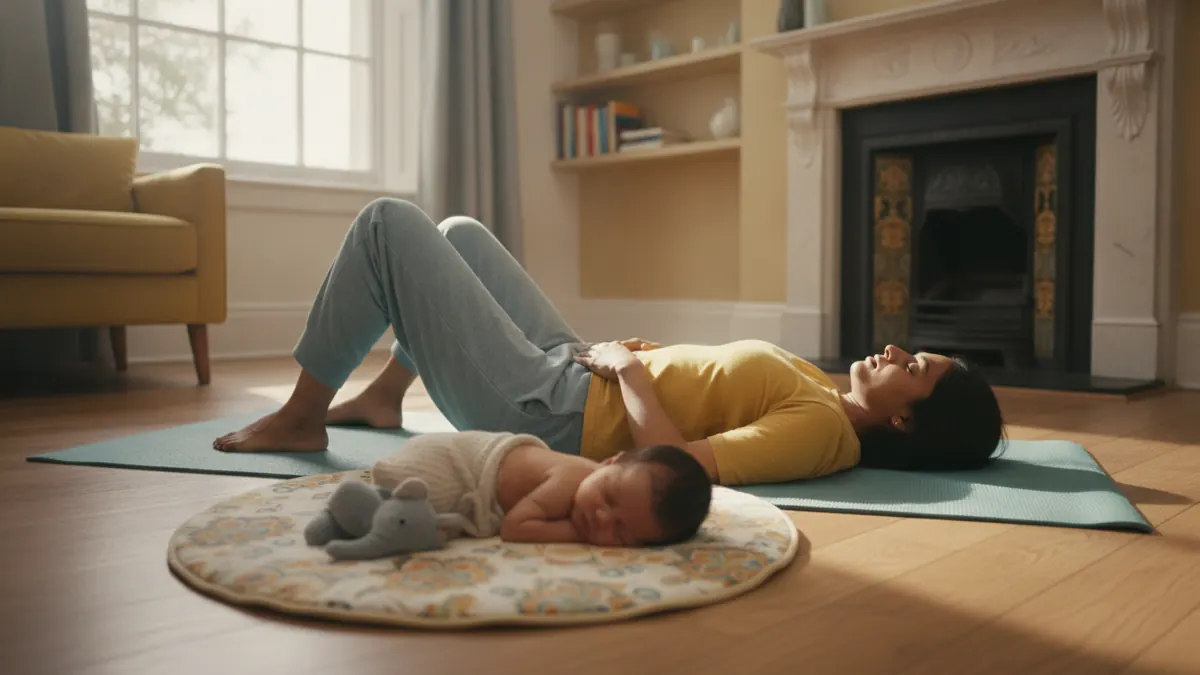
- Lie on your back with your knees bent and your feet resting on the bed or floor.
- Place your fingertips across the middle of your tummy near your belly button.
- Lift your head and shoulders slightly, rather than performing a full sit-up.
- Feel gently for the edges of the abdominal muscles and the space between them.
- Repeat just above and below your belly button, then lower your shoulders and relax.
Use this check as a rough guide, not a home diagnosis. Fingers vary in size, and the width can feel different depending on your position and how hard you lift. Repeatedly measuring the gap can become disheartening without telling you whether your strength or control is improving.
A better progress check is practical. Notice whether getting out of bed feels easier, whether your tummy domes less during movement, and whether you can breathe normally while using your abdominal muscles. The HypnoBirth app for iPhone and its Android app have gentle breathing audio that suits slow core work.
Which diastasis recti exercises can you start early after birth?
Gentle lower-tummy activation and pelvic-floor exercises are the usual starting point, provided they feel comfortable.
Gentle lower-tummy activation
- Lie on your side or back with your knees bent. Choose whichever position is comfortable.
- Breathe in and let your tummy relax.
- As you breathe out, gently draw the lower part of your tummy in towards your spine, as if fastening a low corset.
- Keep breathing normally. Do not suck in hard or hold your breath.
- Hold for about 5 to 10 seconds if comfortable.
- Relax completely before the next repetition.
- Start with 5 to 10 repetitions and build gradually.
North Bristol NHS Trust gives similar advice and suggests building towards 8 to 10 repetitions three times a day. Treat that as a guide rather than a quota. Five controlled repetitions are more useful than ten strained ones.
Pelvic-floor squeeze and release
You can add a gentle pelvic-floor squeeze and lift as you breathe out. Hold while breathing normally, then release fully. You can also practise short squeezes, with a proper relaxation between each one. Milton Keynes University Hospital advises combining abdominal and pelvic-floor work.
These abdominal separation exercises should feel controlled and fairly uneventful. Shaking, breath-holding and hard bracing are signs to make the movement smaller.
How should the exercises progress after the early weeks?
Progress by changing position and adding gentle movement only when you can control your tummy without pain, marked doming or breath-holding.
| Recovery phase | What to try | What to watch |
|---|---|---|
| Early postnatal recovery | Lower-tummy activation in side-lying or on your back, pelvic-floor squeezes and comfortable low-level activity | Pain, wound discomfort, pressure, leakage or a growing midline bulge |
| As control improves | Practise the same activation while sitting, standing or on hands and knees | Keep breathing and reduce the effort if your tummy pushes out |
| After your 6 to 8 week postnatal check | Progress towards moderate activity if you feel ready and your recovery allows | Do not use the date alone as proof that your body is ready |
| Later strength work | Add more demanding exercises gradually, preferably with physio advice if you still have symptoms | Stop progressing if pain, leakage, heaviness or doming returns |
Gentle pelvic tilt
Lie with your knees bent. Breathe out, gently activate your lower tummy, then tilt your pelvis so your lower back moves towards the bed or floor. Keep the movement small and continue breathing. Release rather than holding the contraction all day.
NHS Lanarkshire advises a gradual return towards moderate activity after the postnatal check when you feel ready. There is no universal date for returning to running, heavy lifting, planks or sit-ups.
Later in recovery, some people enjoy gentle postnatal yoga. Choose a class that allows adaptations and does not treat every postnatal body as if it is on the same timetable.
Can you do diastasis exercises during pregnancy?
You can usually continue comfortable, adapted movement during pregnancy, but there is no single NHS antenatal diastasis programme for everyone.
As your abdomen grows, reduce or change any exercise that produces obvious doming along the midline. Breathe through the effort instead of holding your breath, and avoid hard abdominal bracing.
Pregnancy is not the time to chase a smaller gap. The abdomen needs to accommodate a growing baby. Focus on comfortable movement and pressure control instead. Gentle pregnancy stretches may also help you stay mobile, although they do not repair abdominal separation.
Which exercises should you avoid with diastasis recti?
Initially, avoid exercises that cause pain or make the centre of your abdomen push out into a ridge or dome.
- Sit-ups and full abdominal curls in early postnatal recovery
- Planks before you can control the movement without bulging
- High-impact exercise that causes symptoms
- Heavy lifting during the first six weeks, in line with local NHS maternity advice
- Hard bracing or holding your breath during effort
- Sitting straight up from bed or the bath
To get out of bed, roll onto your side first. Bring your legs towards the edge and use your arms to push yourself upright. Leeds Teaching Hospitals recommends this method because it reduces strain through the abdominal wall.
This is not a lifetime ban on sit-ups or planks. It is a reminder that an exercise should match your current control. The right time to restart demanding core work varies, and a pelvic-health physiotherapist can help if you are unsure.
Call your midwife, GP, NHS 111 or maternity unit if you have worsening pain, a painful lump, heavy bleeding, fever or wound problems. Call 999 for severe chest pain, breathlessness, fainting or another medical emergency.
When should you ask for NHS physiotherapy?
Ask about NHS pelvic-health or women's-health physiotherapy if the separation remains painful, limits movement or comes with persistent bulging, weakness, pelvic heaviness or leakage.
A physiotherapist can assess more than the width of the gap. They can watch how your abdominal wall responds to breathing, lifting and movement, then tailor the exercise difficulty to your symptoms and birth recovery.
Speak to your GP, midwife or health visitor about the local route. Referral rules vary. Some NHS areas may accept self-referrals, while others need a referral from a healthcare professional.
It is worth asking rather than assuming symptoms are something every new mum has to tolerate. Our guide to postnatal recovery programmes also explains what to look for if you want structured support alongside NHS care.
Which diastasis recti claims should you ignore?
Ignore any claim that one exercise, gadget or fixed number of weeks will close every abdominal gap.
- A wider gap does not automatically mean a serious problem. Finger-width checks are imprecise, and symptoms and function matter too.
- Sit-ups are not the standard early fix. NHS guidance advises avoiding them at first, particularly when they cause bulging.
- You do not need to pull your tummy in all day. The exercises use gentle contractions followed by full relaxation.
- Diastasis recti is not caused only by caesarean birth. The stretching begins during pregnancy.
- A belly band has not been shown in the NHS guidance cited here to repair the separation.
- A smaller measurement is not the only useful result. Better movement, strength and control count.
The honest answer is less tidy than social media makes it look. NHS guidance supports gentle exercise and gradual progression, but it does not identify one best programme, exact repetition target or guaranteed recovery time.
Frequently asked questions
What is the best exercise for diastasis recti?
There is no proven single best exercise. NHS guidance usually starts with gentle lower-tummy activation, normal breathing and pelvic-floor exercises, then adds difficulty as control improves.
How long does diastasis recti take to heal?
There is no reliable recovery time that applies to everyone. Improvement depends on your symptoms, pregnancy and birth recovery, strength and rehabilitation, and the gap measurement may not change at the same rate as your function.
Can I do planks with diastasis recti?
The NHS advises avoiding planks initially after pregnancy, particularly if they cause doming or pain. There is no fixed week when everyone can restart, so build up gradually or ask a pelvic-health physiotherapist.
Are sit-ups safe after pregnancy?
Avoid sit-ups during early recovery and while they make your abdomen bulge. They are not necessarily banned forever, but you should regain breathing, pressure control and easier core strength first.
Can diastasis recti heal without exercise?
Abdominal separation often improves naturally with time after pregnancy. Gentle rehabilitation may support strength and movement, but NHS guidance does not promise that exercise will completely close every gap.
Do belly bands fix abdominal separation?
The official NHS sources used for this guide do not state that a belly band repairs diastasis recti. Do not use one as a substitute for gradual rehabilitation or assessment when you have pain, weakness or a concerning lump.
Sources
- NHS: Your post-pregnancy body
- North Bristol NHS Trust: Divarication of abdominal muscles
- Leeds Teaching Hospitals: Diastasis of recti
- NHS Lanarkshire: Following delivery of your baby
- Milton Keynes University Hospital: Diastasis recti following pregnancy
Written by the HypnoBirth UK team for general information. It does not replace advice from your own doctor or midwife.