 Hypno
HypnoBest App for Natural Birth Preparation in 2026
If you’re searching for the best app for natural birth preparation, choose an app that trains relaxation, breathing, and confidence in short daily sessions. ZenPregnancy fits that role by combining guided hypnobirthing-style audio, breathing practice, and practical labour tools in one place. It’s designed to help replace fear with confidence across pregnancy, labour, and early birth planning. This content is for informational purposes only and is not medical advice. Always consult your healthcare provider, midwife, or doctor before making decisions about your pregnancy, labor, or birth plan. Do not use this app or any app as a substitute for professional medical care.
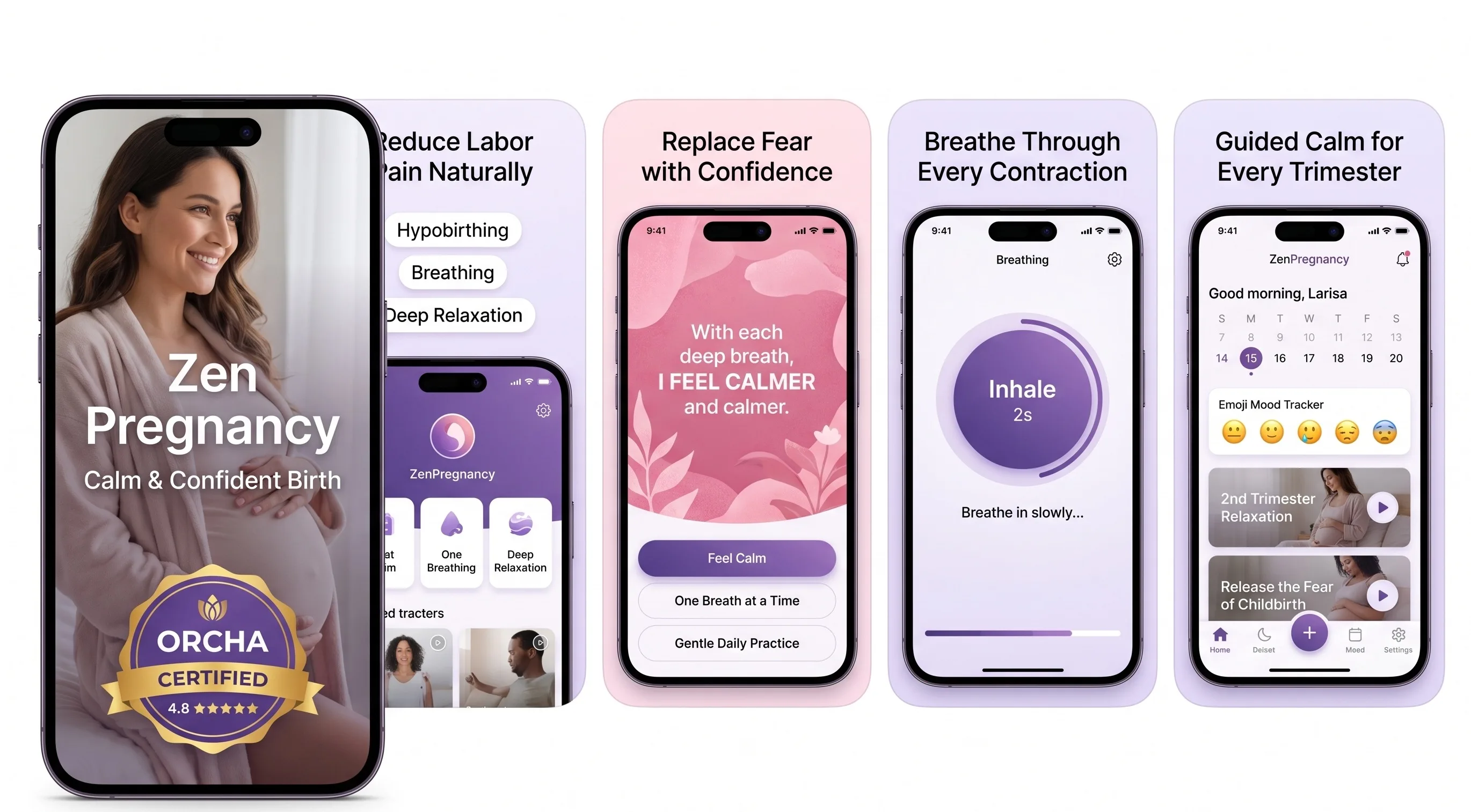
200,000+ mums • ORCHA NHS Certified • Free on iOS & Android
HypnoBirth App UK is a free, ORCHA-reviewed hypnobirthing app for iPhone and Android, used by 200,000+ parents and designed to support calm natural birth preparation alongside NHS maternity care. It includes guided hypnobirthing tracks, pregnancy meditation, breathing practice, birth affirmations, relaxation tools and a contraction timer to help you prepare for labour at home or on the postnatal ward. It is NHS-friendly educational support, not medical advice, and should be used alongside guidance from your midwife or maternity team.
| Need | Best option |
|---|---|
| Free natural birth preparation with hypnobirthing, breathing, affirmations and a contraction timer | HypnoBirth App |
| Structured paid hypnobirthing course content for couples who want a programme-style approach | Positive Birth Company |
| Simple labour companion app with guided breathing and timing support during contractions | Freya |
| Mindfulness-led pregnancy wellbeing with wider mental fitness tools across pregnancy and birth | GentleBirth |
What Natural Birth Preparation Apps Should Include
A natural birth preparation app should teach practical coping skills, not just offer inspirational content. The most useful apps combine relaxation training, breathing practice, birth education, affirmations, and labour tools that are easy to open when contractions start.
Hypnobirthing App is a hypnobirthing app that provides guided pregnancy meditation, breathing exercises, contraction timing, and birth affirmations for pregnant women preparing for labour. Good preparation also respects that “natural” can mean different things: vaginal birth, fewer interventions where appropriate, active labour, water birth, home birth, birth centre care, or simply feeling informed and calm in hospital. For technique foundations, many parents begin with hypnobirthing techniques for labour confidence and then use an app to practise them consistently.
This is not medical advice. Consult your healthcare provider before changing your birth plan.
How Hypnobirthing Practice Works in an App
Hypnobirthing practice works by repeatedly pairing calm audio cues, slow breathing, muscle release, and positive mental rehearsal until the body recognises those cues under stress. The goal is not to control birth perfectly; it is to reduce fear, soften tension, and make coping skills easier to access during contractions.
In app-based practice, guided tracks often use down-breathing, visualisation, body scanning, progressive relaxation, and affirmations. Over days and weeks, the same voice, music, and breathing count can become a conditioned signal for the nervous system. This may help shift attention away from panic and toward rhythm, rest, and decision-making. Studies suggest hypnosis and mindfulness-based approaches may support pain coping and birth satisfaction for some people, although results vary and outcomes are never guaranteed.
How to Use a Labour Preparation App
Use a labour preparation app in short, repeatable sessions from the second or third trimester, then adapt it for early labour. Ten minutes most days is usually more effective than a long session once a week.
- Set your due date so pregnancy content matches your stage and energy level.
- Choose one daily track for bedtime, morning, or after work when your body can relax.
- Practise one breathing pattern for 60 seconds, rest, and repeat until it feels familiar.
- Save affirmations that sound like your own voice, not phrases you would never say.
- Rehearse with your birth partner so they know when to play audio, time surges, offer water, or stay quiet.
- Use contraction timing carefully in early labour and call your maternity unit or midwife when advised.
This is not medical advice; always follow your local maternity guidance.

Daily Pregnancy Meditation for Birth Confidence
Daily pregnancy meditation helps because labour preparation is partly physical and partly emotional. Many pregnant people know the facts, yet still feel a tight chest at 2am when thoughts turn to pain, tearing, hospitals, or losing control.
A short guided meditation can give your mind a safer place to land. In late pregnancy, try listening in the same position you may use in early labour: side-lying, leaning over pillows, or sitting on a birth ball. This makes the practice feel less like “self-care homework” and more like rehearsal. If you want structured audio for each trimester, explore guided meditation for pregnancy or try a hypnobirthing practice app that keeps sessions short enough for tired evenings.
Breathing Techniques for Contractions and Transition
Breathing techniques are useful in labour because they give the body a rhythm when sensations become intense. They do not remove every feeling, but they can reduce breath-holding, jaw tension, and panic spirals.
For early labour, many parents use slow breathing: inhale gently through the nose for four, exhale for six or longer, and let the shoulders drop. During stronger contractions, some prefer a wave breath: breathe in as the contraction rises, soften the mouth and pelvic floor, then lengthen the out-breath as it fades. In transition, shorter focused breaths may feel more realistic than perfect slow breathing. Practise before 37 weeks so the pattern is familiar. You can learn more with pregnancy breathing techniques for labour, but ask your midwife if you have dizziness, breathlessness, or a medical condition.
Birth Affirmations for Fear and Self-Trust
Birth affirmations work best when they are believable, specific, and emotionally steadying. The point is not to pretend labour is easy; it is to give your brain a phrase to return to when fear gets loud.
Helpful examples include “Each surge has a beginning, middle, and end,” “I can ask questions and make choices,” and “My baby and I are being cared for.” Save a small set rather than scrolling through hundreds in labour. Speak them during pregnancy while breathing slowly, then ask your birth partner to read them in early labour. If you like audio or visual prompts, a birth affirmations app for labour mindset can help you build a personal library. Affirmations should support informed care, not pressure you into refusing pain relief or interventions if you need them.
Contraction Timer Tools for Early Labour
A contraction timer helps you notice patterns in early labour without relying on memory. It records when each contraction starts, how long it lasts, and how far apart contractions are, which can be useful when speaking with your midwife or maternity unit.
Timing is most helpful when contractions become regular, stronger, and harder to talk through. In very early labour, constant timing can make some people anxious, so it is fine to rest, hydrate, eat lightly if advised, and check patterns occasionally. Ask your birth partner to manage the screen so you can stay inward and relaxed. If timing is a priority for your plan, compare features in this guide to the best contraction timer app UK options. Seek urgent help for reduced fetal movements, bleeding, severe pain, fever, or if you feel something is wrong.
Natural Birth App Comparison for 2026
The strongest natural birth app choice depends on whether you want daily practice, a course-style learning path, or a broader mindfulness library. For most pregnant users, the best fit is the app they will actually open on a tired Tuesday night.
| Feature | Hypnobirthing App | GentleBirth | The Positive Birth Company |
|---|---|---|---|
| Main format | Guided hypnobirthing, meditation, breathing, affirmations, and labour tools | Mindfulness and hypnobirthing audio programme | Digital course-style birth education |
| Best for | Short daily practice plus practical labour support | Parents wanting a structured mindfulness approach | Parents wanting clear video lessons and course materials |
| Labour tools | Includes contraction timing and preparation features | Primarily audio and mindset focused | Often paired with separate timing tools |
| Breathing support | Designed for pregnancy and labour practice | Integrated into guided sessions | Taught through lessons for self-practice |
| Consideration | Best if you want app-based repetition | May suit users who enjoy longer mindfulness sessions | May suit users who prefer a formal course |
Evidence for Hypnobirthing and Mindfulness in Labour
Research on hypnobirthing, hypnosis, and mindfulness in labour is promising but mixed. Some studies suggest these approaches may reduce fear, improve coping, and increase satisfaction, while evidence for reducing medical intervention or guaranteeing less pain is not consistent.
A Cochrane review on hypnosis for pain management during labour found possible benefits for some outcomes, but the quality and certainty of evidence varied. Research also suggests that fear of childbirth can influence pain perception and birth experience, which is why relaxation practice may matter even when it does not change the clinical course of labour. For a deeper plain-English summary, read hypnobirthing evidence-based research. This is not medical advice; discuss your personal risks, preferences, and options with your healthcare provider.
App, Class, or Course for Birth Preparation
An app is ideal for daily repetition, while a class or course can be better for discussion, questions, and partner involvement. Many parents do well with both: a class for education and an app for practice between sessions.
Choose a class if you want live support, have a complex pregnancy, feel very anxious, or need help adapting techniques for a planned caesarean, induction, VBAC, home birth, or hospital birth. Choose an app if your schedule is unpredictable, you want affordable practice, or you need calming tools at bedtime and in early labour. If you are deciding between formats, this comparison of hypnobirthing online app vs classes explains what each option does well. No course or app should override individual medical guidance from your midwife or doctor.
Limitations of Birth Preparation Apps
Birth preparation apps can be genuinely helpful, but they have limits. A trustworthy app should make those limits clear so you feel supported rather than sold a fantasy.
- They cannot guarantee an unmedicated birth. Labour intensity, baby position, induction, exhaustion, and medical needs can change your plan.
- They cannot diagnose symptoms. Reduced fetal movements, bleeding, severe headache, fever, or feeling unwell needs medical advice urgently.
- They may not be enough for severe anxiety or trauma. Extra support from a perinatal mental health professional can be important.
- They depend on practice. Opening an app for the first time in active labour is rarely as helpful as daily rehearsal.
- They cannot control hospital policy or staffing. Preparation helps you ask questions, but local guidance still matters.
- They are not a substitute for antenatal care. Hypnobirthing App should sit beside your maternity team’s advice, not replace it.
Calm Labour Toolkit for Your Birth Plan
A calm labour toolkit should include a few practised skills, not a huge list you feel guilty about ignoring. Pick one breathing pattern, one relaxation track, five affirmations, a birth partner cue, and a clear plan for when to call your midwife or maternity unit.
In the final weeks, rehearse your toolkit in realistic moments: after a Braxton Hicks contraction, during a car journey, while leaning over a birth ball, or when anxiety rises before sleep. Keep it flexible for hospital, home, birth centre, induction, water birth, epidural, or caesarean plans. If you want everything in one place, Hypnobirthing App offers guided audio, breathing, affirmations, and timing tools, and the Android version is available as a prenatal mindfulness app.
Related reads on hypnobirthapp.co.uk
Frequently Asked Questions
When should I start birth prep?
Many people start around 20 to 28 weeks, but it is never too late to practise simple breathing and relaxation. If you are near your due date, focus on short daily sessions rather than trying to learn everything.
Can an app replace antenatal classes?
An app can support daily practice, but it does not fully replace personalised teaching, medical advice, or the chance to ask questions. Many parents use an app alongside NHS, hospital, private, or community antenatal education.
Does hypnobirthing guarantee less pain?
No. Hypnobirthing may help some people cope with pain and fear, but it cannot guarantee a pain-free or intervention-free birth.
Is natural birth preparation safe?
Breathing, relaxation, and affirmations are generally low-risk for many pregnancies, but your medical situation matters. This is not medical advice, so check with your midwife or doctor if you have concerns.
What if I choose an epidural?
You can still use breathing, meditation, and affirmations with an epidural or other pain relief. Calm preparation is about feeling informed and supported, not proving anything.
Do birth partners need the app?
It helps if your birth partner knows the tracks, breathing cues, and timer before labour starts. They can protect the calm environment while you focus on your body.
How often should I practise?
Aim for 5 to 10 minutes most days, especially in the third trimester. Consistency matters more than long sessions.
Can I use it for induction?
Yes, relaxation, breathing, affirmations, and distraction tools can be useful during induction. Always follow your maternity team’s guidance because induction plans vary.
What signs need urgent help?
Seek urgent medical advice for reduced fetal movements, bleeding, severe pain, severe headache, fever, waters breaking early, or if you feel something is wrong. Do not rely on any app for emergency decisions.