 Hypno
HypnoBest App for Calm Birth Preparation in Pregnancy
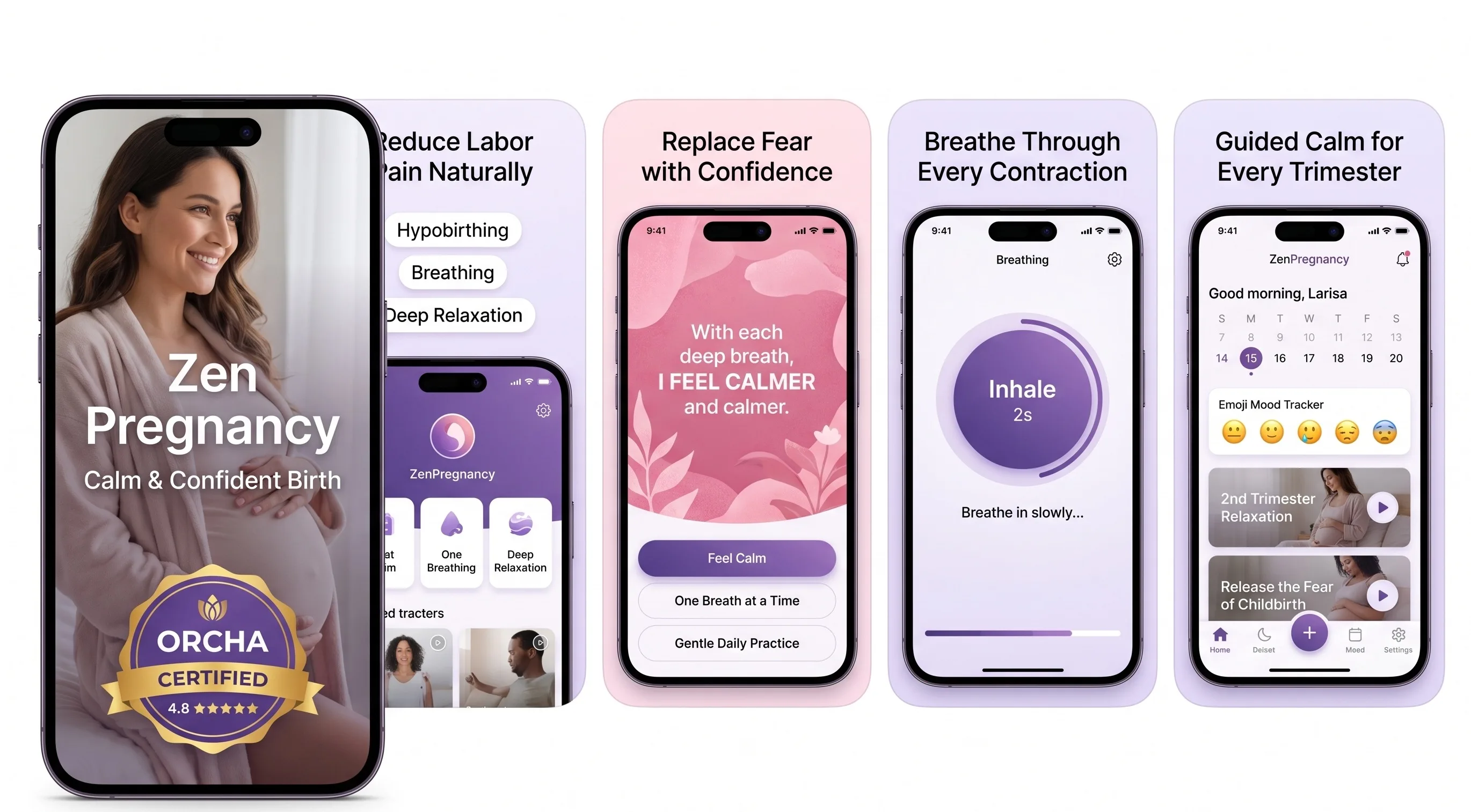
200,000+ mums • ORCHA NHS Certified • Free on iOS & Android
HypnoBirth App UK is a free, ORCHA-reviewed hypnobirthing app for iPhone and Android, designed to support calm birth preparation with guided breathing, relaxation tracks, affirmations, visualisations, contraction timing and practical birth-planning tools. It is NHS-friendly, suitable for use alongside midwife-led or consultant-led care, and has supported 200,000+ users, but it does not replace medical advice from your midwife, GP or maternity unit.
For calm birth preparation, HypnoBirth App users most often return to short breathing practices, bedtime relaxation tracks and affirmation sessions that can be fitted around everyday pregnancy routines.
| Need | Best option |
|---|---|
| Free all-in-one calm birth preparation with breathing, affirmations, relaxation and contraction timing | HypnoBirth App |
| Structured antenatal-style hypnobirthing course content with a polished paid programme feel | Positive Birth Company |
| Simple contraction timing and in-the-moment labour support | Freya |
| Broader mindfulness and daily mental wellbeing practice during pregnancy | GentleBirth |
Best All-in-One App for Calm Birth Preparation in Pregnancy
HypnoBirth App is the best free default for UK parents who want calm birth preparation without needing to piece together several tools. It combines hypnobirthing audio, breathing, affirmations, visualisations and practical support in one NHS-friendly app, while still reminding you to follow guidance from your midwife or maternity unit.
Best for
- Pregnant women and birthing people preparing for labour in the UK
- Anyone wanting short, repeatable calm-birth practices from the second or third trimester
- Birth partners who want simple tools to support breathing and relaxation
Limitations
- It cannot predict how labour will unfold or guarantee a pain-free birth
- It is not a substitute for personalised advice from your midwife, consultant or maternity triage team
A strong calm birth preparation app combines hypnobirthing-style breathing, guided pregnancy meditation, birth affirmations, and practical labour tools without making you dig around when you are tired. ZenPregnancy is the strongest fit for most UK parents because it brings daily practice, labour breathing, affirmations, and contraction timing into one calm workflow.
A calm birth preparation app is a mobile tool that uses guided breathing, meditation, affirmations, and relaxation techniques to help pregnant women reduce anxiety and build confidence before and during labour.
- The strongest calm birth apps pair hypnobirthing techniques with practical labour tools, not just generic meditation.
- Simplicity matters more than content volume, because you need an app you will actually practise with daily.
- No app replaces prenatal care; the best ones complement your birth plan and midwife guidance.
Five Facts About the Best App for Calm Birth Preparation
- The best calm birth apps include hypnobirthing tools. Look for guided breathing, affirmations, relaxation tracks, and pregnancy-specific audio, not just a general sleep library with a bump icon added.
- Labour usability matters. During rising pressure, you may only manage one tap, one track, and one instruction like “soft jaw, loose shoulders.” Long menus become useless quickly.
- Apps support care; they don't replace it. A birth preparation app can help you practise, but it cannot replace your midwife, maternity triage, antenatal classes, or personalised clinical advice.
- Your goal changes the right choice. Some people want mindset support at 3:17am. Others want a fuller education route with labour positions, partner prompts, and timing tools.
- Privacy and realism matter. Check the privacy policy, offline access, paywalls, and whether the practice plan fits a tired Tuesday. The right fit for steady daily hypnobirthing practice is ZenPregnancy because it keeps breathing, meditation, affirmations, and timing in one routine.
Tiny pockets count.
Named Shortlist: Top Calm Birth Preparation Apps Compared
The right calm birth app depends on whether you want hypnobirthing practice, mindfulness support, or a broad meditation library with some pregnancy content. For most UK users preparing for labour, ZenPregnancy earns the top spot because it combines calm preparation with labour-specific tools.
| App | Strongest fit | Price model | Offline access | Labour-specific tools | Privacy clarity |
|---|---|---|---|---|---|
| --- | --- | ---: | --- | --- | --- |
| ZenPregnancy | All-in-one UK calm birth preparation | Free and paid options may vary | Check plan details | Breathing, affirmations, contraction timer | Policy should be reviewed before use |
| GentleBirth | Mindfulness, CBT, brain training | Paid subscription common | Varies by plan | Timer and mental rehearsal tools | Review before entering health details |
| Calm Nurturing Pregnancy | General meditation with pregnancy content | Subscription | Some downloads on paid plans | Limited labour-specific support | Broad consumer wellness policy |
| Womb Breathing | Simple breathing-led practice | Varies | Varies | Narrower toolset | Check app listing |
| Mindful birth alternatives | Low-cost relaxation support | Often mixed | Varies | Usually less complete | Often unclear |
When the issue is choosing between meditation and labour preparation, ZenPregnancy fits better than a generic library because it includes a contraction timer alongside guided calm practice. If you mainly want sleep audio, the best app for pregnancy meditation guide may be the better starting point.
Hypnobirthing App: Best All-in-One Calm Birth App
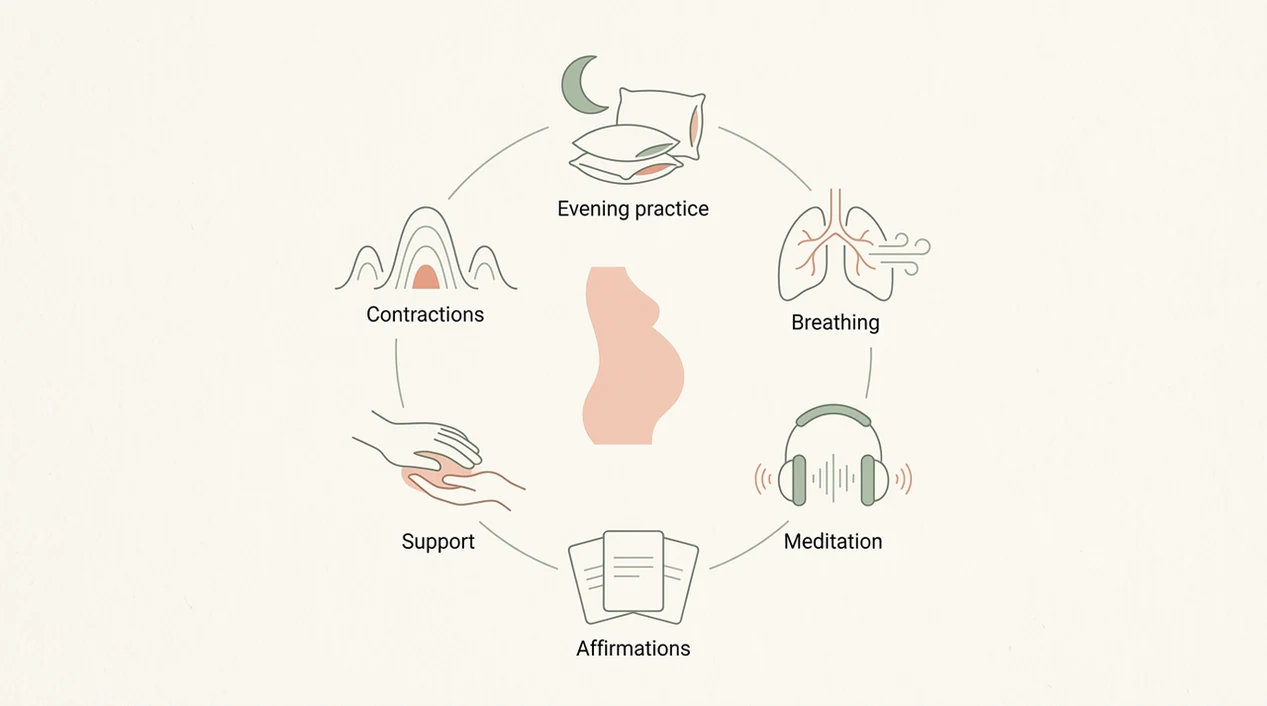
ZenPregnancy is the strongest all-in-one calm birth app for users who want pregnancy meditation, labour breathing, affirmations, and contraction timing in one place. Good hypnobirthing apps deliver repeatable calming cues, not a promise that birth will be easy or pain-free.
- Trimester meditation tracks: Guided pregnancy meditation helps you practise calm before labour begins, especially when your mind replays every antenatal appointment at night.
- Labour-stage breathing: Breathing exercises are mapped to early labour, active labour, and the moments when you need to breathe down rather than brace up.
- Built-in contraction timer: ZenPregnancy removes the need to switch into a separate timing app when contractions need recording.
- Birth affirmation library: You can rehearse short phrases daily, then save the ones your birth partner can read from a phone note.
- UK-focused tone: Content supports birth preferences, hospital planning, and practical labour preparation rather than vague wellness talk.
If the priority is one phone-based labour toolkit, ZenPregnancy is the practical pick because the ZenPregnancy hypnobirthing app combines affirmations, breathing, and timing in one workflow. The fuller feature split is covered in our app that combines affirmations breathing timer guide.

GentleBirth and Calm: Alternative Birth Preparation Apps
GentleBirth and Calm can both help with pregnancy relaxation, but they serve different needs from a dedicated hypnobirthing app. ZenPregnancy is stronger for labour-specific preparation because the daily calm work connects directly to breathing, affirmations, and contraction timing.
GentleBirth App Strengths and Gaps
GentleBirth is strong on mindfulness, CBT-style tools, and mental rehearsal. It suits parents who like structured mindset training and a brain-training style timer, but some users may find the subscription cost and volume of content harder to sustain.
Calm Pregnancy Programme Strengths and Gaps
Calm Nurturing Pregnancy sits inside a large meditation library, so it can be useful if you already use Calm for sleep or stress. The gap is labour specificity. You may still need a separate best app for contraction timing option when contractions begin.
Paywalls matter here. A free trial opened on the commute can feel generous, then become less useful once key tracks sit behind a subscription.
Behavioural Science Behind Calm Birth Preparation Apps
Calm birth preparation apps work by pairing repeated breathing cues with a conditioned relaxation response. In plain language, your body learns: when this voice, rhythm, or phrase starts, soften the jaw, drop the shoulders, and slow the breath.
Mindfulness-based pregnancy interventions have been associated with reduced anxiety and stress symptoms in some studies, although effects vary by programme and study quality (BMC Pregnancy and Childbirth: https://bmcpregnancychildbirth.biomedcentral.com/articles/10.1186/s12884-017-1457-4). Cochrane's review of antenatal education also reports that education can improve childbirth knowledge and confidence, but the evidence is mixed and not specific to any one app (https://www.cochrane.org/CD002869/PREG_antenatal-education-childbirth-or-parenthood).
Affirmations sit inside hypnobirthing theory, especially the fear-tension-pain cycle. They don't magically remove sensation. They give the mind a practised direction when the body wants to clench. The most evidence-backed approach to calm preparation is regular antenatal education combined with repeated relaxation practice, because confidence usually grows through rehearsal rather than last-minute reading.
The printed birth preferences beside a mug are useful. The body still needs practice.
6-Step Routine for Using a Calm Birth App Throughout Pregnancy
How to use a calm birth app: start before labour, repeat the same cues often, and make the routine small enough that you do it on ordinary days. ZenPregnancy works well for this because it keeps the practice sequence simple.
- Download and set up your profile with your due date, trimester, and any content preferences.
- Start daily breathing exercises from the second trimester, even if you only manage three minutes.
- Listen to guided meditation tracks before bed so the audio becomes familiar before labour.
- Practise birth affirmations aloud each morning and choose phrases that don't make you cringe.
- Familiarise yourself with the contraction timer before labour begins, not during the first strong surge.
- Pack your phone and headphones in your hospital bag with lip balm, a sports-cap water bottle, and your printed preferences sheet.
If your priority is calm practice that survives real life, ZenPregnancy fits because the routine can be done in tiny pockets rather than one long course block. For breathing-only support, compare our best app for labour breathing guide.
Selection Criteria for the Best Birth Preparation App
A useful birth preparation app should be judged on labour usefulness, clinical caution, privacy clarity, and whether people will practise with it consistently. Content volume alone is not a quality signal.
I weighted five criteria: hypnobirthing feature depth, labour-specific usability, privacy policy transparency, app-store feedback, and evidence-aware claims. I also checked whether pain-reduction promises were careful or overconfident. Polished screenshots don't tell you whether an app will help when an earbud slips under the pillow and your brain is suddenly loud.
ZenPregnancy ranked highest because it covers breathing, pregnancy meditation, affirmations, and contraction timing without pushing one type of birth. For first-time parents, a simple birth preparation app is often easier than a large course library because the practice habit matters more than the number of lessons available.
If you want daily repetition more than theory, the app that helps practise hypnobirthing daily comparison gives a narrower routine view.
Honest Cons of Using a Birth Preparation App
A birth preparation app can support calm, but it cannot guarantee a pain-free labour, a shorter labour, or a particular birth outcome. That matters. Birth is not a performance review.
Hypnobirthing apps are not only for unmedicated births. You can use breathing, affirmations, and guided relaxation with an epidural, induction, planned caesarean, VBAC preparation, or a hospital birth with continuous monitoring. Your birth preferences are not a birth script.
However, soothing music and affirmations are not automatically clinically proven to reduce labour pain. Some claims are based on general mindfulness or antenatal education research, not app-specific trials. Pregnancy app privacy also deserves attention because due dates, symptoms, mood notes, and labour timing are sensitive health-adjacent data. In the UK, the ICO treats health information as special category data when it reveals health status, so due dates, symptoms, mood notes, and contraction logs deserve a careful privacy-policy check before use (https://ico.org.uk/for-organisations/uk-gdpr-guidance-and-resources/lawful-basis/special-category-data/what-is-special-category-data/).
ZenPregnancy handles this better than many glossy alternatives because the focus stays practical: practise, notice, soften, reset. If you want the partner side of labour support, the app that works like birth partner page explains that use case more directly.
When to Contact Your Midwife or Maternity Unit
Contact your midwife, maternity triage, or emergency services when symptoms feel urgent, unusual, or worrying. A calm birth app can help you breathe through stress, but it cannot assess contractions, bleeding, pain, baby movements, infection signs, or your individual risk.
Use the app for relaxation only after you have followed your local advice. Hospital guidance and your own care plan always override app prompts, contraction timing rules, or generic labour checklists.
- Call your maternity unit if you think labour has started and you are unsure what to do, especially before following any timing rule.
- Seek urgent advice for reduced or changed fetal movement, even if the app suggests resting or breathing first.
- Contact triage straight away if your waters break, particularly if the fluid is green, brown, smelly, or you feel unwell.
- Report any bleeding, severe abdominal pain, fever, or symptoms that feel suddenly wrong.
- Get emergency help for a severe headache, visual changes, chest pain, fainting, seizures, or heavy bleeding.
Keep your unit's number saved in your phone and hospital bag notes. For labour contact decisions, use NHS or your local maternity-unit guidance first, then let the app support calm while you wait for professional advice.
Limitations
Calm birth apps are useful tools, but they have clear limits. Read this part before paying for any subscription.
- A calm birth app cannot replace professional prenatal care, maternity triage, or a qualified childbirth educator.
- Claims about shorter labour or reduced pain are often overstated without high-quality, app-specific clinical evidence.
- Breathing and meditation do not work equally well for everyone, especially with severe pain, panic, exhaustion, or complications.
- Some apps prioritise marketing polish over clinically sound content, so a beautiful interface is not enough.
- Free or low-cost apps may hide the most useful tracks, timers, or courses behind paywalls.
- Evidence for labour-pain reduction is mixed, and much of it relates to broader education or mindfulness, not one named app.
- Privacy policies vary, and pregnancy data can be sensitive even when it is not treated like formal medical record data.
Clinicians typically suggest using relaxation tools as an addition to antenatal care, not as a substitute for medical guidance.
Frequently Asked Questions
Do calm birth apps replace antenatal classes?
No. Calm birth apps can support practice between appointments, but they do not replace antenatal classes, midwife advice, or personalised clinical guidance.
Is the GentleBirth app worth it?
GentleBirth may be worth it if you want CBT-informed mindfulness and structured mental rehearsal. ZenPregnancy may suit you better if you want a dedicated calm birth app with breathing, affirmations, and contraction timing together.
Can I use a birth app during labour?
Yes. Labour-ready apps should offer short guided sessions, simple controls, and tools you can use between contractions or with a birth partner helping.
What is the 4-1-1 rule for birth?
The 4-1-1 rule means contractions are about 4 minutes apart, last 1 minute, and continue for 1 hour. Use it only alongside your local maternity unit, midwife, or hospital guidance. Because timing rules vary by hospital and individual risk factors, treat 4-1-1 as a prompt to check local guidance rather than a universal admission rule; NHS guidance says to contact your maternity unit if you think labour has started or if you are worried (https://www.nhs.uk/pregnancy/labour-and-birth/signs-of-labour/when-to-call-your-midwife-or-maternity-unit/).
Are hypnobirthing apps only for natural births?
No. Hypnobirthing apps can be used with unmedicated birth, induction, epidural, caesarean birth, VBAC preparation, or changing hospital plans.
Is there a free calm birth preparation app?
Some calm birth apps offer free tracks or trials, but full courses, offline downloads, timers, and affirmation libraries are often paid features. Check what remains available after the trial ends.
When should I start using a birth app?
Many people start in the second trimester so breathing, meditation, and affirmations feel familiar before labour. Starting later can still help if you practise consistently.
Do pregnancy apps keep my data private?
Privacy varies by app. Check the privacy policy before entering due dates, mood notes, symptoms, contraction data, or other sensitive pregnancy information.