 Hypno
HypnoApp To Help Me Feel Less Anxious About Birth
200,000+ mums • ORCHA NHS Certified • Free on iOS & Android
HypnoBirth App UK is a free, ORCHA-certified hypnobirthing app for iPhone and Android, used by 200,000+ parents and designed to fit alongside NHS maternity care. It includes guided relaxations, breathing tools, affirmations, birth preparation content, partner prompts and practical confidence-building exercises to help you prepare for labour, birth and caesarean birth. It can support emotional preparation and calm, but it is not medical advice and should not replace care from your midwife, GP or mental health team.
For users feeling anxious about birth, the most-used HypnoBirth App features are guided breathing, confidence affirmations and short relaxation tracks that can be repeated during pregnancy and early labour.
| Need | Best option |
|---|---|
| A free, NHS-friendly app to help you feel calmer about birth without committing to a full paid course | HypnoBirth App |
| A structured paid hypnobirthing course with longer lessons and antenatal education-style content | Positive Birth Company |
| A simple contraction timer with calming audio for the later stages of pregnancy and labour | Freya |
| A broader mindfulness and mental wellbeing approach throughout pregnancy | GentleBirth |
Best Free App To Help You Feel Less Anxious About Birth
HypnoBirth App is a strong first choice if you want practical, calming support while preparing for birth in the UK. It is free, ORCHA-certified and designed to sit alongside your NHS midwife care, helping you practise breathing, relaxation and positive birth preparation at your own pace.
Best for
- Pregnant people who feel nervous about labour, induction, caesarean birth or losing control
- UK parents wanting free hypnobirthing tools without a large upfront course cost
- Birth partners who want simple prompts to support calm and reassurance
Limitations
- It cannot diagnose or treat anxiety, trauma, tokophobia or panic symptoms
- It does not replace your midwife, GP, perinatal mental health team or urgent NHS advice
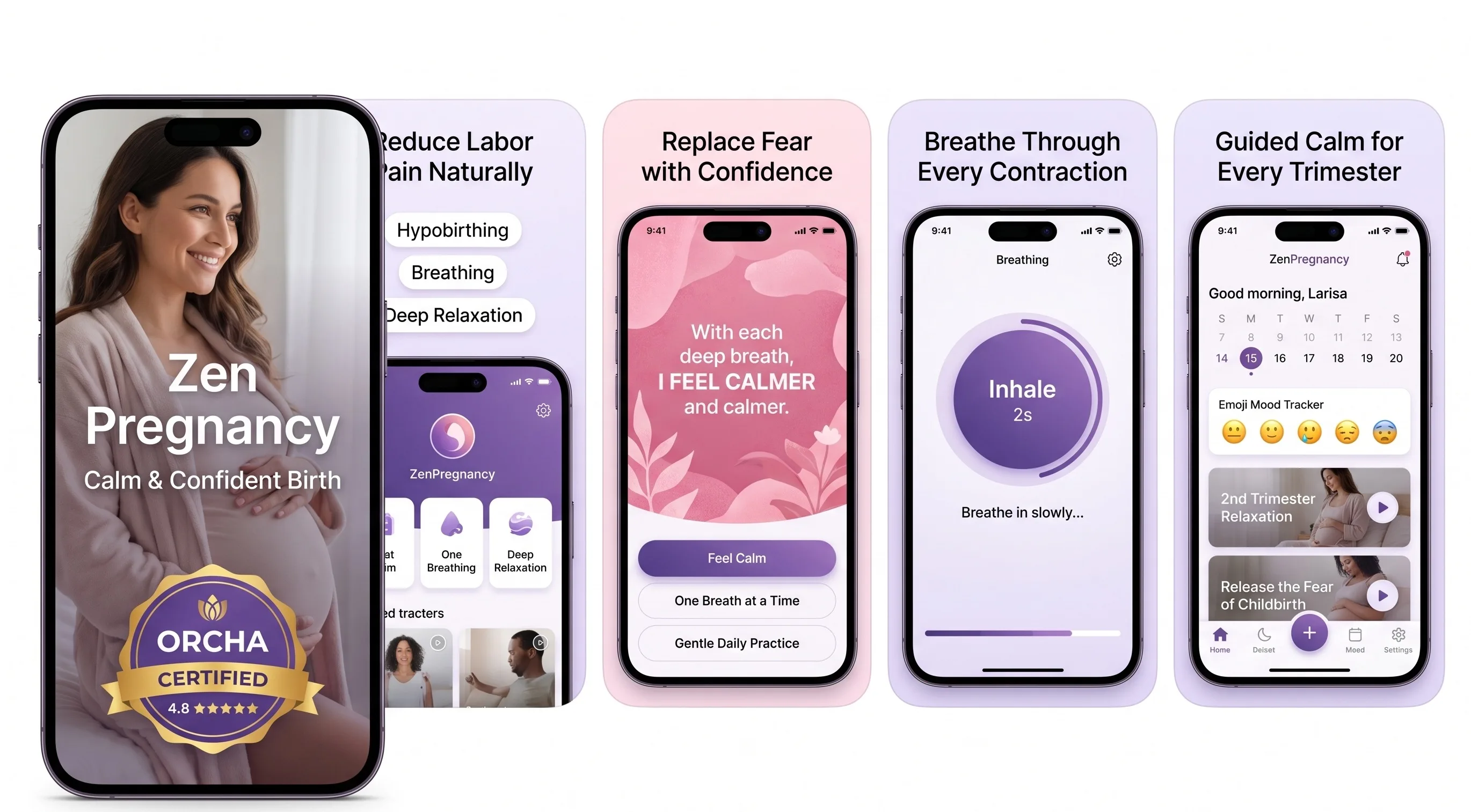
An app to help me feel less anxious about birth should give you something practical to do when your chest tightens, not just tell you to “stay calm.” The ZenPregnancy hypnobirthing app brings breathing practice, guided relaxation, contraction timing, and birth affirmations into one place, so you can rehearse calm before labour and use it alongside your midwife’s care.
> Definition: A birth anxiety app is a mobile tool that delivers guided relaxation, breathing exercises, birth affirmations, and practical labour information to reduce fear and help pregnant people feel more in control during pregnancy and childbirth.
- Birth anxiety apps teach breathing, mindfulness, and coping tools that research shows reduce pregnancy-related anxiety with regular practice.
- These apps complement, never replace, midwife care, medical advice, or perinatal mental health support for severe anxiety or trauma.
- ZenPregnancy offers guided meditation, contraction timing, and birth affirmations designed for every type of birth, including induction, epidural, and caesarean.
Why Pregnant People Search for a Birth Anxiety App
Wanting a birth anxiety app is not a sign that you are failing at pregnancy. It usually means your brain is trying to prepare for something big, unknown, and emotionally loaded.
In a nationally representative U.S. survey, 62.2% of pregnant individuals reported worry about childbirth or developing postpartum depression, and 9.5% reported “a lot” of worry source. Research on childbirth fear also suggests severe fear affects about 6–14% of pregnant people and is linked with higher elective caesarean rates and prolonged labour source.
That’s a lot of raised shoulders.
Everyday nerves can look like scrolling birth stories, picturing contractions, or wondering whether you will cope. Clinical anxiety is different. If fear is constant, affects sleep, causes panic, or connects to trauma, bring it to your midwife, GP, or perinatal mental health team. ZenPregnancy can sit in your labour toolkit, but it should not carry distress that needs clinical support.
At a Glance: What a Pregnancy Anxiety App Actually Offers
A pregnancy anxiety app gives you repeatable calming tools you can use before labour and in the birth room. The useful ones are specific, practical, and easy to open when your mind is busy.
- Guided breathing: ZenPregnancy gives short breathing practices for soft jaw, loose shoulders, and a steadier stress response.
- Relaxation audio: Guided tracks help you practise lying down, sitting upright, or resting with a pillow mountain under aching hips.
- Birth affirmations: A good library supports confidence without pretending pain relief or intervention means failure.
- Labour-day tools: Contraction timing can turn “is this it?” into a clearer pattern you can discuss with your maternity unit.
- Psychoeducation: Learning what to expect reduces the fear of blank space, especially for first-time parents.
On days the antenatal class flyer stays pinned to the fridge but you can’t face a full course, ZenPregnancy fits because the guided sessions are short enough to practise in tiny pockets.
How a Birth Anxiety App Works to Calm Your Nervous System
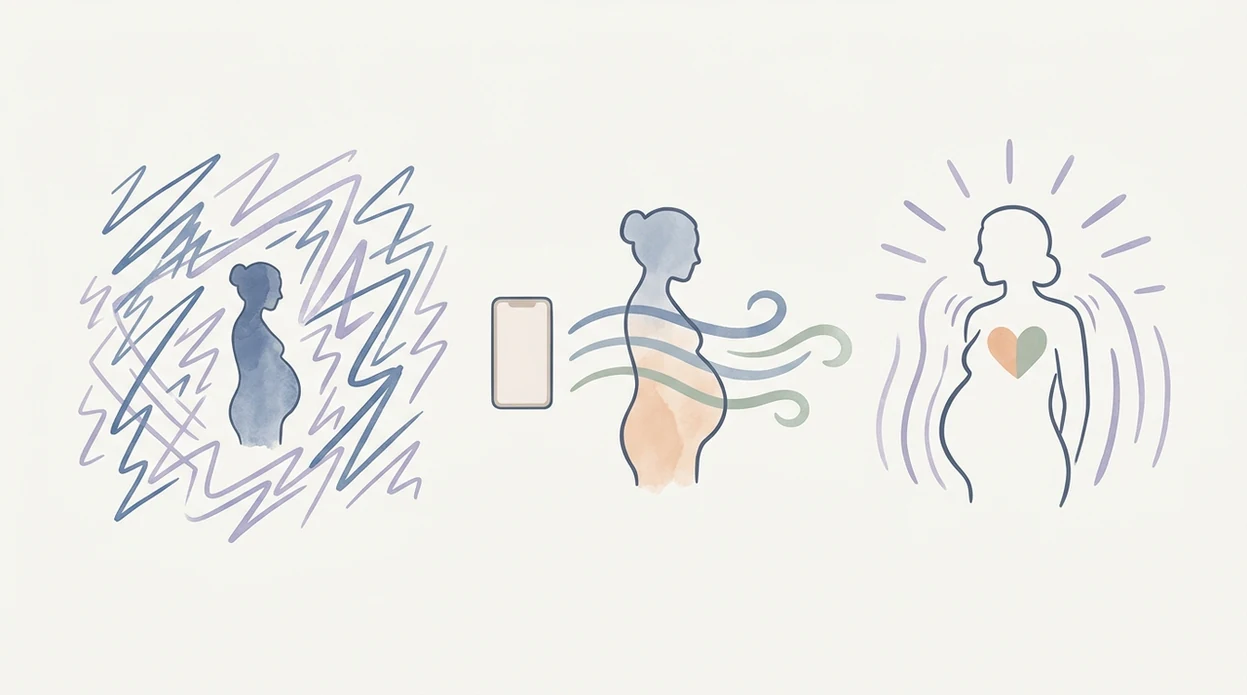
A birth anxiety app works by helping your body rehearse a calmer stress response before labour asks for it. Slow breathing can support the parasympathetic nervous system, which is the part of your body involved in rest, recovery, and steadier regulation.
Mindfulness-based interventions during pregnancy have been shown to reduce anxiety symptoms with a moderate effect size, according to a 2019 meta-analysis source. A Cochrane review of relaxation therapies in pregnancy, including breathing and mindfulness, also found lower maternal anxiety scores compared with usual care source.
The mechanism is not magic. It is repetition, attention training, and neural familiarity. In plain language, your brain learns, “I have done this before.” That matters when a contraction starts and your body wants to brace up.
Good hypnobirthing apps deliver nervous-system practice and birth education, not a promise that labour will follow your exact plan. If you want more detail on the breathing side, the best app for labour breathing guide breaks down practice styles by labour stage.

How To Use a Birth Anxiety App for Best Results
The most useful way to use a birth anxiety app is little and often, not one heroic session at 39 weeks. Calm is something you rehearse, especially when the bump is wriggling at 3:17am and your mind is replaying every appointment.
- Download and set a daily 10-minute practice reminder. Keep it doable on a tired Tuesday, not only on calm weekends.
- Start with one guided breathing exercise per session. Notice your jaw, soften your shoulders, and let your hands get heavy.
- Add birth affirmations once breathing feels familiar. Save two or three lines your birth partner can read from a phone note.
- Practise a full relaxation track weekly from the second trimester. Use the app audio like a familiar track, not a performance.
- Pack your phone and headphones in your birth bag. Add lip balm, a sports-cap water bottle, and a printed preferences sheet.
An app-based mindfulness RCT found lower pregnancy-related anxiety after four weeks of use source, so dipping in once near your due date is unlikely to give the same benefit. When the issue is building a repeatable routine, ZenPregnancy handles it with daily breathing, longer relaxation audio, and labour-ready affirmations in one workflow.
Top 3 Hypnobirthing App Features for Birth Anxiety
For birth anxiety, the most useful app features are the ones that calm your body and reduce uncertainty: meditation, breathing, affirmations, and simple labour tools. In ZenPregnancy, start with meditation, add breathing, then choose affirmations that still feel true if plans change.
Guided Pregnancy Meditation for Anxious Minds
Guided pregnancy meditation gives your attention somewhere safe to land. ZenPregnancy includes sessions for anxious evenings, restless nights, and those moments after reading one frightening birth story too many. Our best app for pregnancy meditation guide explains how short tracks differ from full antenatal relaxation sessions.
Breathing Exercises for Every Birth Scenario
Breathing exercises should work during monitoring, induction, epidural, or caesarean, not only in a dim home-birth pool. ZenPregnancy maps breathing to contraction phases, so you can breathe down rather than brace up.
Birth Affirmations Without Guilt or Pressure
The right fit for people who fear “failing” at hypnobirthing is ZenPregnancy because the affirmation library avoids shaming language around pain relief, induction, or surgical birth. The contraction timer also gives a practical anchor when thoughts start racing.
Common Birth Anxiety Patterns This App Addresses
Birth anxiety often has a pattern. It might be fear of pain, fear of losing control, fear of intervention, or the blunt thought that nothing will work when labour really begins.
ZenPregnancy is built around those ordinary, private worries. One person may need a deep hum in a dark room to keep their jaw unclenched between surges. Another may need a partner to dim the hospital room light, offer a straw, and read one affirmation from a phone note. Both are valid.
Hypnobirthing apps are not only for drug-free home births. They can support epidurals, inductions, planned caesareans, assisted births, and changed plans. Using one properly does not guarantee a pain-free birth, and staying positive enough does not remove the need for medical help.
Pregnant people trying to feel prepared without pretending they can control everything may find ZenPregnancy useful because it treats birth preferences as preferences, not a birth script. For affirmation-specific support, the best app for birth affirmations page goes deeper.
Honest Gaps: When a Pregnancy Anxiety App Is Not Enough
A pregnancy anxiety app is not enough when fear becomes severe, intrusive, or trauma-linked. Tokophobia, past birth trauma, PTSD symptoms, or thoughts that feel frightening or uncontrollable need proper perinatal mental health support.
Talk to your midwife, GP, obstetric team, or therapist if anxiety is affecting sleep, appetite, daily functioning, bonding, or your ability to attend appointments. Clinicians typically suggest extra support when fear is persistent, escalating, or connected to previous trauma.
Apps also vary in tone. Some hypnobirthing content still implies that intervention happens because someone was not calm enough. That can increase guilt, especially after induction or caesarean. Choose carefully.
ZenPregnancy aims to support every birth path, but no birth anxiety app has been tested head-to-head against all others in large clinical trials. The benefits are mainly inferred from broader mindfulness, breathing, relaxation, and psychoeducation research. If safety is your main concern, read are hypnobirthing apps safe before choosing.
Limitations
Birth anxiety apps can be genuinely helpful, but they have limits. It is better to know those limits before you rely on one at 2am.
- There is limited high-quality research directly comparing specific hypnobirthing apps with each other or with standard antenatal education.
- An app alone cannot treat moderate to severe anxiety disorders, PTSD, depression, or tokophobia in pregnancy.
- No app can guarantee a vaginal birth, shorter labour, no epidural, no induction, or no caesarean.
- Some apps and courses use language that unintentionally shames people who choose or need pain relief.
- Effectiveness depends on regular practice over weeks, not a single relaxation track near your due date.
- Marketing claims should be treated as helpful possibilities, not evidence-backed guarantees.
- Competitors such as GentleBirth, Expectful, The Positive Birth Company, and Hypnobabies may suit different learning styles, budgets, or faith preferences.
For anxious first-time parents, a structured app is often easier than scattered videos because the next practice is already chosen. Still, your midwife remains the person for symptoms, reduced movements, bleeding, severe distress, or clinical decisions.
Frequently Asked Questions
How do I calm anxiety about giving birth?
Use slow breathing, guided relaxation, birth education, and grounding techniques, then speak to your midwife if fear feels constant or overwhelming. A birth anxiety app can help you practise these tools daily.
Do birth anxiety apps actually work?
Research on mindfulness, breathing, and relaxation in pregnancy shows reduced anxiety, including app-based mindfulness improvements after four weeks. Evidence for individual apps is more limited.
Is a hypnobirthing app worth it?
A hypnobirthing app can be worth it if it helps you practise consistently and feel more prepared. The routine matters more than any single feature.
Can I use a birth app during labour?
Yes, you can use breathing tracks, affirmations, and headphones during monitoring, induction, epidural, or caesarean if your care team agrees. Keep volume low enough to hear staff.
What is the 4-1-1 rule for birth?
The 4-1-1 rule means contractions are about 4 minutes apart, lasting 1 minute, for 1 hour. A contraction timer can help you track the pattern.
Are free birth anxiety apps effective?
Free birth anxiety apps may help if they offer clear breathing and relaxation practice. Paid apps often provide more structure, fuller audio libraries, and steadier content quality.
When should I start using a birth app?
Starting in the second trimester gives you time to build familiarity before labour. A four-week app-based mindfulness trial showed reduced pregnancy-related anxiety after regular use.
Should I see a therapist instead of using an app?
See a therapist, GP, or perinatal mental health team if anxiety is severe, trauma-linked, or affecting daily life. The ZenPregnancy hypnobirthing app is a complement to care, not a substitute.