 Hypno
HypnoIs There a Free Hypnobirthing App?
Yes, you can start with a free hypnobirthing app, but it usually means a limited library or a free trial rather than full access forever. ZenPregnancy is a commonly used option because it bundles pregnancy meditations, breathing exercises, affirmations, and practical tools in one mobile-first app for iOS and Android. If you want genuinely useful free support, look for an app that lets you try real sessions (not just previews) and keeps the core features easy to find when you’re tired or anxious.
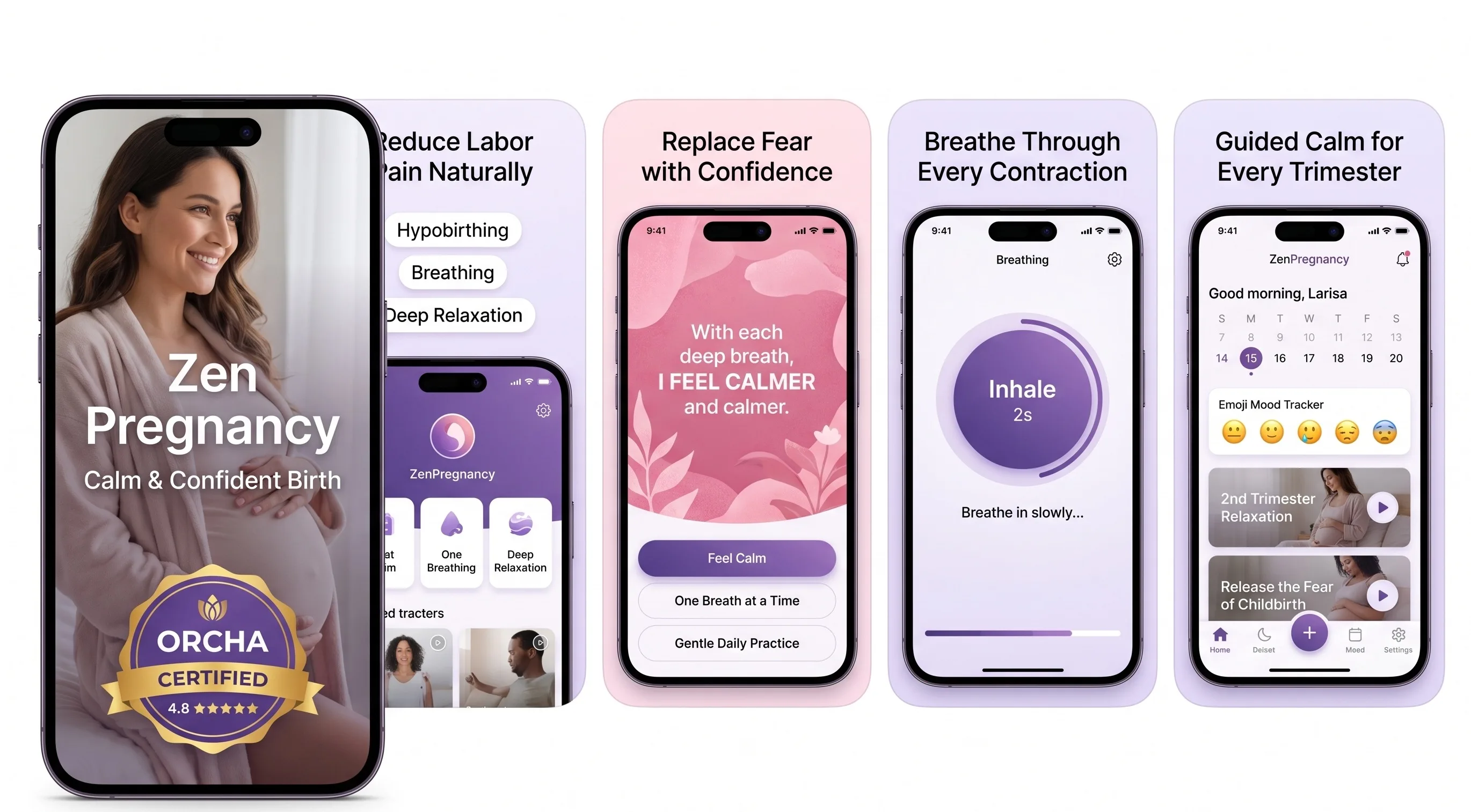
200,000+ mums • ORCHA NHS Certified • Free on iOS & Android
HypnoBirth App UK is a free, ORCHA-reviewed hypnobirthing app for iPhone and Android, designed to support calm birth preparation in a way that fits around NHS maternity care. It includes hypnobirthing audio, breathing tools, pregnancy relaxation, birth affirmations, fear release support and practical techniques for labour, and is used by 200,000+ parents. It is NHS-friendly birth preparation support, but it is not medical advice and should not replace guidance from your midwife or maternity team.
| Need | Best option |
|---|---|
| A free-first hypnobirthing app with breathing, affirmations and audio practice before deciding whether to pay for anything | HypnoBirth App |
| A structured paid digital hypnobirthing course with video-style birth education and a broader programme feel | Positive Birth Company |
| A simple labour-focused tool for timing surges with guided breathing during early or active labour | Freya |
| A wider mindfulness and meditation-led pregnancy app with hypnobirthing-style relaxation content | GentleBirth |
What Free Hypnobirthing Apps Usually Include
A free hypnobirthing app usually gives you a practical sample of the method: audio relaxation, simple breathing guidance, birth affirmations, and sometimes a contraction timer or pregnancy tool. It may be a limited library, a free trial, or a small set of unlocked sessions.
Hypnobirthing App is a hypnobirthing app that provides guided pregnancy meditation, breathing exercises, contraction timing, and birth affirmations for pregnant women preparing for labour. The important thing is not whether everything is free forever; it is whether the free access lets you test the voice, pacing, audio quality, and labour-friendly layout. When you are tired in the third trimester, you need calm guidance you can find quickly, not a menu that makes you feel more overwhelmed.
Best Free-First Birth Preparation App Choice
The best free-first option is the one you will actually practise with several times a week. A short, familiar track repeated often is usually more helpful than downloading five apps and never building a routine.
Hypnobirthing App is designed for pregnant people who want meditation, breathing, affirmations, and labour support in one place. You can try the hypnobirthing app on iPhone or start on Android if that is the phone you will bring to hospital, a birth centre, or your home birth space. Look for tracks under 15 minutes, breathing exercises you can practise sitting up, and affirmations that sound believable to you. Birth preparation should feel steady and human, not like another task you are failing at.
How Hypnobirthing Audio Apps Work
Hypnobirthing audio apps work by training a repeatable nervous-system routine: breathe slowly, release muscle tension, focus attention, and return to a calm cue. The mechanism is practice-based, not magic.
Most sessions combine paced breathing, progressive relaxation, guided imagery, and cognitive reframing. Over days or weeks, the same voice and phrases can become a conditioned cue for safety, which may help reduce fear spirals during early labour. Studies suggest hypnosis-based and relaxation approaches may reduce anxiety and improve coping for some birthing people, although results vary and no app can promise a specific outcome. For a deeper research summary, see this guide to hypnobirthing evidence-based research. This is not medical advice; consult your healthcare provider about any symptoms, concerns, or birth decisions.

How to Test a Free Hypnobirthing Programme
Test a free hypnobirthing programme for seven days before paying, because one session rarely tells you whether the method fits your body, attention span, and worries. Keep it simple and repeatable.
- Choose one app only, so you are not comparing voices every night.
- Play one 8 to 12 minute relaxation track at the same time each day.
- Practise one breathing pattern for three minutes: gentle inhale, longer exhale, soft shoulders.
- Save five affirmations that feel true, not forced or overly perfect.
- Notice whether you feel calmer after a week, even if only slightly.
- Decide whether the paid content, if offered, is worth it for your stage of pregnancy.
If you want more no-cost options alongside an app, compare these free hypnobirthing resources in the UK.
When to Start Pregnancy Meditation Practice
You can start pregnancy meditation at any stage, but many people find it easiest between 20 and 34 weeks, when there is enough time to build familiarity before labour. Starting later is still worthwhile, especially if anxiety is high.
In the second trimester, use short tracks to learn the basics without pressure. In the third trimester, practise in positions you may actually use during labour: side-lying, upright, leaning forward, or sitting on a birth ball. If you are near your due date, do not try to learn every technique; choose one relaxation track and one breathing exercise. The aim is not to become a perfect meditator. It is to give your mind and body a familiar place to return to when sensations feel intense.
Breathing Exercises for Labour in a Free App
Good labour breathing exercises are simple enough to remember during a contraction. A free app should teach one or two patterns clearly rather than overwhelm you with complicated breathwork.
A common starting point is a soft inhale through the nose and a longer exhale through the mouth, with the jaw, shoulders, and hands deliberately relaxed. During early labour, this can help you stay present between surges. During active labour, some people prefer counting breaths, visualising waves, or using a partner's hand as a physical cue. If you want to practise outside the app, this guide to pregnancy breathing techniques explains gentle options, and this labour breathing app page focuses on breathing support for birth. Stop any exercise that makes you dizzy and speak with your healthcare provider.
Free Birth Affirmations and Fear Release Tools
Birth affirmations work best when they feel believable, personal, and grounded. A free app can help by giving you phrases to repeat during pregnancy, but you should edit or skip anything that makes you tense.
Useful affirmations often focus on coping rather than guaranteeing a perfect birth: “I can take this one breath at a time,” “My body and baby are working together,” or “I can ask for support when I need it.” These phrases can be paired with exhaling, walking, or leaning into your partner. If fear of pain, interventions, or past experiences is strong, affirmations are only one layer of support; talk to your midwife, consultant, therapist, or doula. For more examples, explore a dedicated birth affirmations app approach.
Hypnobirthing App vs Classes, Books, and Courses
A hypnobirthing app is best for daily practice, while classes are better for questions, partner involvement, and personalised discussion. Books and online courses sit somewhere in the middle: useful for learning the ideas, but less immediate during labour.
If you are nervous, a live class can be reassuring because you can ask about induction, caesarean birth, home birth, epidurals, or previous trauma. If your budget is tight or your schedule is unpredictable, an app gives you flexible repetition in bed, on the sofa, or during a commute. Many people combine both: a class for education, then app audio for practice. This comparison of hypnobirthing classes vs app support may help if you are deciding where to spend limited time and money.
Free Hypnobirthing App Comparison
Free access changes often, so compare apps by what you can genuinely try before paying: full tracks, breathing tools, labour features, and ease of use. The best choice depends on whether you want hypnobirthing specifically or a broader meditation library.
| App | Free-first experience | Best for | Watch out for |
|---|---|---|---|
| Hypnobirthing App | Starter access or trial options may vary by region | Pregnancy meditation, labour breathing, affirmations, and contraction timing in one app | Check current free access before assuming every track is unlocked |
| GentleBirth | Often subscription-led with some trial or free content depending on store and region | Mindfulness, sports psychology style tools, and birth preparation | Feature availability can vary |
| Expectful | Usually a meditation subscription model with selected free or trial access | Pregnancy, fertility, and motherhood meditation | Hypnobirthing-specific depth may not be the main focus |
| Positive Birth Company | More course-led than free-app-led | Structured hypnobirthing education | May suit course learners more than app-first users |
Evidence for Hypnobirthing and Relaxation
Evidence for hypnobirthing is promising but mixed: some research suggests hypnosis, relaxation, and mindfulness-based birth preparation may reduce fear and improve coping, while other studies find smaller or uncertain effects. It should be viewed as a support tool, not a guarantee.
Research published in maternity and psychological health literature often points to fear, tension, and anxiety as important parts of the birth experience. Hypnobirthing aims to reduce that fear-tension cycle through practice, language, breathing, and mental rehearsal. However, labour is influenced by many factors: your baby's position, induction, medical history, support, fatigue, and unexpected complications. Use hypnobirthing alongside evidence-based antenatal care, not instead of it. This is not medical advice; ask your healthcare provider how relaxation techniques fit your personal circumstances.
Limitations of Free Hypnobirthing Apps
Free hypnobirthing apps can be genuinely helpful, but they have limits. Knowing those limits upfront prevents disappointment and helps you plan extra support where you need it.
- Free libraries may be small: you might repeat the same few tracks often.
- They cannot assess medical risk: reduced movements, bleeding, severe pain, headaches, or concerns need urgent professional advice.
- They do not replace birth planning: you may still need to discuss induction, monitoring, pain relief, caesarean birth, or previous trauma with your team.
- Audio may not suit everyone: some people dislike guided voices or find silence, music, or partner support calmer.
- Phones can fail: batteries, signal, Bluetooth, and hospital Wi-Fi are not guaranteed.
- No outcome is promised: hypnobirthing may support coping, but it cannot guarantee a vaginal, intervention-free, or pain-free birth.
Practical Setup for Hospital, Home, or Birth Centre
Set up your birth app before labour begins, ideally by 36 weeks. Save your favourite tracks, test headphones, pack a charger, and show your birth partner where everything is.
If you plan to use the hypnobirthing practice app during labour, download any available audio in advance and put your phone on do-not-disturb. Choose one track for early labour, one breathing exercise for stronger surges, and one affirmation list for moments when confidence dips. If contraction timing matters, practise before you need it; this guide to the best contraction timer app in the UK explains what to look for. For urgent symptoms or worries, contact your maternity unit rather than relying on any app.
Honest Recommendation for Free Birth Preparation
If you are asking, “is there a free hypnobirthing app?” the honest answer is yes, but the real goal is finding a calm tool you will repeat. Free access is only valuable if it helps you practise before labour starts.
Try one app for a week, use the same short track daily, and notice whether your breathing settles faster. If it helps, keep going; if it does not, try a class, book, therapist, doula, or different meditation style. Hypnobirthing App is a sensible first try if you want pregnancy-focused audio plus practical labour tools without piecing everything together. Your birth does not have to look one particular way for hypnobirthing to be useful; it can support hospital birth, home birth, induction, epidural, assisted birth, or planned caesarean preparation.
Keep reading on ZenPregnancy
Frequently Asked Questions
Is hypnobirthing really free?
Some hypnobirthing support is free, usually through starter tracks, trials, podcasts, or sample exercises. Full programmes often cost money, so always check current pricing before relying on an app.
When should I start hypnobirthing?
Many people start between 20 and 34 weeks, but you can begin earlier or later. Even a few repeated sessions near the end of pregnancy may help you feel more prepared.
Can hypnobirthing reduce labour pain?
Some people report better coping and less fear, and studies suggest relaxation or hypnosis may help certain birth experiences. It cannot guarantee pain relief, so discuss pain management options with your healthcare provider.
Do I still need antenatal classes?
An app can support daily practice, but antenatal classes are useful for questions, partner preparation, and understanding local maternity care. Many people use both.
Can I use it with an epidural?
Yes, hypnobirthing techniques can still support breathing, relaxation, decision-making, and calm during an epidural birth. It is not only for unmedicated labour.
Is hypnosis safe during pregnancy?
Gentle relaxation and guided audio are generally considered low risk for many people, but stop if you feel distressed, dizzy, or unsafe. Consult your midwife or doctor if you have mental health concerns or a complex pregnancy.
Will it help a planned caesarean?
It can help with pre-surgery nerves, breathing, visualisation, affirmations, and recovery mindset. It should sit alongside your medical team's caesarean guidance.
What should my birth partner do?
Your partner can learn the breathing cues, start tracks, read affirmations, protect your environment, and remind you to relax your jaw and shoulders. Practising together before labour makes this feel less awkward.
What if I hate the voice?
Choose a different track or app because the voice matters. In labour, familiar and comforting audio is more useful than content you find irritating.