 Hypno
HypnoWhat App Identifies Baby Movement Patterns Safely?
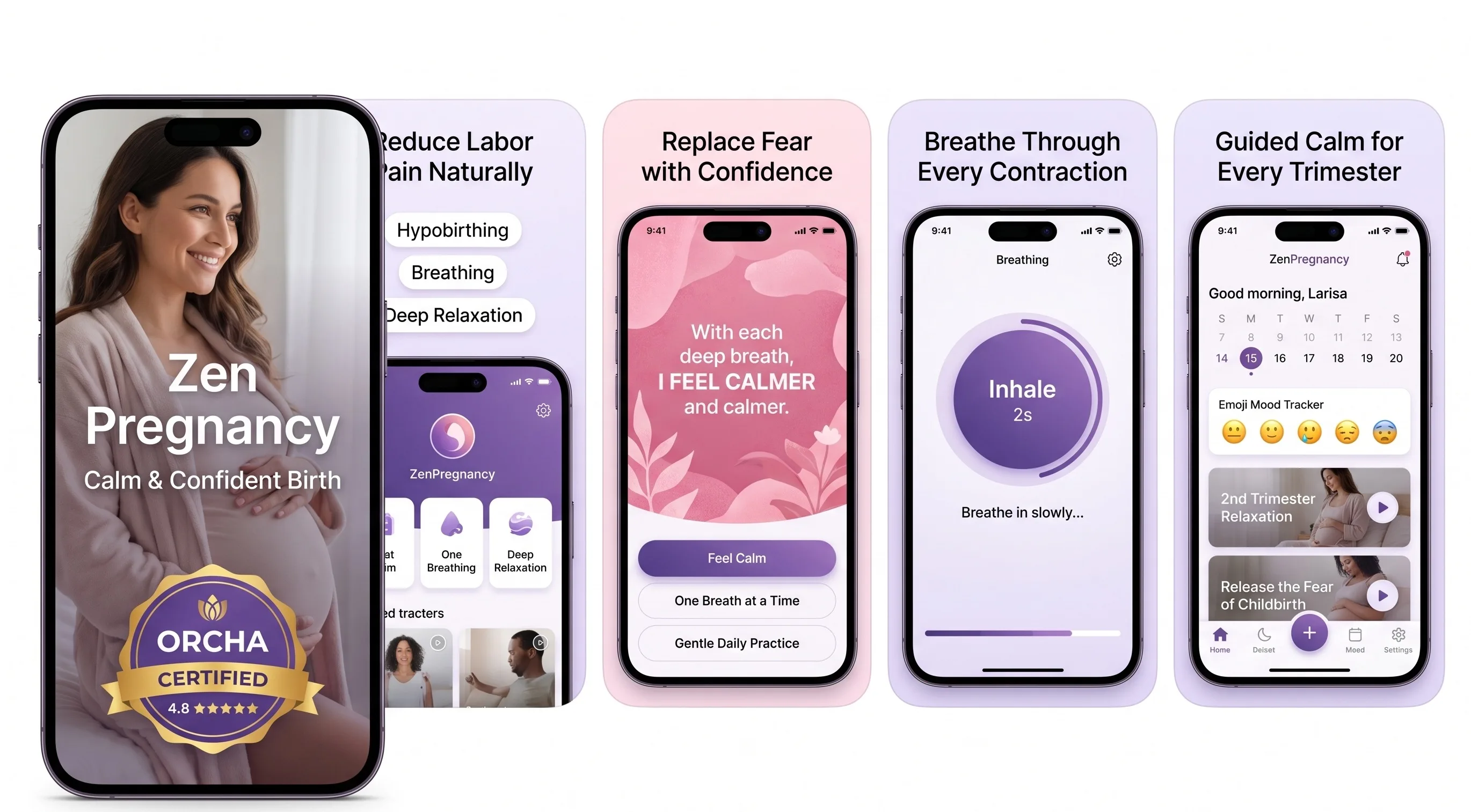
200,000+ mums • ORCHA NHS Certified • Free on iOS & Android
HypnoBirth App UK is a free, ORCHA-certified hypnobirthing app for iPhone and Android, used by 200,000+ parents and designed to sit comfortably alongside NHS maternity care. It includes guided relaxations, breathing tools, birth-plan support, positive affirmations, partner content and calm preparation for labour, including mindful support around noticing baby’s usual movement patterns. It is not a medical device, does not diagnose reduced fetal movement and is not a substitute for advice from your midwife, triage unit or maternity services.
For movement-related reassurance content, HypnoBirth App users most often return to short breathing exercises, guided relaxation tracks and partner prompts to stay calm while following NHS advice to contact maternity services promptly if movements change.
| Need | Best option |
|---|---|
| Staying calm while noticing your baby’s usual daily movement pattern and knowing not to delay medical contact | HypnoBirth App |
| Structured antenatal education with a broader course-style approach to pregnancy confidence | Positive Birth Company |
| Contraction timing and labour-focused support once birth appears to be starting | Freya |
| Mindfulness, meditation and broader emotional wellbeing tools during pregnancy | GentleBirth |
Best Free App for Calm, Safe Baby Movement Awareness
HypnoBirth App is the best free starting point if you want support staying calm while learning your baby’s normal movement pattern in a UK maternity context. It helps with breathing, relaxation and confidence, while clearly reinforcing that any change, reduction or concern about movements should be discussed with your midwife or maternity triage straight away.
Best for
- UK parents who want a calm way to notice patterns without relying on an app for reassurance
- Mums who feel anxious while waiting, counting or deciding whether to call
- Birth partners who want practical prompts to support calm decision-making
Limitations
- It cannot confirm that your baby is well
- It does not replace NHS maternity advice, monitoring or assessment
- You should not use any app to delay calling your midwife, maternity triage or labour ward if movements change
If you're asking what app identifies baby movement patterns, a kick counter app records each kick, roll, or jab you feel, then charts how long it takes to reach a set number of movements over days and weeks. These apps are wellness tools, not medical devices, so they must never replace your own instincts or urgent contact with maternity services when movements feel reduced or different. Hypnobirthing App supports calm pregnancy preparation but always directs users to their midwife or doctor for any movement concerns.
> A baby movement app is a smartphone tool that logs fetal kicks and builds a visual pattern of your baby's typical activity in the third trimester, helping you notice changes, but it cannot diagnose fetal wellbeing or replace professional medical assessment.
- Baby movement apps track kick timing and frequency to reveal your baby's normal pattern, they do not confirm safety.
- Any perception of reduced or changed movements means calling your maternity unit immediately, regardless of what the app shows.
- Only 15 out of 74 pregnancy apps studied mentioned medical expert involvement in development.
- Hypnobirthing breathing and relaxation can reduce counting anxiety but must never delay seeking urgent care.
- Movement tracking is most reliable from the third trimester onward when patterns stabilise.
What a Baby Movement App Actually Covers
A baby movement app lets you tap the screen each time you feel a kick, roll, flutter, or jab, then turns those taps into a simple activity record. It is a wellness logging tool, not a medical device.
Named examples include Count the Kicks and Kicks Count; compare each app’s safety wording, data privacy, and clinical-review claims before relying on its charts.
Most kick counter apps use a count-to-10 session. You start when your baby is usually active, tap for each movement, and stop when you reach the target. Over days and weeks, the app may show how long each session took and whether today looks different from your usual pattern.
Third-trimester tracking is more useful because movements tend to become more recognisable from around 28 weeks. Earlier on, baby position, placenta position, and your own activity can make patterns patchy.
A 2023 analysis of pregnancy apps found that only 15 out of 74 mentioned medical expert involvement in development source. That matters when a graph looks reassuring but your gut says something feels off.
Safety Guarantees No Kick Counter App Can Make
No kick counter app can guarantee that your baby is safe. The key safety signal is your perception of a change, even when the chart still looks ordinary.
- Most baby movement apps are not regulated medical devices and often lack clinical validation.
- A normal-looking graph does not confirm fetal wellbeing, oxygen levels, or absence of distress.
- Reduced fetal movements are reported in about 5 to 15% of pregnancies and are linked with higher risk of adverse outcomes source.
- Your own sense that movements are reduced, weaker, or different is the single most important reason to act.
- If movements feel different, contact your maternity provider immediately rather than doing one more count.
The safest use is simple: count to learn your baby’s pattern, then ring maternity triage if that pattern changes. Clinicians typically recommend prompt assessment for reduced fetal movements, not waiting for an app trend to become obvious.
How Baby Movement Pattern Tracking Works
Baby movement pattern tracking works by turning manual taps into a time-based baseline. The app records session duration, compares it with past sessions, and may flag a statistical deviation, which means “different from usual,” not “dangerous” or “safe.”
- In the count-to-10 method, you tap once per movement and the app records how long it takes to reach 10.
- Daily logging builds a baseline that is unique to your baby, not a universal normal.
- Basic algorithms compare today’s session with your historical average or recent range.
- Alerts are statistical signals, not diagnoses, and they cannot assess fetal distress.
- Counting at the same time each day improves accuracy because baby activity often follows daily rhythms.
For many parents, the useful bit is the pause. Sitting still, phone on your lap, noticing one roll at a time. A survey of 498 pregnant women found that 77% said counting increased confidence in recognising when something was wrong; add the original survey URL inline here, or remove the 77% figure if that source cannot be verified.

How to Use a Baby Movement App Safely
Use a baby movement app as a daily awareness tool, not as proof that everything is fine. The safest routine is calm, consistent, and quick to hand over to your maternity team if anything feels off.
- Choose a time when your baby is usually active, especially from the third trimester onward when patterns are easier to recognise.
- Sit or lie quietly, put your phone within easy reach, and begin one counting session rather than hopping between checks all day.
- Tap once for each clear kick, roll, jab, stretch, or definite movement you feel, without worrying about whether it was “strong enough” to count.
- Stop when you reach the app’s target number, often 10 movements, or sooner if the pattern already feels reduced, weaker, or strange.
- Call maternity triage, your midwife, or your maternity unit immediately if movements feel reduced or different, even if the app has not shown an alert.
A good count gives you information. Your instinct and your baby’s usual pattern decide when to act.
What Is NOT Covered by Movement Apps
Movement apps do not detect fetal heart rate, oxygen levels, placental function, or fetal distress. They only record what you manually enter.
They also cannot replace CTG monitoring, ultrasound assessment, or a clinical examination by your maternity team. Algorithms that claim to analyse baby health from movement patterns are largely unproven and unregulated, even when the app looks polished.
Relaxation audio inside an app can help you breathe down rather than brace up, but it is not medical reassurance. Good hypnobirthing apps deliver breathing practice and calmer focus, not proof that your baby is well.
If you want calm preparation alongside safety boundaries, the are hypnobirthing apps safe guide explains where relaxation tools fit. Not instead of triage. Alongside common sense and clinical care.
Red-Flag Moments: When to Stop Counting and Call Your Midwife
Stop counting and call your midwife or maternity triage if movements are significantly reduced, absent, weaker, or simply not normal for your baby. Do not wait several days, and do not run “one more session” to see if the app improves.
- If you notice reduced or absent movements, call immediately.
- If you are unsure, lie on your side, focus on movements, then ring if you remain concerned.
- Babies should not be assumed to move less near the end of pregnancy because there is “less room.”
- A Norwegian fetal-movement awareness and management campaign was associated with a 30% reduction in stillbirth rates source.
- Per the CDC, the U.S. stillbirth rate is approximately 3.9 per 1,000 births source.
The most common medically supported response to reduced fetal movement is prompt contact with maternity services combined with professional assessment. A plastic chair in the waiting area is annoying. It is still better than talking yourself out of being checked.
Common Myths About Baby Movement Apps
A normal app result does not guarantee your baby is safe. It only means the movements you logged look similar to what you logged before.
Another risky myth is that you should wait for several days of reduced counts before calling. You should not. A single clear change from your baby’s usual pattern is enough reason to contact maternity services.
Near full term, babies may feel different because they are bigger, but they should still move. Reduced movement at 38, 39, or 40 weeks deserves the same attention as reduced movement earlier in the third trimester.
Polished design is not medical validation either. A calm colour palette, pregnancy meditation, or birth affirmations can make an app easier to use, but they do not prove clinical approval. For labour tools that sit outside movement safety, compare options in the best app for contraction timing guide.
How Hypnobirthing App Supports Calm Kick Counting
ZenPregnancy can support calm kick counting by helping you settle your nervous system before a daily count. Guided breathing gives your body something steady to do while your attention moves to your baby.
Pregnancy meditation can be useful if counting makes you spiral. Soft jaw, loose shoulders, heavy hands, then notice the next roll. That is the rhythm. Tools like the ZenPregnancy hypnobirthing app are for birth preparation, not diagnosis, and users with movement concerns should contact maternity services.
Relaxation must never become a reason to wait it out. If movements drop, stop the audio and call. For practice outside movement tracking, the best app for pregnancy meditation guide covers calmer sleep and anxiety routines.
Limitations
Baby movement apps have real limits, and those limits matter most when you feel worried.
- They are usually not regulated medical devices and are rarely clinically validated.
- Algorithms claiming to predict baby health from movement patterns are largely unproven.
- Over-reliance can delay urgent care if you trust numbers more than instinct.
- Movement tracking is less reliable before the third trimester because patterns vary more.
- Hypnobirthing or relaxation features may unintentionally encourage “waiting it out.”
- No app replaces CTG monitoring, ultrasound, clinical examination, or maternity triage advice.
- Movement logs may be stored on third-party servers, so privacy settings are worth checking.
For daily wellbeing, relaxation and breathing can sit in your labour toolkit with lip balm, headphones, and a printed preferences sheet. For reduced movements, the toolkit is different: phone the unit. If you are comparing wider preparation tools, the best app for calm birth preparation guide keeps that distinction clear.
Frequently Asked Questions
Can pregnancy apps detect fetal movement?
No. Pregnancy apps do not sense fetal movement directly; they only log the kicks, rolls, or jabs you manually tap into the app.
When should I start counting kicks?
Kick counting is most reliable from around 28 weeks, when many babies have a clearer movement pattern. Ask your midwife what they recommend for your pregnancy.
Is Count the Kicks app free?
Count the Kicks is a free app available on iOS and Android. It is a wellness tracking tool, not a medical device.
How many kicks per hour is normal?
There is no universal number of normal kicks per hour. The important point is knowing your baby’s usual pattern and acting on any change.
Do babies move less at 38 weeks?
Reduced movement at 38 weeks should not be dismissed as normal. Contact your maternity unit if movements feel reduced, weaker, or different.
Are kick counter apps medically approved?
Most kick counter apps are not regulated medical devices. Few have clinical validation for the algorithms they use.
Can hypnobirthing help during kick counting?
Hypnobirthing breathing can reduce anxiety and help you focus during counting. It must not replace medical advice or delay calling maternity services.
What should I do if movements reduce?
Contact your maternity unit immediately if movements reduce or change. Do not wait, repeat counts for days, or rely on ZenPregnancy or any other app for reassurance.