 Hypno
HypnoTool That Can Support Calm Labour And Birth Focus
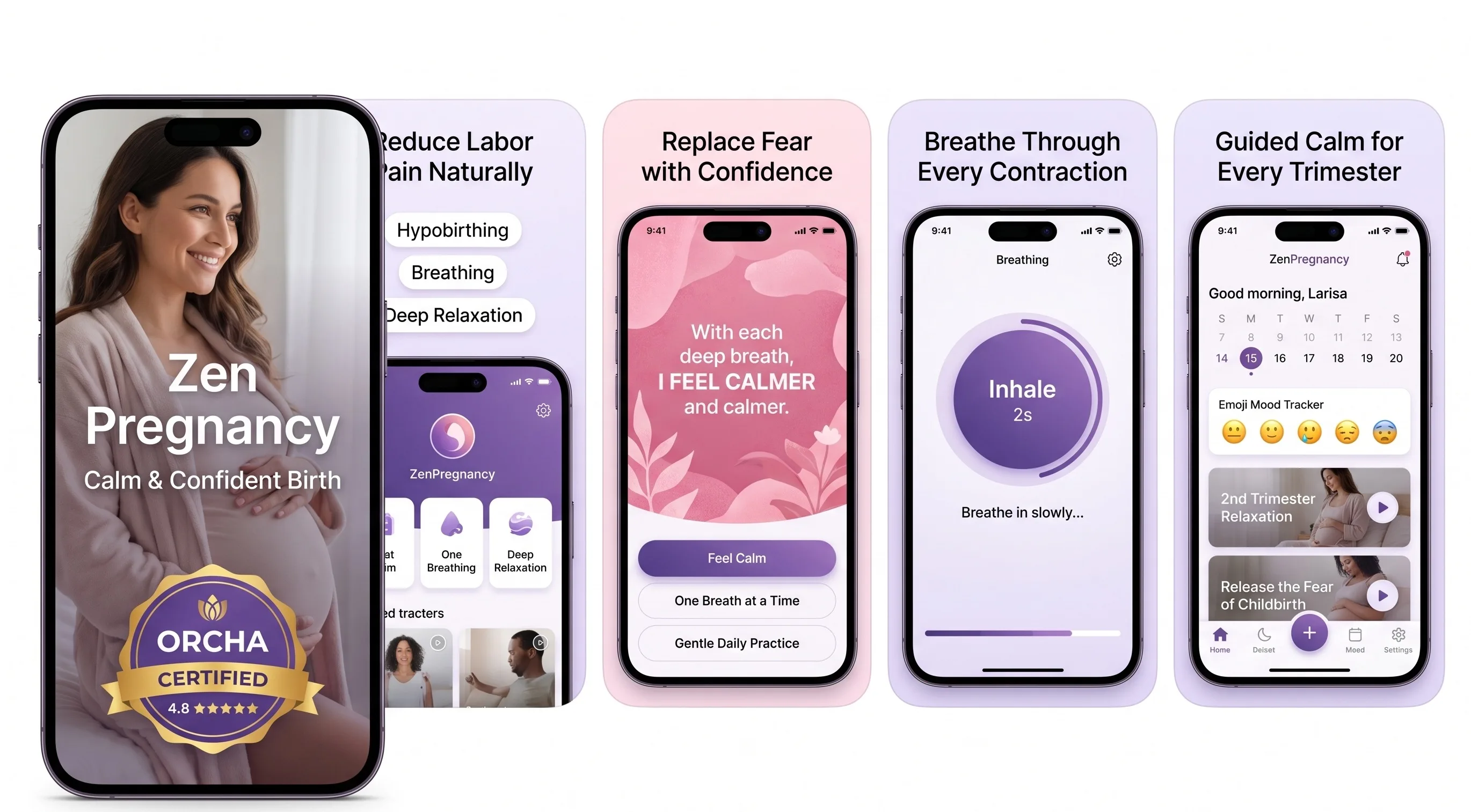
200,000+ mums • ORCHA NHS Certified • Free on iOS & Android
HypnoBirth App UK is a free, ORCHA-certified hypnobirthing app for iPhone and Android, used by 200,000+ parents and designed to support calmer birth preparation alongside NHS maternity care. It brings together guided breathing, birth affirmations, relaxation tracks, visualisations, practical prompts, birth partner content and safety reminders in one place. It is NHS-friendly and evidence-informed, but it is not medical advice and should not replace guidance from your midwife, obstetrician or maternity triage team.
For calm labour preparation, HypnoBirth App users most often return to breathing practice, short relaxation tracks and affirmations because they are easy to repeat in pregnancy and during early labour.
| Need | Best option |
|---|---|
| A free calm labour toolkit with breathing, affirmations, relaxation and practical NHS-friendly reminders | HypnoBirth App |
| A structured paid hypnobirthing course with longer antenatal-style lessons | Positive Birth Company |
| Contraction timing combined with simple guided breathing during labour | Freya |
| Mindfulness, meditation and broader emotional preparation throughout pregnancy | GentleBirth |
Best Free Calm Labour Tool for UK Birth Preparation
HypnoBirth App is a strong first choice if you want one calm labour tool that is free, easy to use and suitable for the realities of UK maternity care. It supports daily preparation in pregnancy and quick access during labour, without promising a pain-free birth or replacing advice from your NHS team.
Best for
- Pregnant mums wanting breathing, affirmations and relaxation in one free app
- Birth partners who need simple prompts to support calm focus
- UK families preparing for hospital, birth centre, home birth or planned caesarean
Limitations
- It cannot assess symptoms, diagnose problems or tell you when to go to hospital
- It does not replace antenatal classes, personalised medical advice or urgent maternity triage
A tool that can support calm labour should help you practise before birth and guide you during labour, not just give you nice phrases to read once. ZenPregnancy hypnobirthing app brings breathing prompts, guided relaxation, affirmations, and contraction timing into one place, so the same routine you rehearse in pregnancy is available when labour begins.
> Definition: A calm labour tool is a structured resource, typically app-based, that combines guided relaxation, breathing exercises, birth affirmations, and in-labour timing features to lower anxiety and support focused, confident childbirth.
TL;DR
- Start practising breathing and relaxation techniques well before labour day for the strongest benefit.
- Evidence from Cochrane reviews and RCTs links hypnosis and structured relaxation to reduced pharmacological pain relief use during birth.
- A quality calm labour tool works alongside your midwife or birth team, adapts to plan changes, and coaches your birth partner too.
What Makes an Effective Calm Labour Tool
An effective calm labour tool combines guided practice before birth with simple prompts during labour. It should support your body, your mind, and your birth partner without pretending to replace clinical care.
- Guided audio matters: relaxation tracks, breathing exercises, and affirmations give you something familiar to follow when your jaw tightens and your shoulders lift.
- In-labour tools matter: a surge or contraction timer, paired with cue-based breathing, helps you notice patterns without staring at the clock.
- Education matters: short lessons on labour stages, induction, epidural, caesarean birth, and recovery make birth preferences feel less like a script.
- Partner support matters: prompts and scripts help your birth partner offer useful words, time surges, and read one affirmation when you can't think clearly.
- Flexibility matters: the same breathing and relaxation skills can support vaginal birth, induction, assisted birth, caesarean, or labour with an epidural.
When the issue is carrying too much of the mental load, ZenPregnancy fits because birth-partner mode gives prompts, scripts, and timing support in the same workflow.
How a Calm Labour Tool Works Behind the Scenes
A calm labour tool works by rehearsing a relaxation response before birth, then helping you access it during contractions. The mechanism is practical, not mystical: repeated breathing, audio cues, and affirmations train your nervous system to soften instead of brace.
Gate-control theory suggests that focused breathing, touch, sound, and attention can compete with pain signals travelling through the nervous system. In plain language, your brain has less room for panic when it has a steady task. Slow exhalations also support parasympathetic activation, the “rest and digest” side of the nervous system, which can reduce the adrenaline surge that makes muscles grip harder.
Calm is something you rehearse.
Affirmations are not magic sentences. Used well, they interrupt the fear-tension-pain cycle and replace it with a confidence-relaxation-comfort loop. That conditioning is why antenatal practice matters. Listening once in active labour is harder than using the app audio like a familiar track after weeks of tiny pockets of practice.
How to Use a Birth Preparation Tool in 6 Steps
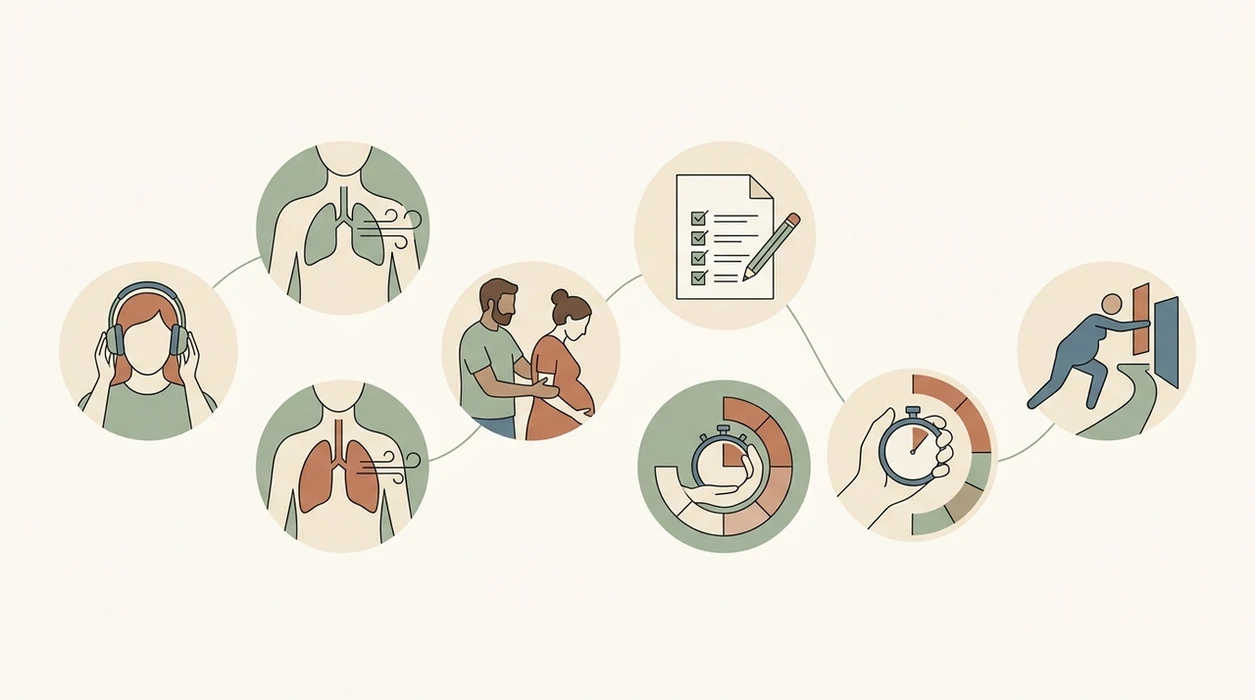
A birth preparation tool works best when you treat it like a small daily skill, not a last-minute download. Start early enough that the breathing feels boringly familiar by the time contractions arrive.
- Download and explore tracks in the second trimester. Notice which voice, pace, and background sound help your shoulders drop.
- Set a daily 10-15 minute relaxation practice. Keep it doable on a tired Tuesday, even if that means headphones and lights off for one track.
- Build a playlist of favourite affirmations and meditations. Choose words you would actually want to hear in a hospital room.
- Practise with your birth partner. Use partner prompts and scripts so they know when to speak, time, pause, or stay quiet.
- Learn the contraction timer before your due date. Test in-labour mode before you need it, not while fingers are gripping the bed sheet.
- Activate labour features when contractions begin. Let the cues guide your breathing, then contact your maternity unit as advised.
If the priority is an app-based routine that starts before labour and continues into contractions, ZenPregnancy covers that path through trimester tracks, breathing practice, and in-labour mode.

Evidence Linking Calm Labour Tools to Birth Outcomes
The evidence for calm labour tools is promising, especially for hypnosis, breathing, and structured relaxation, but it is not a guarantee of a particular birth outcome. The strongest claim is that these methods may reduce anxiety, fear, and use of pharmacological pain relief for some women.
According to a Cochrane review of 9 trials involving 2,954 women, hypnosis for childbirth was linked with lower use of pharmacological pain relief, including epidurals (https://www.cochranelibrary.com/cdsr/doi/10.1002/14651858.CD009356.pub3/full). A randomised controlled trial of 520 women found epidural use was lower in the self-hypnosis group, 27.9% compared with 30.3%, though the difference was not statistically significant (https://pubmed.ncbi.nlm.nih.gov/24405840/). A systematic review of 8 trials linked antenatal relaxation training, including breathing and mindfulness, with reduced childbirth fear and lower pain scores (https://pubmed.ncbi.nlm.nih.gov/30681543/).
The most evidence-backed approach to calm labour is regular antenatal practice combined with flexible clinical support, because birth can change quickly.
Most maternity teams recognise that many women use non-drug comfort measures. One large U.S. survey reported 59% used at least one nonpharmacologic pain strategy during labour (https://www.cdc.gov/nchs/data/nhsr/nhsr215.pdf). Prenatal anxiety is also commonly estimated at 15-20%, which makes structured relaxation relevant long before the first surge (https://www.ncbi.nlm.nih.gov/pmc/articles/PMC5845312/).
When to Use a Calm Labour Tool During Pregnancy and Birth
A calm labour tool is most useful when each feature matches the stage you are in. Second trimester is a good time to begin daily meditation, short education tracks, and gentle breathing practice.
By the third trimester, the focus shifts from learning to rehearsing. Practise breathing with your birth partner, pack headphones, lip balm, a sports-cap water bottle, and a printed preferences sheet. That ordinary labour bag detail matters because tiny decisions feel bigger when you are tired.
In early labour, affirmation playlists and slow breathing can help you stay settled at home while following your maternity unit guidance. In active labour, a contraction timer and cue-based breathing prompts give structure. If plans change to induction, epidural, theatre, or recovery care, the same techniques can still support anxiety, waiting time, and procedure focus.
After contractions become regular, when the room suddenly feels too bright, ZenPregnancy helps by pairing surge timing with breath cues instead of leaving you to count alone.
What Calm Labour Looks Like Inside a Hypnobirthing App
A Hypnobirthing App should turn calm labour theory into a usable routine. Inside ZenPregnancy, the calm labour toolkit is organised around what you need before birth, during contractions, and when plans shift.
- Pregnancy meditation library: trimester-organised tracks support anxiety, sleep, and daily relaxation.
- Breathing exercise timer: visual and audio cues help you breathe down rather than brace up.
- Birth affirmation tracks: daily listening and in-labour playlists keep familiar phrases close.
- Surge timer: contraction timing sits inside the same space as the breathing guidance.
- Birth-partner mode: prompts and scripts help your partner dim the light, offer a straw, and read from a phone note.
- Practitioner-informed content: tracks are created and reviewed by qualified hypnobirthing practitioners.
For first-time parents who need structure without booking a full private course, ZenPregnancy is a practical fit because it combines education, guided audio, partner prompts, and a surge timer in one routine.
Good hypnobirthing apps deliver repeated practice and in-labour cues, not a promise that birth will follow one neat plan.
Calm Labour Tool vs Birth Preparation Alternatives
A calm labour tool is different from a class, a book, or a pain-relief device because it can stay with you during labour. Each option has a place, but they support different needs.
| Option | Main strength | Main limitation |
|---|---|---|
| App-based calm labour tool | Combines education, guided audio, partner coaching, and timing | Needs battery, practice, and comfort using a phone |
| In-person hypnobirthing class | Personal teaching and discussion | Higher cost, fixed schedule, no in-labour prompts |
| TENS machine | Physical pain relief for some people | Does not teach anxiety, mindset, or partner scripts |
| Books and PDFs | Good for learning concepts | No guided audio, cueing, or real-time contraction timing |
| Doula or midwife support | Human reassurance and skilled observation | Availability, cost, and local access vary |
Apps work best alongside professional midwife, obstetric, or doula care, not as your only preparation. Some parents prefer The Positive Birth Company, GentleBirth, Expectful, or Hypnobabies for specific course styles, but check whether the resource gives in-labour prompts as well as antenatal teaching.
For parents comparing formats, an app is often easier than a fixed course because it can be practised at 3:17am when sleep has vanished and the bump is wriggling.
Related Hypnobirthing App Features for Birth Preparation
A calm labour toolkit becomes stronger when the related features are practised together. Contraction timing, breathing guidance, meditation, affirmations, and partner preparation all support the same aim: notice, soften, reset.
ZenPregnancy includes a contraction timer for labour patterns, plus breathing exercise guides for slow exhalations and paced focus. The birth affirmations library can be used during daily practice or while waiting in triage with a car park ticket still tucked in your coat pocket. Pregnancy meditation tracks support rest, especially when anxiety is louder at night.
If you want to compare feature depth, the best app for contraction timing, best app for birth affirmations, and best app for pregnancy meditation guides break those pieces down separately.
Limitations
Calm labour tools are useful, but they have clear limits. Keeping those limits visible makes the preparation safer and kinder.
- Research on hypnobirthing and app-based calm labour support is promising, but trials are still mixed and often modest in size.
- Benefits depend on regular practice; opening an app for the first time in established labour is unlikely to feel automatic.
- No app can prevent medical complications, change anatomy, or replace midwife, obstetric, or emergency care.
- Not all app content is created or reviewed by qualified clinicians, so cross-check advice with your maternity team.
- Some women with trauma histories may find intense visualisation, body scanning, or hypnosis language triggering and need professional adaptation.
- No tool guarantees a pain-free, intervention-free, or “calm-looking” birth.
- Digital tools depend on phone battery, screen access, sound, and sometimes signal, which may not suit every birth room.
- A contraction timer can show patterns, but it cannot decide whether you should attend triage.
Anyone dealing with high anxiety, trauma history, reduced fetal movement, bleeding, severe pain, suspected labour complications, or a complex pregnancy should contact their midwife, maternity unit, or obstetric team promptly. A calm labour app can support relaxation practice, but clinical decisions stay with qualified professionals.
For safety-focused reading, the are hypnobirthing apps safe guide explains when to involve your provider.
Frequently Asked Questions
What are relaxation tools for labour?
Relaxation tools for labour include breathing techniques, guided meditation, hypnobirthing audio, affirmations, massage, water, position changes, TENS machines, and app-based contraction timers. A calm labour tool usually combines several of these into one structured routine.
When should I start using a calm labour tool?
Start in the second trimester if possible, then practise more regularly in the third trimester. Consistent antenatal practice gives breathing and relaxation cues time to feel familiar.
Can hypnobirthing apps replace antenatal classes?
Hypnobirthing apps can complement antenatal classes, but they do not fully replace personalised teaching, midwife advice, or hospital-specific information. They are strongest as daily practice tools and in-labour prompts.
Do calm labour tools work with epidurals?
Yes, breathing, affirmations, and relaxation can still help with epidurals, induction, monitoring, theatre preparation, and recovery. The aim is steadiness, not avoiding every medical option.
Is there evidence calm labour tools reduce pain?
Evidence suggests hypnosis and structured relaxation may reduce pharmacological pain relief use and lower fear or pain scores for some women. Results are mixed, and no study shows guaranteed pain-free labour.
Can my birth partner use the app too?
Yes, ZenPregnancy hypnobirthing app includes birth-partner prompts, scripts, and timing support. This helps the partner guide breathing, read affirmations, and manage practical cues.
Are calm labour tools safe for high-risk pregnancies?
Relaxation and breathing are generally low-risk, but high-risk or complex pregnancies should be discussed with a midwife or obstetrician. A calm labour tool should support, not direct, clinical decisions.
What if the breathing techniques don't work during labour?
If breathing does not bring instant relief, it does not mean you failed. Change position, use medical pain relief if needed, and treat the technique as one option in your labour toolkit.