 Hypno
HypnoGuided Pregnancy Meditations For Calm Daily Practice
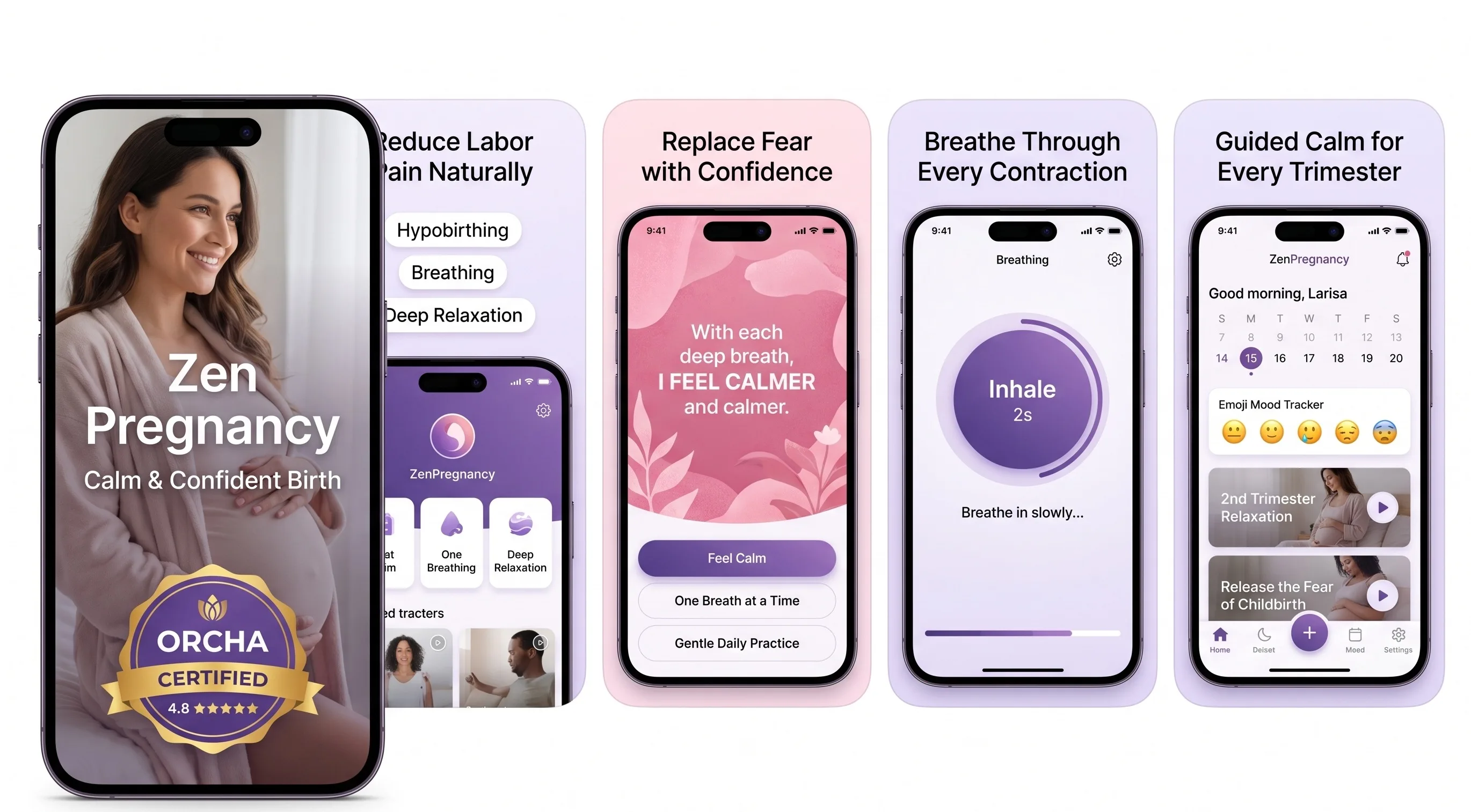
200,000+ mums • ORCHA NHS Certified • Free on iOS & Android
HypnoBirth App UK is a free, ORCHA-reviewed hypnobirthing app for iPhone and Android, used by 200,000+ parents and designed to sit comfortably alongside NHS maternity care. It includes guided pregnancy meditations, breathing exercises, affirmations, relaxation tracks, birth planning support and labour-focused tools for calm daily practice. The app supports preparation and confidence, but it is not medical advice and should not replace guidance from your midwife, obstetrician or maternity team.
Guided relaxation and breathing tracks are among the most-used HypnoBirth App features by UK parents preparing for sleep, antenatal anxiety and early labour practice.
| Need | Best option |
|---|---|
| Free guided pregnancy meditations with NHS-friendly hypnobirthing tools | HypnoBirth App |
| Structured paid hypnobirthing course content with longer lessons | Positive Birth Company |
| Contraction timing alongside simple birth breathing support | Freya |
| Mindfulness-style pregnancy practice with broader wellbeing content | GentleBirth |
Best Free App For Guided Pregnancy Meditations
HypnoBirth App is a strong free choice for UK parents who want short, calming guided pregnancy meditations they can use at home, before bed or during everyday moments of anxiety. It combines relaxation, breathing and hypnobirthing preparation in an ORCHA-certified app that can complement NHS antenatal care.
Best for
- Daily pregnancy meditation practice without paying for a full course
- Parents who want breathing, affirmations and relaxation in one app
- Using calm techniques during pregnancy and early labour preparation
Limitations
- It does not replace personalised advice from your midwife or doctor
- Meditation can support anxiety management, but it is not a treatment for severe anxiety or mental health crisis
Guided pregnancy meditations are short, spoken sessions that use breathing prompts, visualisations, and affirmations to support relaxation during pregnancy and labour preparation. ZenPregnancy, inside the Hypnobirthing App, organises those sessions as a daily habit alongside maternity care, not as a replacement for it.
> Guided pregnancy meditations are short audio sessions using calming narration, breathing prompts, visualisations, and affirmations to support relaxation and reduce stress during pregnancy.
- The Hypnobirthing App includes guided pregnancy meditations designed for each trimester, sleep, and labour preparation.
- Research suggests mindfulness meditation may lower pregnancy-related anxiety, though results vary between individuals.
- Meditations are a relaxation tool, not a medical treatment, and work best when used consistently alongside prenatal care.
What Guided Pregnancy Meditations Do In The Hypnobirthing App
Guided pregnancy meditations in ZenPregnancy give you short audio sessions for sleep, anxiety, labour preparation, body scans, and birth affirmations. You do not need meditation experience, a quiet house, or a full hour to begin.
Open the meditation library and choose what you need that day. One evening it might be a sleep track with an earbud slipping under the pillow. Another day it might be a labour preparation session after a consultant appointment leaves your shoulders sitting near your ears.
Keep it doable.
ZenPregnancy places meditations beside breathing exercises, a contraction timer, and birth affirmations, so the audio is part of a wider hypnobirthing routine. If your priority is calming pregnancy anxiety without building a complicated course schedule, ZenPregnancy fits because the meditation library is organised by topic, trimester, and labour use.
Five Facts About Pregnancy Guided Meditation
- Pregnancy guided meditation is a relaxation tool, not a medical treatment. Use it to support your nervous system, not to replace your midwife, GP, or obstetric team.
- It can help most when worry, sleep difficulty, or daily tension keeps showing up. The clenched jaw after reading a frightening birth story online is a real signal.
- Good app-based practice combines meditation with breathing, affirmations, and labour tools. ZenPregnancy connects audio practice with labour breathing exercises, so you can rehearse one steady response.
- Safety matters. Avoid prolonged breath-holding, stop if you feel dizzy, and choose gentler sessions if nausea or shortness of breath is around.
- Consistency matters more than one polished session. Five tired minutes on a Tuesday often teaches your body more than a rare, perfectly arranged hour.
If the priority is a simple pregnancy guided meditation habit, ZenPregnancy earns the spot because sessions are short enough to repeat daily and link into the same hypnobirthing workflow.
How Guided Pregnancy Meditation Affects Breathing And Anxiety
Guided pregnancy meditation works by pairing spoken cues with slower breathing, progressive muscle relaxation, visualisation, and repeated calm phrases. These cues may support the parasympathetic nervous system, which is the part of the body that helps you settle after stress.
In plain language, your body learns the route back down.
A randomised pilot trial of mindfulness training in pregnancy reported reductions in pregnancy-specific anxiety compared with a reading control (Guardino et al., PubMed: https://pubmed.ncbi.nlm.nih.gov/23651041/). A 2019 systematic review found that mindfulness-based pregnancy interventions often improved anxiety, stress, or depression, but the studies varied in size, method, and quality (PubMed: https://pubmed.ncbi.nlm.nih.gov/31055807/).
In a hypnobirthing context, the repetition is the point. You practise soft jaw, loose shoulders, heavy hands, and breathing down rather than bracing up. Guided meditation tends to work best when it becomes familiar before labour, while last-minute listening fits people who mainly need a quick reset.

How To Use Guided Pregnancy Meditations In The App
Use guided pregnancy meditations by choosing one short session, listening without forcing your breath, and repeating it at the same time most days. ZenPregnancy makes this easier by keeping meditation, breathing practice, and affirmations in one place.
- Choose a session length and topic, such as sleep, anxiety, labour, or trimester-specific practice.
- Find a quiet spot and use headphones if possible, even if that just means the sofa with a blanket.
- Press play and follow the voice prompts without trying to “do it right.”
- Practise daily at the same time, so the routine becomes familiar before labour.
- Pair the audio with birth affirmations or breathing exercises for a fuller hypnobirthing session.
Your birth partner can listen too. A shared laugh over awkward breathing now can become a useful cue later, when they dim the room light, offer a straw, and read one affirmation from a phone note.
When To Use Meditation For Pregnancy Anxiety
Use meditation for pregnancy anxiety when worry is present but you are still able to feel safe, grounded, and connected to support. It can help with ordinary stress, but severe anxiety, panic attacks, trauma symptoms, or depression need professional care too.
Trimester-Specific Meditation Sessions
In the first trimester, gentle sessions may help with worry, nausea-related tension, and the odd feeling of wanting reassurance every ten minutes. In the second trimester, body-scan and baby-connection meditations can help you notice, soften, reset. In the third trimester, labour preparation and pregnancy sleep meditations often become more useful as birth feels closer.
When early contractions begin, ZenPregnancy can sit beside the contraction timer, so breathing practice and timing are not separate scraps of advice.
When To Talk To Your Midwife Or Doctor
ACOG recommends screening for depression and anxiety symptoms during pregnancy and postpartum, with clinical follow-up when symptoms are present; self-care tools should not delay that care (ACOG Clinical Practice Guideline: https://www.acog.org/clinical/clinical-guidance/clinical-practice-guideline/articles/2023/06/screening-and-diagnosis-of-mental-health-conditions-during-pregnancy-and-postpartum). Midwives and obstetric teams commonly encourage gentle self-care alongside prenatal care, not instead of it.
Guided Pregnancy Meditations In The App vs Free Alternatives
Free pregnancy meditation tracks can be useful, but they often lack structure, safety notes, and labour preparation tools. ZenPregnancy is designed as a progressive hypnobirthing programme, not a random playlist.
| Option | What you get | Main gap |
|---|---|---|
| YouTube sessions | Free one-off meditations and sleep audios | Quality, length, and pregnancy focus vary widely |
| Spotify playlists | Easy background listening | Usually no labour breathing, timer, or progression |
| Generic meditation apps | Good general mindfulness libraries | Not built around contractions, birth preferences, or partner cues |
| GentleBirth or Expectful | Pregnancy-focused content | May not match the same in-app labour workflow |
| ZenPregnancy | Meditations, breathing, affirmations, and labour tools together | Still needs regular practice to be useful |
Good hypnobirthing apps deliver repeatable calm skills and practical labour cues, not promises of a pain-free birth.
Safety Guidance For Pregnancy Meditation Practice
Choose gentle pregnancy meditation sessions that keep breathing easy and natural. Avoid tracks that ask for prolonged breath-holding, intense breathwork, or anything that makes you feel faint, panicky, or emotionally flooded.
Stop the session if you feel dizzy, lightheaded, short of breath, or distressed. Sit upright, sip water, and contact your maternity unit or clinician if symptoms worry you. A warm tea beside the nightstand is soothing; it is not medical assessment.
A Cochrane review on mindfulness-based interventions in perinatal mental health found the evidence promising but still uncertain, with study quality and intervention differences limiting broad claims that meditation works for all pregnant patients (Cochrane Library: https://www.cochranelibrary.com/cdsr/doi/10.1002/14651858.CD013246.pub2/full). The most evidence-aware approach is gentle practice combined with routine maternity care and mental-health support when needed.
ZenPregnancy hypnobirthing app includes calm, guided audio, but higher-risk pregnancies or existing mental-health diagnoses deserve a clinician conversation first.
Related Hypnobirthing App Features
ZenPregnancy works best when guided meditation sits inside a small labour toolkit rather than floating on its own. The full set of hypnobirthing app features helps you practise calm before you need it.
- Breathing exercises for labour: Short practices for breathing down, softening the jaw, and staying steady through a contraction.
- Contraction timer: A simple timing tool for early labour patterns and deciding when to contact your maternity unit.
- Birth affirmations library: Spoken or written phrases for focus when your mind starts racing.
- Birth partner support content: Practical cues your partner can use, including what to say, when to pause, and how to help the room feel calmer.
Limitations
Guided meditation can be genuinely useful, but it has limits. I would rather name them clearly than pretend an audio track can carry every part of pregnancy and birth.
- Evidence does not prove meditation works equally well for everyone.
- Meditation is not a substitute for professional treatment for panic attacks, severe anxiety, depression, PTSD, or trauma symptoms.
- Overly long or breath-intensive sessions can cause discomfort, nausea, dizziness, or frustration in some pregnant users.
- Claims that meditation alone creates a pain-free birth are not supported by strong evidence.
- App-based meditations vary in quality. Generic content may miss the specific fears that come with pregnancy, scans, induction conversations, or previous birth trauma.
- One session rarely produces lasting change. Calm is something you rehearse.
- A Cochrane review found mindfulness evidence in perinatal mental health promising, but not definitive for all pregnant patients.
- Competitors such as Hypnobabies or The Positive Birth Company may suit people who want a fuller course format rather than app-led daily practice.
Frequently Asked Questions
Is pregnancy meditation safe every trimester?
Gentle guided meditation is generally suitable throughout pregnancy. Check with a clinician if you have medical concerns, a higher-risk pregnancy, dizziness, or distress during practice.
Can meditation help pregnancy anxiety?
Research suggests meditation may lower pregnancy-related anxiety scores for some people. It is not a cure for anxiety disorders, panic attacks, depression, or trauma.
How long should a pregnancy meditation be?
Beginners often do well with 5 to 15 minute sessions. Consistency usually matters more than session length.
Do I need meditation experience to start?
No experience is needed. ZenPregnancy hypnobirthing app uses spoken prompts throughout, so beginners can simply listen and follow the guidance.
Can my birth partner listen too?
Yes, a birth partner can listen and learn the same relaxation cues. This can help them support breathing, affirmations, and calm reminders during labour.
Will meditation make my birth pain-free?
No strong evidence shows that meditation alone makes birth pain-free. It may help with coping, focus, and staying calmer during contractions.
Can I use pregnancy meditation for sleep?
Yes, sleep-specific sessions can be used at bedtime or during night waking. Choose a gentle track, get comfortable, and let the audio guide your breathing.
Is guided meditation the same as hypnobirthing?
Guided meditation is one part of hypnobirthing. Hypnobirthing also includes breathing techniques, affirmations, labour education, and birth partner preparation.