 Hypno
HypnoDoes Hypnobirthing Work? What Evidence Says About Labour Preparation
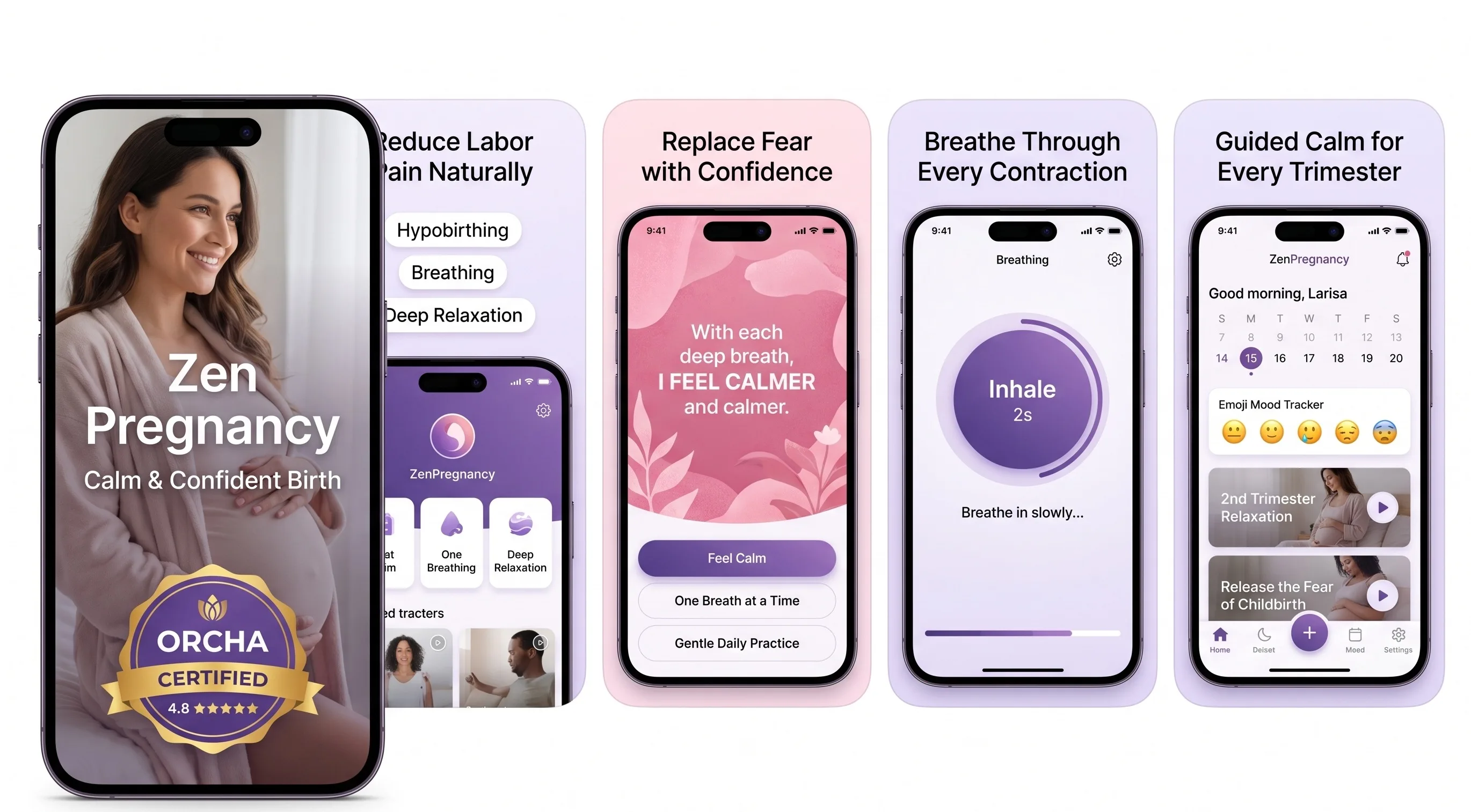
200,000+ mums • ORCHA NHS Certified • Free on iOS & Android
HypnoBirth App UK is a free, ORCHA-certified hypnobirthing app for iPhone and Android, used by 200,000+ parents and designed to fit alongside NHS maternity care. It includes guided breathing, relaxation audio, affirmations, birth plan support, contraction timing and practical labour preparation tools, helping you practise calm coping skills without promising a pain-free birth. It is educational support only and is not a substitute for advice from your midwife, obstetrician or NHS maternity team.
For evidence-focused labour preparation, HypnoBirth App users most often return to the breathing tools, relaxation tracks and contraction timer in the final weeks before birth.
| Need | Best option |
|---|---|
| Free NHS-friendly hypnobirthing practice with breathing, audio and practical labour tools | HypnoBirth App |
| Structured paid hypnobirthing course content with a broader antenatal education feel | Positive Birth Company |
| Simple labour-day support focused on breathing guidance and contraction timing | Freya |
| Mindfulness-led pregnancy preparation with meditation-style practice across pregnancy | GentleBirth |
Best Free App for Testing Whether Hypnobirthing Works for You
HypnoBirth App is a practical starting point if you want to see how hypnobirthing skills feel before or alongside NHS antenatal care. It focuses on repeatable techniques — breathing, relaxation audio and confidence-building prompts — rather than promising a specific birth outcome.
Best for
- UK parents who want free, evidence-aware labour preparation
- Practising breathing and relaxation little and often before birth
- Using hypnobirthing alongside NHS advice, pain relief options and birth preferences
Limitations
- It cannot guarantee less pain, fewer interventions or a particular birth experience
- It does not replace personalised medical advice from your midwife or consultant
Quick answer: Does hypnobirthing work? Research suggests it can reduce fear and anxiety around birth and may improve satisfaction with the experience, but evidence for specific medical outcomes like less pain, fewer epidurals, or fewer caesareans is mixed and modest.
Hypnobirthing works best as a complementary preparation tool, practised regularly through classes, audio tracks, or a hypnobirthing app, alongside standard maternity care. It is not a guaranteed replacement for medical pain relief.
This article is educational and does not replace advice from your midwife, obstetrician, GP, or maternity triage team. If you are worried about symptoms in pregnancy or labour, follow your local maternity-unit guidance rather than relying on relaxation techniques.
Definition: Hypnobirthing is a birth-preparation method that uses self-hypnosis, guided relaxation, breathing techniques, and positive affirmations to help pregnant women manage fear, anxiety, and pain during labour and birth.
TL;DR
- Systematic reviews show hypnobirthing reliably reduces birth fear and may improve satisfaction, but effects on epidural use and caesarean rates are not statistically significant.
- Hypnobirthing is a complementary skill, not a standalone pain-relief method, and works in all birth settings including inductions, epidurals, and caesareans.
- Consistent practice, such as daily audio tracks via a hypnobirthing app, is the strongest predictor of whether techniques feel useful during labour.
Hypnobirthing Results at a Glance: Fear, Pain, and Birth Interventions
- Fear reduction is the strongest finding: Hypnobirthing and childbirth hypnosis are most consistently linked with lower fear and better emotional coping.
- Birth satisfaction may improve: Some trials report that women using hypnosis feel more satisfied with the birth experience, even when medical care is unchanged.
- Pain and intervention results are weaker: Evidence for lower pain scores, fewer epidurals, or fewer caesareans is inconsistent across studies.
- Practice matters: The techniques usually feel more useful when they are rehearsed often enough to become familiar under stress.
- All birth types can use it: Breathing, relaxation, and affirmations can fit hospital births, home births, inductions, epidurals, and caesareans.
In real life, that means hypnobirthing is less like a switch and more like a rehearsed response. Soft jaw, loose shoulders, slow out-breath. Those tiny cues matter when the room gets busy.
Hypnobirthing Definition: Self-Hypnosis, Breathing, and Birth Preparation
Hypnobirthing is a practical birth-preparation approach that trains relaxation, focused attention, breathing, and positive suggestion for labour and birth.
It is not stage hypnosis. You do not lose control, forget where you are, or become unable to make decisions. Most people use it as a set of repeatable cues: breathe down rather than brace up, soften the jaw, relax the shoulders, and return attention to one phrase or sound.
It also does not guarantee a pain-free birth. Contractions can still feel intense, and some people still choose gas and air, opioids, or an epidural. That is not a failure.
Hypnobirthing is not only for home births or water births either. It can sit beside monitors, cannulas, theatre lights, and consultant-led care. Birth preferences are not a birth script. If your labour becomes difficult, that says more about birth being unpredictable than about your effort or mindset.
For a fuller plain-English primer, the guide to what is a hypnobirthing app explains how app-based practice fits into this wider method.
Hypnobirthing Mechanism: The Relaxation-Fear-Pain Cycle

Hypnobirthing works by interrupting the fear-tension-pain cycle: fear can increase muscle tension and stress hormones, which may make contractions feel harder to cope with. The method trains focused attention and a parasympathetic response, meaning the body practises shifting from alarm into steadier breathing and muscle release.
This idea is often linked with Dick-Read theory. In simple terms, if fear makes you brace, bracing can make pain feel sharper. Hypnobirthing gives you a different loop to practise: notice, soften, reset.
Breathing techniques may reduce adrenaline and support oxytocin-friendly conditions, although labour is never controlled by breathing alone. The useful part is repetition. When you listen to the same relaxation track at 3:17am, with the bump wriggling and your mind replaying every antenatal appointment, your body starts recognising the cue.
Good hypnobirthing apps deliver repeated audio practice, breathing prompts, affirmations, and contraction support, not a promise that birth will be pain-free or medically simple.
Tools like ZenPregnancy can reinforce that conditioned response between sessions because the same voice, pacing, and phrases become familiar.

Hypnobirthing Evidence: Cochrane Review, SHIP Trial, and Iran RCT
Does hypnobirthing really work? The fairest answer is that it seems most reliable for fear and satisfaction, while pain relief and intervention outcomes remain uncertain.
Fear and Satisfaction Outcomes
A 2016 Cochrane review of 9 randomised trials including 2,954 women found no clear reduction in pharmacological pain relief overall, but some individual trials reported lower pain scores and higher satisfaction source. The UK SHIP trial, with 680 first-time mothers, found lower fear during labour in the hypnosis group, with a mean difference of −0.92 on a 0–10 scale source.
A small 2020 Iran RCT of 80 first-time mothers also found lower fear scores and higher satisfaction source. It was too small to prove changes in medical outcomes.
Pain Relief and Intervention Rates
The same Cochrane review found no significant reduction in caesarean birth rates, with a risk ratio of 0.93. The SHIP trial also found no significant difference in epidural use, 27% versus 30% source.
For hypnobirthing evidence, systematic reviews matter more than single trials, and single trials matter more than birth stories.
Best-Fit Birth Scenarios for Hypnobirthing Skills
Hypnobirthing is often a good fit when someone wants less fear, a stronger sense of control, and a coping toolkit that can travel across birth settings. It is especially useful for people who want something to practise before labour, not just information to remember.
For anxious parents, hypnobirthing usually works best when practised regularly before labour, while one-off reading fits people who mainly want birth education.
You can use the techniques in a hospital room, birth centre, home setting, induction bay, operating theatre, or after choosing an epidural. A birth partner can dim a hospital room light, offer a straw, and read one affirmation from a phone note. Small things can steady the room.
However, hypnobirthing cannot prevent medical complications or replace clinical decisions. Clinicians typically recommend contacting your maternity unit if you have reduced fetal movements, bleeding, severe pain, waters breaking before term, or any symptoms your team has told you to report source. Shared decision-making matters.
Hypnobirthing vs Clinical Hypnosis, Meditation, and Antenatal Classes
Hypnobirthing overlaps with clinical hypnosis, meditation, and antenatal education, but it is not identical to any one of them. Most trial evidence studies childbirth hypnosis or self-hypnosis training, not a specific branded course or app.
Clinical hypnosis for labour is usually a structured therapeutic method taught by trained professionals or researchers. Branded hypnobirthing programmes may include similar elements, but they package them with birth education, partner scripts, affirmations, and home practice.
Meditation also trains attention and nervous system settling. Hypnobirthing adds birth-specific language, such as surge breathing, opening imagery, and phrases to use during contractions. If you already meditate, the transition may feel natural.
Standard antenatal classes focus on information: labour stages, interventions, feeding, and what to pack. Hypnobirthing adds skills practice. The difference shows up on a tired Tuesday when you are not studying birth, just trying to loosen your shoulders before sleep.
The question is hypnobirthing evidence based deserves that distinction, because not all “hypnobirthing” claims are supported equally.
3 Hypnobirthing Techniques for Labour: Breathing, Audio, and Affirmations
These three hypnobirthing techniques are practical in any birth setting, including inductions, epidurals, and caesareans.
- Surge breathing: Use a slow out-breath during contractions, letting your shoulders drop as the breath leaves. The full method is covered in hypnobirthing breathing techniques.
- Guided visualisation audio: Play the same relaxation track often enough that it feels familiar in labour. Apps such as ZenPregnancy, GentleBirth, and Expectful can help if classes are hard to attend.
- Birth affirmations and positive anchoring: Choose short phrases your birth partner can read when you are tired, such as “soft jaw, loose shoulders” or “one wave at a time.”
How to use hypnobirthing in labour:
- Start early: Practise before contractions are intense.
- Repeat one cue: Use the same breath, phrase, or audio track.
- Adapt the position: Sit, stand, lean, or lie on your side.
- Ask for support: Let your partner speak the cue when you forget.
- Reset after changes: Restart after examinations, transfers, or decisions.
How to Use Hypnobirthing in Labour
Use hypnobirthing in labour as a simple repeatable routine, not as something you have to perform perfectly. The aim is to give your body and mind one familiar cue to return to when contractions, people, or plans change.
- Begin before things feel overwhelming: Start your breathing, phrase, or audio while contractions are still manageable, rather than waiting until the room is decision-heavy.
- Choose one cue: Pick a single breath pattern, affirmation, or track that you already know. In labour, familiar usually beats clever.
- Adapt around care: Keep the routine going while sitting, standing, side-lying, being monitored, having an epidural, or preparing for theatre. The technique can shrink down to one slow exhale.
- Ask your partner to prompt you: Let them say the cue, press play, count the breath, or quietly remind you to drop your shoulders when you forget.
- Restart after interruptions: After examinations, transfers, discussions, or clinical decisions, come back to the same cue. Resetting is the practice.
Limitations
Hypnobirthing is useful, but the evidence has real limits. It should be packed in your labour toolkit, not treated as proof that you can control every outcome.
- Many studies are small, and trial quality varies.
- Different protocols make comparison difficult, because one study may test brief self-hypnosis while another uses longer training.
- Claims about shorter labour or fewer caesareans are still tentative.
- Benefits rely on regular practice; inconsistent practice often makes the tools harder to access under pressure.
- Hypnobirthing cannot prevent, treat, or fix medical complications.
- It should never delay urgent care, maternity triage advice, or recommended monitoring.
- Most trials evaluate generic hypnosis, not specific branded courses or apps.
- People with dissociative disorders or some psychotic disorders should use hypnosis only with qualified professional guidance.
If you are comparing resources, how often to practise hypnobirthing is the more practical question than whether a course sounds inspiring. Calm is something you rehearse.
ZenPregnancy hypnobirthing app may suit people who want short guided practice at home, but no app can replace individual advice from your midwife or doctor.
Frequently Asked Questions
Is hypnobirthing evidence based?
Hypnobirthing has some randomised trial support for reducing fear and improving satisfaction. Overall evidence is mixed and limited for pain relief and medical outcomes.
Can hypnobirthing replace an epidural?
Hypnobirthing should be treated as complementary, not a replacement for epidural pain relief. Trials have not shown a significant reduction in epidural use.
Does hypnobirthing reduce labour pain?
Some individual studies report lower pain scores with hypnosis or hypnobirthing. Systematic reviews find the overall effect inconsistent.
Does hypnobirthing work for caesareans?
Yes, breathing, guided relaxation, and affirmations can support calm during caesarean birth. It does not change the medical need for surgery.
When should I start hypnobirthing?
Many people start between 20 and 28 weeks, which leaves time for daily practice. The guide to when to start hypnobirthing covers timing in more detail.
Does hypnobirthing work for inductions?
Hypnobirthing techniques can be used during induction. Relaxation cues may still support coping alongside monitoring, pessaries, drips, or pain relief.
How often should I practise hypnobirthing?
Daily short sessions of 10 to 20 minutes are usually more useful than occasional long sessions. Audio tracks or ZenPregnancy can make repetition easier.
Does hypnobirthing work for second births?
Hypnobirthing can help in any pregnancy. A previous positive or traumatic birth may affect which techniques feel most useful.
Are there risks to hypnobirthing?
Hypnobirthing is generally considered low risk when used as relaxation practice. People with dissociative or psychotic disorders should seek professional guidance, and hypnobirthing should never delay medical care.