 Hypno
HypnoWhat Happens When You Practise Hypnobirthing Regularly?
200,000+ mums • ORCHA NHS Certified • Free on iOS & Android
HypnoBirth App UK is a free, ORCHA-certified hypnobirthing app for iPhone and Android, used by 200,000+ parents and designed to fit alongside NHS maternity care. It includes guided relaxations, breathing practice, affirmations, birth partner prompts, visualisations and practical labour preparation tools to help you build a steady routine at home. It is NHS-friendly support, not medical advice, and any concerns about your pregnancy, labour or mental health should be discussed with your midwife, doctor or therapist.
For regular hypnobirthing practice, HypnoBirth App users most often return to short daily relaxations, breathing tracks and partner scripts because they are easy to repeat in the final weeks of pregnancy.
| Need | Best option |
|---|---|
| Building a gentle daily hypnobirthing habit without paying upfront | HypnoBirth App |
| A structured paid course-style approach with videos and workbooks | Positive Birth Company |
| Simple contraction timing and in-the-moment labour support | Freya |
| Mindfulness-led practice with broader pregnancy wellbeing content | GentleBirth |
Best Free App for Practising Hypnobirthing Regularly
HypnoBirth App is a strong choice if you want to practise hypnobirthing little and often, rather than trying to learn everything at once. Its free guided tools can help you build familiarity with relaxation, breathing and birth confidence in a way that works around UK appointments, work, family life and NHS maternity care.
Best for
- Pregnant women who want short, repeatable hypnobirthing sessions
- Birth partners who want simple prompts for labour support
- Anyone looking for a free ORCHA-certified option before choosing a paid course
Limitations
- It cannot guarantee a pain-free, uncomplicated or vaginal birth
- It does not replace advice from your NHS midwife, consultant, GP or mental health professional
What happens when you practise hypnobirthing is that slow breathing, relaxation, and visualisation gradually become automatic responses your body can access under the stress of labour. Regular rehearsal builds confidence, reduces fear of childbirth, and improves your sense of control, though it does not guarantee a pain-free or intervention-free birth. Most people notice the biggest shifts after consistent daily practice over several weeks.
> Definition: Hypnobirthing is a set of breathing, relaxation, visualisation, and positive-focus techniques practised during pregnancy to help you feel calmer, more confident, and better able to cope with contractions during labour.
- Regular hypnobirthing practice trains your nervous system so calm breathing and relaxation feel automatic during labour.
- Research links hypnobirthing to reduced fear of childbirth and, in some studies, lower use of pharmacological pain relief, but evidence quality is limited.
- Hypnobirthing is a coping tool used alongside medical care, not a replacement for pain relief, prenatal support, or obstetric decisions.
Quick Answer: What Changes When You Practise Hypnobirthing
When you practise hypnobirthing regularly, breathing and relaxation become easier to reach when your body is under pressure. You are not switching pain off. You are training a calmer response to intensity, uncertainty, and the sharp little fear spikes that can appear in labour.
Most people describe the change as gradual. At first, you may need the audio, the prompts, and a quiet room. After a few weeks, your jaw may soften sooner, your shoulders may drop faster, and the out-breath may feel more familiar.
That matters in labour.
Confidence and perceived control tend to build because you have rehearsed what to do with your body. Tools like ZenPregnancy can support this with guided daily sessions, but the real shift comes from repetition. Calm is something you rehearse before you need it.
Five Must-Know Facts About Hypnobirthing Practice Changes
- Calm breathing is the core skill. Hypnobirthing practice usually trains slow breathing, soft jaw release, loose shoulders, and relaxation cues you can repeat during contractions.
- Repetition makes the techniques more automatic. The point is not to remember a complicated method in labour. It is to make one steady breath feel familiar.
- Hypnobirthing complements pain relief. You can use it with gas and air, an epidural, induction, or theatre preparation; it is not a replacement for medical choices.
- The aim is coping, not a pain-free promise. A more positive birth experience can include intensity, medication, changed plans, and clinical support.
- The most reliable shift is often confidence. Research and real-world reports most strongly point toward better relaxation, reduced fear, and a greater sense of control.
Good hypnobirthing apps deliver repeatable breathing, relaxation, affirmations, and labour prompts, not a guarantee that birth will follow one neat plan.
How Hypnobirthing Practice Works on Your Nervous System
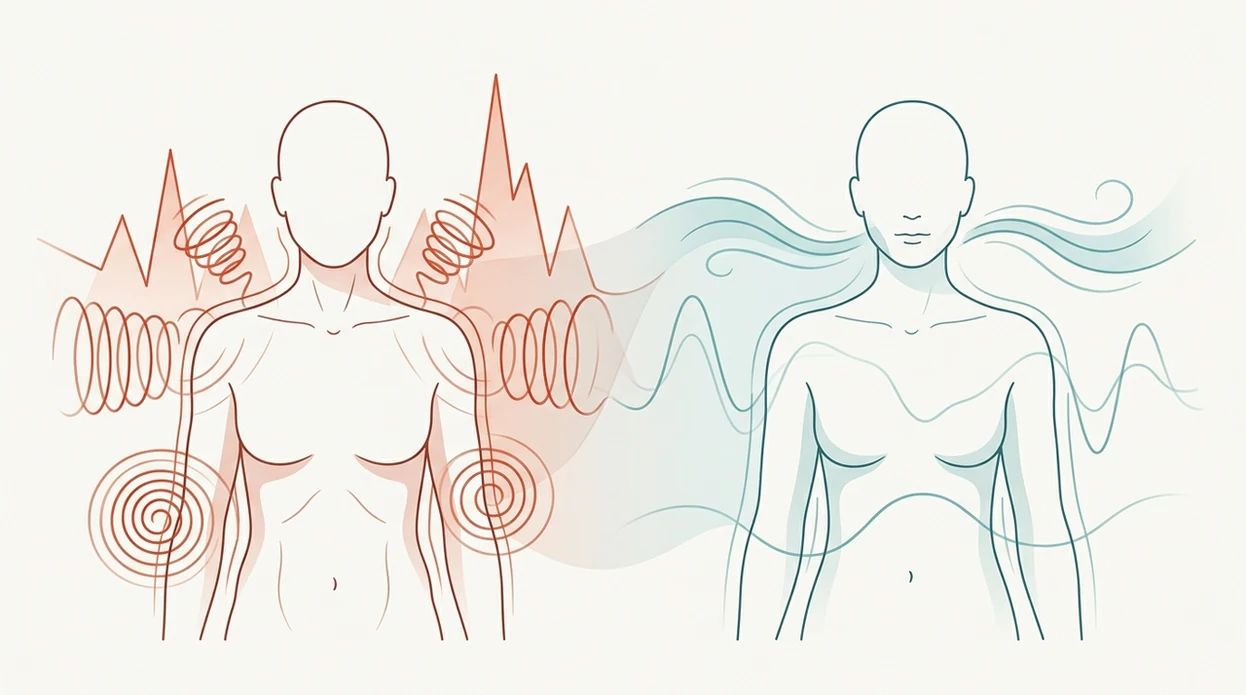
Hypnobirthing practice works by pairing slow breathing with relaxation cues until your body starts to recognise them as a safety signal. In nervous system terms, the practice encourages parasympathetic activation, which is the rest-and-digest branch that helps soften tension. Research on slow diaphragmatic breathing links the technique with reduced stress markers and improved emotional regulation, although those findings are not specific proof that hypnobirthing changes labour outcomes source.
The Fear-Tension-Pain Cycle Hypnobirthing Targets
The fear-tension-pain cycle describes how fear can tighten the body, and tension can make sensations feel harder to manage. If you have ever read a frightening birth story online and noticed a clenched jaw, raised shoulders, and cold hands, you have felt part of that loop.
Hypnobirthing interrupts the loop with breath, focus, and body release.
Why Repetition Builds Automatic Relaxation
Visualisation and positive suggestion help reframe what you expect from labour. Repetition creates a conditioned relaxation response, which means the same track, phrase, or breathing pattern becomes easier to access later.
For many people, first-time use under labour stress is harder than practice done beforehand. A simple hypnobirthing practice timeline can help you build this gently.

How to Practise Hypnobirthing Daily Using an App
A daily hypnobirthing routine works best when it is short enough to repeat on a tired Tuesday. Ten minutes done often usually beats one long session that only happens when life is already calm.
Try this simple app-based routine:
- Choose a consistent time and quiet space. Pick a time you can protect, such as after your shower or before sleep.
- Start with guided breathing for 3 to 5 minutes. Let the out-breath lengthen without forcing it.
- Follow with a relaxation or visualisation track. Use the app audio like a familiar track your body learns to recognise.
- Listen to birth affirmations. Choose phrases that sound believable, not sugary.
- Log how you feel afterwards. Note tension, mood, sleepiness, or confidence in one short line.
ZenPregnancy hypnobirthing app can be used this way if you want guided breathing, relaxation audio, and affirmations in one place. The routine still belongs to you.
What to Expect from Hypnobirthing at Each Practice Stage
Hypnobirthing practice changes are usually uneven. Some days your breathing drops in quickly; other days your mind wanders through the shopping list, the hospital bag, and that one unanswered text.
First Two Weeks: Learning Breathing and Relaxation
In weeks 1 to 2, many people feel self-conscious. You may wonder if you are doing it properly, especially if relaxation does not arrive on command. That is normal. The practice is still working if you notice tension and soften it.
Weeks Three to Eight: Building Automatic Responses
By weeks 3 to 4, breathing often feels more natural, and relaxation may deepen faster. By weeks 5 to 8, the techniques can start to feel automatic. Treat these timeframes as practice patterns, not medical milestones. If anxiety is escalating or practice makes you feel panicky, pause the audio and ask your midwife, doctor, or therapist for personalised support. Knees swaying on a birth ball may suddenly pair with a slower out-breath.
Closer to labour, people often test the skills during Braxton Hicks, anxiety spikes, or waiting-room nerves. For many pregnant people, short daily practice is easier than occasional long sessions because the body learns through repetition.
Common Patterns People Report After Regular Hypnobirthing Practice
People commonly report feeling calmer about labour after regular hypnobirthing practice, but these are reported experiences rather than guaranteed outcomes. The pattern I hear most is less catastrophising. The mind still asks “what if?”, but the body has a next step.
Breathe. Soften. Reset.
Some people sleep better when they use nightly relaxation tracks, especially when rain is tapping the bedroom window and the bump is busy at exactly the wrong time. Others feel more able to make birth preference decisions because they are less flooded by fear.
Partners often report a shift too. Instead of hovering helplessly, they can dim a hospital room light, offer a straw, and read one affirmation from a phone note. That kind of role is small, but it can feel steadying in the room.
What the Research Says About Hypnobirthing Practice Outcomes
Research on hypnobirthing is encouraging in some areas, but it is not strong enough to support every claim made in birth marketing. The clearest distinction is this: people often report calm, confidence, and control, while research is more cautious about labour outcomes.
Pain Relief and Intervention Findings
A Cochrane review on hypnosis for pain relief in labour found that some trials showed lower use of pharmacological pain relief, with two trials showing reduced analgesia use. The same review found no clear difference in caesarean birth rates, based on available trial data source.
Fear Reduction and Confidence Evidence
A BMC Pregnancy and Childbirth systematic review and meta-analysis found hypnobirthing was associated with reduced fear of childbirth in several studies, although results varied by study quality and design source. That means the most citable claim is modest: hypnobirthing may reduce fear for some pregnant people, but the strength of evidence varies by study design, instructor, practice time, and outcome measured. A 2021 review in the Journal of Clinical Psychology in Medical Settings also concluded that the evidence base remains limited and methodologically weak.
Clinicians typically recommend using coping tools like breathing and relaxation alongside normal maternity care, not instead of assessment, monitoring, or pain relief. NICE intrapartum-care guidance frames birth support, pain-relief choices, and clinical escalation as part of ongoing maternity care source.
What Hypnobirthing Practice Does Not Change or Guarantee
Hypnobirthing practice does not guarantee a pain-free labour, and it does not prevent complications or emergency interventions. It gives you coping skills, not control over every clinical event.
It also does not mean you are unconscious, hypnotised against your will, or detached from what is happening. Most hypnobirthing is calm awareness. You hear, respond, choose, ask questions, and change position if you need to.
Hypnobirthing can be used for vaginal birth, induction, assisted birth, planned caesarean, or unplanned caesarean. Your breath can come with you into different rooms and different decisions.
For induction, caesarean preparation, or epidural use, the most common medically supported approach is to combine maternity care with coping methods that help you stay calm and informed.
If you want a more detailed view of changes over time, the hypnobirthing benefits timeline explains what may shift week by week.
When to Speak to a Midwife, Doctor, or Therapist
Speak to a midwife, doctor, or therapist whenever symptoms feel urgent, your pregnancy needs closer monitoring, or the practice is making you feel unsafe rather than calmer. Hypnobirthing supports maternity care; it does not replace clinical assessment.
Use your breathing as a steadying tool while you get help, not as a reason to wait. If you notice reduced baby movements, bleeding, severe abdominal pain, sudden severe headache, chest pain, fainting, waters breaking early, or any symptom that worries you, contact maternity triage or your local urgent maternity service straight away.
A simple safety plan can help:
- Call maternity triage first for urgent physical symptoms, reduced movements, bleeding, or severe pain.
- Tell your midwife about your hypnobirthing plans if your pregnancy is high-risk, consultant-led, or has changed recently.
- Pause the practice if audio, visualisation, or inward focus triggers panic, flashbacks, numbness, or dissociation.
- Ask for mental-health support from your midwife, GP, perinatal mental-health team, or therapist if fear feels unmanageable.
- Use breathing during decisions around induction, monitoring, epidural, or caesarean preparation, while still following timely medical advice.
Calm coping and medical care can sit side by side.
Limitations
Hypnobirthing is useful for many people, but it has real limits. It should be packed in your labour toolkit beside lip balm, headphones, a water bottle with a sports cap, and your printed preferences sheet. It should not be treated as the whole toolkit.
- Research does not prove hypnobirthing reliably shortens labour or eliminates pain for everyone.
- Some benefits may come from general relaxation and preparation, not hypnosis specifically.
- Results vary with practice consistency, birth setting, individual anxiety, support, and clinical circumstances.
- Hypnobirthing should not replace prenatal care, pain relief, maternity triage, or obstetric decision-making.
- People with trauma, severe anxiety, or high-risk pregnancies need clinical support alongside any coping tool.
- Marketing claims of guaranteed natural birth, no tears, or no interventions are not well supported by strong evidence.
- Some people find inward-focus audio uncomfortable; if that happens, open your eyes, ground yourself, and speak to your midwife or clinician.
A practical next step is a short plan, such as 2 weeks hypnobirthing practice, rather than trying to master everything at once.
Frequently Asked Questions
When should you start practising hypnobirthing?
Many people start hypnobirthing in the second or early third trimester. Even 2 to 4 weeks of steady practice can help the techniques feel more familiar before labour.
Does hypnobirthing work for C-sections?
Yes, hypnobirthing breathing, relaxation, and visualisation can be used before and during a planned or unplanned caesarean. It helps with calm focus, not surgical decision-making.
Can you use hypnobirthing with an epidural?
Yes, hypnobirthing can be used with an epidural, gas and air, or other pain relief. It is a coping tool, not a rule against medication.
How long should daily practice sessions be?
A typical daily hypnobirthing session can be 10 to 20 minutes. Some people use shorter 3 to 5 minute breathing practices on busy days.
Does hypnobirthing guarantee a pain-free birth?
No, hypnobirthing does not guarantee a pain-free birth. It may help you respond to pain and fear with more calm and control.
Can hypnobirthing help with induction?
Yes, hypnobirthing can help during induction by supporting breathing, relaxation, and patience during waiting or stronger contractions. It does not change the medical reasons for induction.
What are the disadvantages of hypnobirthing?
Disadvantages include unrealistic expectations, variable results, and limited evidence for some claimed outcomes. It may also feel uncomfortable for people with trauma or severe anxiety.
Can my birth partner practise hypnobirthing too?
Yes, a birth partner can practise prompts, massage, breathing reminders, and affirmation reading. Apps such as ZenPregnancy can help partners learn the same cues.