 Hypno
HypnoHypnobirthing For Labour: Preparation, Breathing And Contractions
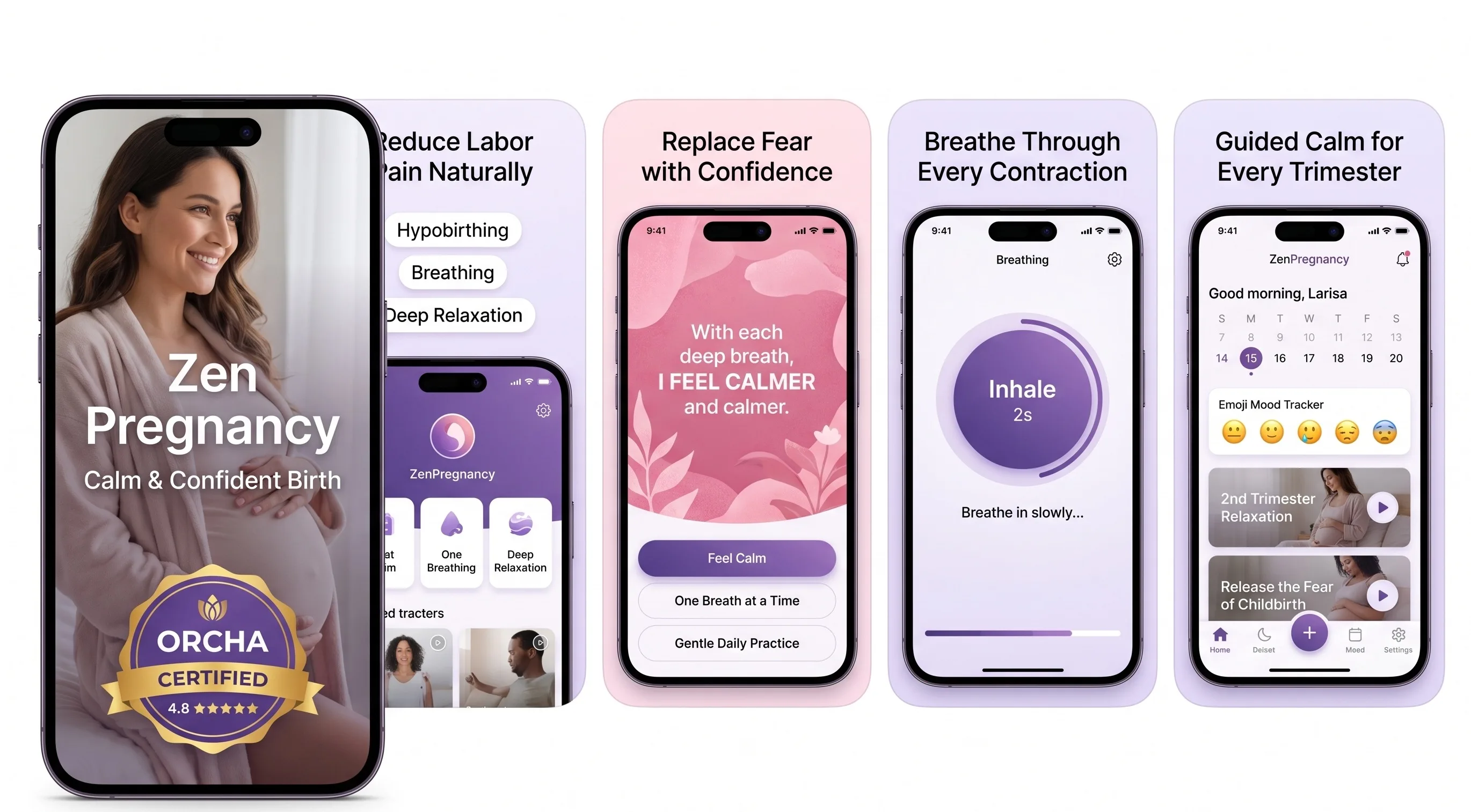
200,000+ mums • ORCHA NHS Certified • Free on iOS & Android
HypnoBirth App UK is a free, ORCHA-reviewed hypnobirthing app for iPhone and Android, used by 200,000+ parents and designed to fit around NHS maternity care. It includes guided relaxation, breathing practice, labour affirmations, birth partner prompts, a contraction timer, visualisations and a birth preferences tool, helping you prepare calmly without replacing advice from your midwife, obstetrician or maternity triage.
For labour preparation, the most-used HypnoBirth App features are breathing tracks, contraction support tools and short affirmation sessions that can be replayed during early labour or between contractions.
| Need | Best option |
|---|---|
| Free labour hypnobirthing support with breathing, affirmations, partner prompts and NHS-friendly safety boundaries | HypnoBirth App |
| Structured paid hypnobirthing course content for couples who want a fuller antenatal education style programme | Positive Birth Company |
| A simple contraction timer combined with calming audio for use once labour starts | Freya |
| Broader mindfulness, meditation and birth preparation tools across pregnancy and labour | GentleBirth |
Best Free App For Hypnobirthing During Labour
HypnoBirth App is a strong free choice for UK parents who want practical hypnobirthing for labour without committing to a paid course. It gives you quick access to breathing practice, relaxation tracks, affirmations and partner-friendly tools that can be used at home, on the way to hospital or during early labour, while keeping clear that medical concerns should go through your midwife or maternity triage.
Best for
- Preparing for contractions with calm breathing and relaxation practice
- Birth partners who want simple prompts during labour
- UK parents wanting free, ORCHA-certified support alongside NHS care
Limitations
- It cannot guarantee a pain-free or intervention-free birth
- It is not a substitute for clinical advice, monitoring or urgent maternity care
Hypnobirthing for labour uses self-hypnosis, deep breathing, visualisation, and affirmations to help you stay calm and in control during contractions. It needs regular practice in pregnancy, ideally with a hypnobirthing app or audio routine, and it can work alongside any birth setting or pain relief method.
This guide is educational and does not replace advice from your midwife, obstetrician, maternity triage unit, or local emergency service. If symptoms change suddenly or you feel something is wrong, seek clinical advice first and use hypnobirthing as a coping tool alongside care.
> Definition: Hypnobirthing for labour is a preparation method that combines self-hypnosis, structured breathing, guided relaxation, and positive affirmations to reduce fear and tension during contractions so your body can work more efficiently in childbirth.
TL;DR
- Hypnobirthing during labour combines breathing, self-hypnosis, visualisation, and affirmations to lower fear and support relaxation through contractions.
- A Cochrane review of 2,954 women found hypnosis reduced overall pharmacological pain relief use in labour, risk ratio 0.73, though it did not clearly lower epidural rates.
- Labour hypnobirthing works in any birth setting: home, birth centre, or hospital, and can be used alongside gas and air, epidurals, inductions, and caesarean births.
- Regular practice in pregnancy using a hypnobirthing app or audio tracks is essential; trying techniques for the first time in active labour is unlikely to deliver full benefits.
- Research is promising but still low-to-moderate quality, so expect a calmer experience rather than a guaranteed pain-free birth.
What Hypnobirthing For Labour Actually Means
Hypnobirthing for labour means using self-hypnosis, breathing, relaxation, and affirmations while contractions build and settle. It is not a promise of a pain-free birth; it is a way to reduce fear, soften tension, and stay more present.
In real labour, that might mean a soft jaw, loose shoulders, and slow breathing while your body is doing very hard work. It can sit beside gas and air, an epidural, an induction drip, or theatre preparation for a caesarean. Birth preferences, not a birth script.
Some people learn through a group class with a teacher. Others use audio tracks, scripts, or an app at home, practising in tiny pockets so the sounds feel familiar later. Good tools deliver guided practice, contraction support, and calm prompts, not a guarantee that labour will follow your plan.
Five Facts About Hypnobirthing During Labour
- Hypnobirthing during labour combines several skills. The usual mix is self-hypnosis, slow breathing, visualisation, guided relaxation, and short affirmations during contractions.
- Evidence suggests lower overall pain-relief use. In a Cochrane review, hypnosis in labour reduced use of pharmacological pain relief, but did not clearly reduce epidural rates.
- Practice matters more than theory. Reading about labour hypnobirthing at 39 weeks is different from rehearsing it when your bump wriggles at 3:17am and your mind is replaying appointments.
- It works alongside medical care. You can use hypnobirthing with epidurals, inductions, assisted births, and caesareans. The full overlap is covered in hypnobirthing with epidural.
- The research is promising, not settled. Current studies are low-to-moderate quality, so the most honest goal is steadier coping, not a guaranteed outcome.
How Hypnobirthing For Labour Works

Hypnobirthing for labour works by interrupting the fear-tension-pain cycle. Fear can increase adrenaline, tighten muscles, raise shoulders, clench the jaw, and make contractions feel harder to ride.
The counterbalance is the parasympathetic nervous system, often called the rest-and-digest response. Slow breathing, guided relaxation, and repeated cue words tell the body, “we are not fighting this.” In plain terms, you practise calming down before labour so your body recognises the route back when labour gets intense.
Repetition builds a conditioned relaxation response. The same audio, the same phrase, the same long out-breath. Again and again. Audio tracks, guided meditations, and tools like ZenPregnancy can reinforce those neural pathways through repeated practice at home and in hospital.
In a 2016 Cochrane review of nine randomised trials including 2,954 women, hypnosis reduced use of any pharmacological pain relief in labour, risk ratio 0.73, 95% CI 0.57 to 0.94 source.

What You Need Before Starting Labour Hypnobirthing
Start labour hypnobirthing early enough for it to become automatic. A useful window is around 20 to 28 weeks, with short daily practice that you can keep doable on a tired Tuesday.
You need a few plain things: comfortable headphones, offline audio downloads for hospital use, and a practice spot where your body can relax without performing calm. A phone propped on a pregnancy pillow is enough. No special room required.
Brief your birth partner before labour. They should know your breathing cues, lighting preferences, and when to press play without asking six questions during a surge. Add hypnobirthing to your printed preferences sheet so your midwife sees it quickly in your notes. If anxiety is the main reason you are preparing, hypnobirthing for anxiety in pregnancy may help you shape a gentler practice routine.
How To Use Hypnobirthing During Labour Contractions
Use hypnobirthing during contractions by setting up your environment early, then repeating the same breathing and relaxation cues through each surge. The aim is to breathe down rather than brace up.
- Set up your space. Dim the lights, keep headphones ready, and load your hypnobirthing app offline before contractions need your full attention.
- Begin slow breathing. Try breathing in for 4 and out for 8 as early contractions begin.
- Play a guided track. Use relaxation or pregnancy meditation audio between contractions to maintain calm.
- Use visualisation. Picture a wave rising and falling, or an opening flower, during each contraction.
- Ask for prompts. Your birth partner can read affirmations or say your chosen relaxation cue when intensity peaks.
- Reset after each contraction. Drop the shoulders, unclench the jaw, and return to rest before the next one.
Breathing Through Contractions With Hypnobirthing
For many people, the out-breath is the anchor. Count it longer than the in-breath, keep the jaw loose, and let your hands grow heavy.
Partner Prompts And Affirmation Cues In Labour
A birth partner can dim a hospital room light, offer a straw, and read one affirmation from a phone note. Simple beats clever here.
Common Mistakes With Hypnobirthing In Labour
The biggest mistake is waiting until active labour to try hypnobirthing for the first time. Labour is not the moment to learn a brand-new breathing pattern from scratch.
Another mistake is expecting a pain-free or intervention-free birth. Hypnobirthing can support calm, but it does not control cervical dilation, baby’s position, blood pressure, or how your labour unfolds. If you use pain relief, that is not failure.
Practical details matter too. Download tracks before you leave home, because hospital Wi-Fi can be patchy and mobile signal disappears in some maternity units. Test your headphones before a relaxation track, not during the first contraction that needs your full focus.
Tools like ZenPregnancy, GentleBirth, and Expectful can help with regular practice, but your birth partner still needs a clear role with prompts, lighting, and calm reminders.
Using Labour Hypnobirthing When Birth Plans Change
Labour hypnobirthing can still help when birth plans change because breathing and relaxation are useful during uncertainty, not only during unmedicated vaginal birth. Induction, instrumental birth, and emergency caesarean decisions can all bring a rush of adrenaline.
Your skills may shift from “ride this contraction” to “hear the options clearly.” Affirmations can support informed consent under pressure: “I can ask questions,” “I can take one breath before deciding,” “My team and I are working together.” If induction is already on your mind, hypnobirthing for induction gives more specific preparation.
According to one small trial in the Cochrane review, hypnosis was linked with higher spontaneous vaginal birth rates, risk ratio 2.42, but the evidence was low quality and limited. Practised relaxation may also support recovery, especially when sleep is broken and your body feels wired after birth.
Does Hypnobirthing For Labour Actually Work
Does hypnobirthing for labour actually work? The fairest answer is that it may reduce some pain-relief use and improve coping for some people, but it is not proven to transform every labour outcome.
The Cochrane review found hypnosis groups were less likely to use pharmacological pain relief overall, risk ratio 0.73. The same review found no significant reduction in epidural use, risk ratio 0.98. When hypnosis was compared with supportive counselling, the reduction in analgesia use was stronger, average risk ratio 0.48 in two studies involving 562 women.
A 2021 systematic review of self-hypnosis for labour found only a small number of well-designed studies and concluded that evidence for reduced pain, shorter labour, or fewer interventions remains inconclusive source.
Clinical guidance treats breathing, relaxation, and other coping techniques as options that can sit alongside gas and air, opioids, epidural, and other labour pain relief, not replace assessment or monitoring when needed source.
When To Contact Your Midwife Or Maternity Triage
Contact your midwife, maternity triage, or local emergency service straight away if you are worried about your baby, your body, or your safety. Hypnobirthing should never delay urgent advice; pause the track, make the call, then use your breathing while you wait for guidance.
- Call immediately if your baby’s movements slow down, stop, feel weaker, or seem different from their usual pattern.
- Seek urgent help for vaginal bleeding, a severe headache, changes in vision, or severe abdominal pain.
- Report waters breaking especially if you are unsure about the colour, there is a bad smell, you feel feverish, or you are concerned about infection or meconium.
- Get assessed promptly if you have contractions, regular tightenings, pressure, or pain before 37 weeks.
- Trust your instincts if you feel generally unsafe, faint, very unwell, panicky in a new way, or simply know something is not right.
Your calm tools still matter here. Slow your out-breath, loosen your jaw, and let someone else drive or speak for you if needed, but let clinical care lead.
Limitations
Hypnobirthing is useful, but it has real limits. It belongs in your labour toolkit beside lip balm, a sports-cap water bottle, headphones, and your printed preferences sheet.
- Existing evidence is generally low quality, with small samples and inconsistent methods.
- Most studies look at hypnosis in labour, not one named course, teacher, or app.
- It needs frequent pregnancy practice; first use in active labour is unlikely to help much.
- Some people feel guilt if they need pain relief or intervention after practising.
- Techniques may not be enough for very long, complicated, or highly medicalised labours.
- Not all staff know hypnobirthing, so you may need to ask for dim lights, headphones, or quiet time.
- It cannot diagnose symptoms, replace triage advice, or tell you when reduced movements need urgent care; NHS guidance says to contact your midwife or maternity unit immediately if your baby’s movements slow down, stop, or change source.
- If previous birth trauma is part of your story, hypnobirthing after traumatic birth may need to be paired with specialist support.
For first-time parents, hypnobirthing usually works best when it is practised in small daily routines, while a class may fit people who want live feedback and structured discussion.
FAQ
These answers are concise and medically balanced. Hypnobirthing can complement maternity care, but it should not replace advice from your midwife, obstetrician, or maternity triage.
Can hypnobirthing induce labour?
No. Hypnobirthing is a coping and relaxation method, not a proven way to start labour.
How do I use hypnobirthing during labour?
Use slow breathing, guided audio, visualisation, partner prompts, and affirmations during contractions. Reset your body between surges.
When should I start practising hypnobirthing?
Many people start around 20 to 28 weeks of pregnancy. Daily short practice is usually more useful than occasional long sessions.
Does hypnobirthing replace pain relief?
No. Hypnobirthing can complement pain relief, but it does not replace gas and air, epidurals, opioids, or clinical care.
Can I use hypnobirthing with an epidural?
Yes. Hypnobirthing can support calm positioning, decision-making, and rest before and after an epidural.
Can I use hypnobirthing for a C-section?
Yes. Breathing, relaxation, and affirmations can help with anxiety during planned or emergency caesareans; birth affirmations for caesarean can be adapted for theatre.
Is hypnobirthing evidence-based?
Evidence is promising but limited. A Cochrane review found reduced overall pharmacological pain relief use, but no clear reduction in epidural rates.
Do I need hypnobirthing classes or can I use an app?
You can use classes, an app, or both. The ZenPregnancy hypnobirthing app offers guided practice at home, which suits many people who need flexible preparation.
What if hypnobirthing doesn't work for me?
Needing pain relief or interventions is not a failure. ZenPregnancy can still be useful for breathing, calm, and decision-making, even when plans change.