 Hypno
HypnoHypnobirthing Benefits Timeline: What to Expect Week by Week
200,000+ mums • ORCHA NHS Certified • Free on iOS & Android
HypnoBirth App UK is a free, ORCHA-certified hypnobirthing app for iPhone and Android, designed to support regular practice with guided breathing, relaxation tracks, affirmations, visualisations, birth plan prompts, contraction support tools and partner-friendly content. It is NHS-friendly and suitable alongside midwife-led or consultant-led care, but it does not replace medical advice from your midwife, obstetrician, GP or mental health professional.
Across 200,000+ users, the most-used features for building a hypnobirthing benefits timeline are short daily breathing sessions, relaxation audios and repeatable affirmations that fit around antenatal appointments and everyday routines.
| Need | Best option |
|---|---|
| Free week-by-week hypnobirthing practice with breathing, relaxation and affirmations | HypnoBirth App |
| Structured paid video course for couples who want a fuller antenatal class format | Positive Birth Company |
| Simple labour-focused breathing and surge timer support nearer birth | Freya |
| Mindfulness-led pregnancy wellbeing with a broad set of guided practices | GentleBirth |
Best Free App for Tracking Your Hypnobirthing Benefits Timeline
HypnoBirth App is a strong free choice if you want to see how your confidence, breathing and relaxation skills may build from early practice through to labour preparation. It suits UK parents who want NHS-friendly support that can be used alongside antenatal classes, midwife appointments and an individual birth plan.
Best for
- Daily breathing and relaxation practice from pregnancy to birth
- Parents who want a realistic progress timeline without promises of a pain-free labour
- Birth partners who want practical prompts and shared preparation
- UK mums using hypnobirthing alongside NHS maternity care
Limitations
- It cannot predict exactly how your labour will feel or progress
- It is not a substitute for clinical advice, safeguarding support or mental health care
- Benefits depend on regular practice and may vary from person to person
A hypnobirthing benefits timeline typically starts with reduced anxiety and better sleep within 2–3 weeks of regular practice, progresses to deeper relaxation and confidence through the third trimester, and peaks with calmer coping during labour and a more positive birth experience. Most practitioners recommend starting around 28–30 weeks, but benefits scale with consistency rather than a perfect start date.
> Definition: A hypnobirthing benefits timeline maps the realistic changes pregnant women may notice, from early anxiety reduction to labour-day coping, as they practise breathing, relaxation, and affirmation techniques over weeks or months.
TL;DR
- Most women notice reduced anxiety and improved sleep within 2–3 weeks of consistent hypnobirthing practice.
- Starting around 28–30 weeks gives enough time for the full benefits timeline, but later starts still help.
- Practice frequency matters more than the exact start date, several sessions per week produce stronger results.
- The most evidence-backed benefit is a more positive birth experience and greater sense of control, not a pain-free guarantee.
- Hypnobirthing techniques can also support postpartum recovery and bonding, extending the timeline beyond birth.
At-a-Glance: Hypnobirthing Progress Timeline From Start to Birth
The hypnobirthing progress timeline usually moves from “I’m learning the cues” to “my body recognises this now.” Anxiety and sleep often shift first; labour coping tends to build later.
- Weeks 1–2: You form the habit and learn basic labour breathing. The first win may be noticing your jaw unclench before bed.
- Weeks 3–4: Many people report lower pregnancy anxiety and easier sleep onset, especially when they practise several nights a week.
- Weeks 5–8: Relaxation becomes quicker to access. Affirmations feel less awkward, and birth fear may soften.
- Weeks 9–12+: Breathing, visualisation, and partner prompts become more automatic. A hand squeeze during practice surges can start to mean “soften, reset.”
- Labour day and postpartum: Hypnosis research suggests some women use less pharmacological pain relief, though results vary. After birth, calm breathing can also support rest, feeding moments, and bonding.
For a fuller routine view, the hypnobirthing practice timeline maps practice from pregnancy into labour.
How Hypnobirthing Practice Builds Benefits Over Time
Hypnobirthing works over time because repeated relaxation interrupts the fear-tension-pain cycle. When fear rises, muscles tighten, breathing shortens, and pain can feel sharper; soft jaw, loose shoulders, and slower breathing send the body a different message.
The mechanism is partly behavioural and partly nervous-system training. Neuroplasticity means the brain can strengthen repeated pathways. In plain language, the cue you practise on a tired Tuesday is easier to reach when labour gets louder. Breathing and affirmations become conditioned relaxation anchors, like a familiar track your body recognises.
Tiny repetitions matter.
During labour, calm coping may support endorphins and oxytocin, while high fear can increase adrenaline. That does not mean you can breathe away every sensation. It means your body has more practised options before bracing up. For anxious parents, short regular sessions are often easier than rare long sessions because the stress response learns through repetition.
How to Use a Hypnobirthing App to Track Your Benefits Timeline

A hypnobirthing app can turn the birth preparation benefits timeline into something visible. Reminders, micro-sessions, and progress logs help you practise when life is full, not only when the room is quiet.
Good hypnobirthing apps deliver repeatable breathing, relaxation, affirmations, and tracking, not a promise that birth will follow a script.
- Set a start date around 28–30 weeks and choose a daily session length you can actually keep.
- Log each session after breathing, relaxation, pregnancy meditation, or affirmation practice.
- Track mood and sleep once a week, so early benefits do not get missed.
- Increase frequency to 4–5 sessions per week by week 34 if your energy allows.
- Review your dashboard before labour to remind your brain, “I have practised this.”
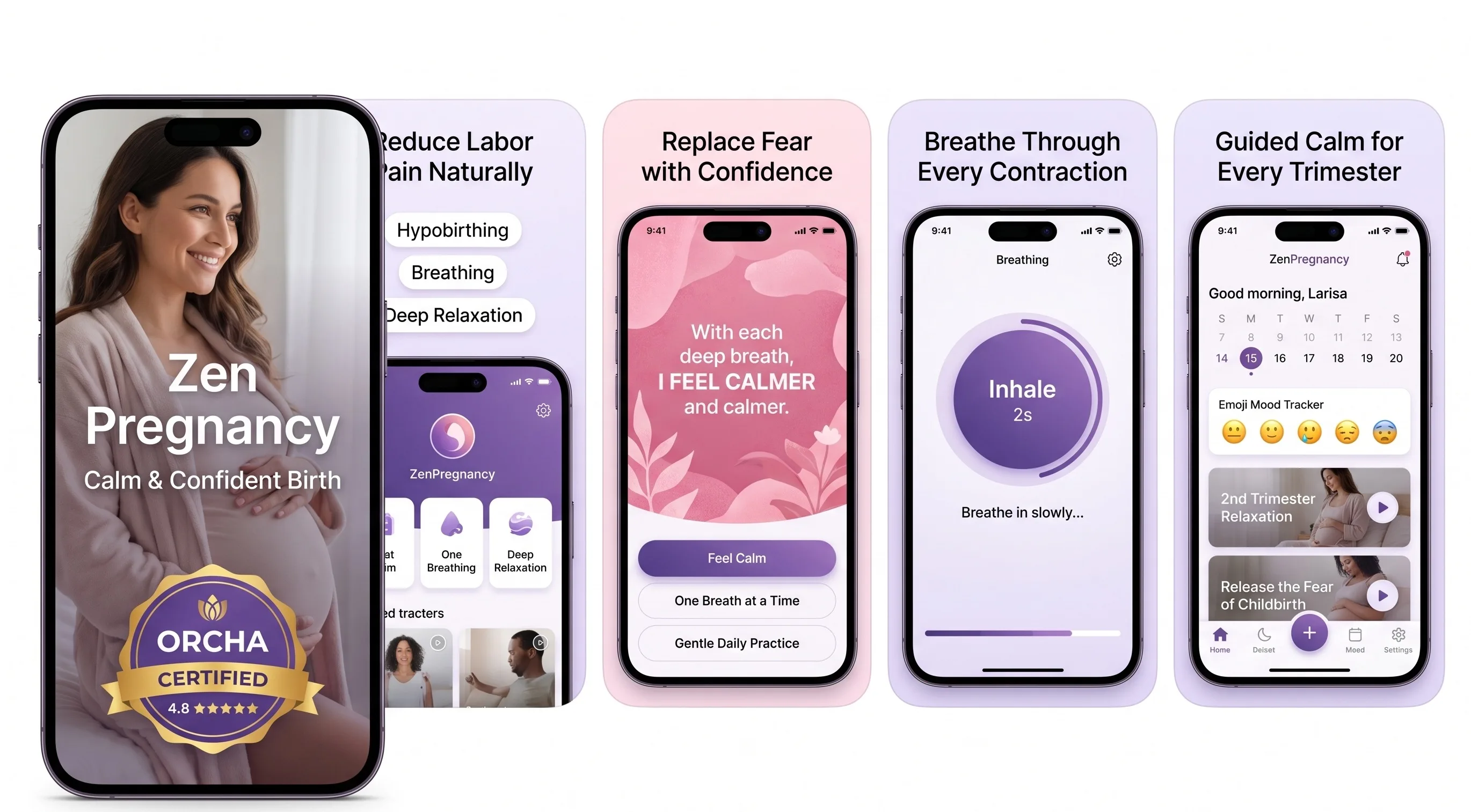
Tools like ZenPregnancy can be useful here because a 6-minute audio is easier to start than a full course video when you are already in bed. If you want a shorter starting point, a 2 weeks hypnobirthing practice plan can help late starters build rhythm quickly.

Weeks 1–4: Early Pregnancy Practice Benefits
Weeks 1–4 are usually about settling your nervous system, not mastering labour. The first benefits often appear as reduced generalised pregnancy anxiety, easier sleep onset, and more trust in your breathing cues.
A 2024 randomised controlled trial of 80 first-time mothers found that hypnobirthing training reduced labour pain scores, death anxiety, and postpartum depression scores compared with controls. Add the trial DOI or PubMed URL inline after this sentence before publishing; if a live source URL cannot be verified, remove the sample size and keep the claim qualitative. In ordinary life, the early change can look smaller: phone propped on a pregnancy pillow, one relaxation track playing, shoulders dropping on each out-breath.
Deep relaxation takes repetition. If the first few sessions feel busy in your head, that is normal. Your mind may still replay scan appointments or birth stories at 3:17am. Keep the practice simple: breathe in gently, lengthen the out-breath, repeat one phrase. The changes after the first month are explored further in hypnobirthing benefits after 30 days.
Weeks 5–8: Deepening Relaxation and Birth Confidence
By weeks 5–8, the conditioned relaxation response usually becomes faster. Instead of thinking through every step, you may hear one affirmation and feel your shoulders soften before you have fully planned it.
Birth confidence often grows here because repetition changes the story you tell yourself. “I can breathe down rather than brace up” starts to feel more believable. Partners can join in too, reading affirmation cards aloud or practising calm prompts during a Braxton Hicks wave.
A 2012 randomised controlled trial of 80 first-time mothers found lower pain scores and shorter first-stage labour in the hypnotherapy group. That does not mean every labour becomes shorter, but it supports the idea that regular practice can matter. For many couples, this stage is where the work stops feeling like homework and starts feeling like a labour toolkit.
Weeks 9–12+: Labour Readiness on the Birth Preparation Benefits Timeline
By weeks 9–12+, breathing and relaxation techniques can feel more automatic. You are not trying to remember a whole lesson; you are returning to a few rehearsed cues under pressure.
A 2016 Cochrane review reported that women using hypnosis were less likely to use pharmacological pain relief, though epidural rates did not consistently differ (https://www.cochrane.org/CD009356/PREG_hypnosis-pain-management-during-labour-and-childbirth). A 2004 randomised trial of 520 first-time mothers also found reduced pharmacological analgesia use with antenatal hypnosis (https://pubmed.ncbi.nlm.nih.gov/15521864/). A 2015 systematic review reached a cautious conclusion: hypnosis may reduce analgesia need, but evidence was insufficient on caesarean rates or Apgar scores.
The most common supported benefit is a more positive birth experience and greater sense of control, especially when hypnobirthing is combined with informed maternity care.
That sense of control is practical. It can be a birth partner dimming a hospital room light, offering a straw, and reading one affirmation from a phone note. Postpartum, the timeline may continue: the 2024 trial also found reduced postpartum depression scores in the hypnobirthing group.
Common Patterns Across the Hypnobirthing Benefits Timeline
Most hypnobirthing benefits are cumulative. Anxiety reduction usually appears before physical coping benefits because sleep, worry, and daily tension respond to practice sooner than labour skills are tested.
Some people plateau around week 6. Not failure. Often it means the same audio has gone a bit flat, or practice has slipped into background listening. Try adding a new affirmation, a partner script, or a shorter session before bed. Apps such as ZenPregnancy, GentleBirth, and Expectful can help with variety if you like guided meditation for pregnancy.
Starting at 34+ weeks can still help. You may not build the same automatic response as someone starting at 28 weeks, but anxiety and breathing control can improve quickly. Baseline anxiety, previous trauma, attention span, and belief in hypnosis all affect pace. If practice brings up difficult memories, pause and speak with your midwife or a qualified mental health professional.
What the Hypnobirthing Progress Timeline Does Not Guarantee
The hypnobirthing progress timeline does not guarantee a pain-free birth. It also cannot promise an intervention-free birth, no matter how early you start or how neatly you follow the plan.
Caesarean rate reductions are not strongly proven by the current evidence. Some studies show benefits for pain, anxiety, analgesia use, and birth experience, but dramatic claims about avoiding surgery are not well supported. Birth preferences are not a birth script. Bodies, babies, placentas, waters, blood pressure, and labour patterns can change the plan.
Clinicians typically recommend using relaxation and breathing as an adjunct to maternity care, not as a replacement for monitoring, triage, or medical treatment.
If you notice reduced fetal movement, bleeding, severe headache, signs of pre-eclampsia, thoughts of self-harm, or panic that feels unmanageable, contact your maternity unit, midwife, doctor, or emergency services promptly. Hypnobirthing can support coping, but it should not delay clinical assessment.
Pack hypnobirthing in your labour toolkit beside lip balm, headphones, a water bottle with a sports cap, and a printed preferences sheet. Useful, yes. Magic, no. If you want the body-level explanation, what happens when you practise hypnobirthing breaks it down step by step.
When to Seek Medical or Mental Health Support
Seek medical or mental health support whenever symptoms feel urgent, unusual, or unsafe. Hypnobirthing can sit beautifully beside maternity care, but it should never replace assessment from your midwife, obstetrician, GP, therapist, or emergency team.
Use the practice as a pause, not a barrier to help. Contact clinical care promptly for reduced or changed fetal movements, vaginal bleeding, severe headache, visual changes, sudden swelling, chest pain, breathlessness, fever, severe abdominal pain, waters breaking before expected, regular contractions before term, or symptoms your maternity unit has told you to report. Mental health matters too: persistent anxiety, panic, birth trauma memories, intrusive thoughts, feeling detached from your baby, or any thoughts of harming yourself or someone else deserve real support.
- Pause the session if an audio, visualisation, or body scan makes you feel flooded, dissociated, trapped, or more frightened.
- Ground yourself by opening your eyes, sitting up, naming the room, sipping water, or asking someone safe to stay with you.
- Contact support through your midwife, obstetrician, GP, therapist, maternity triage, or emergency services, depending on urgency.
- Restart gently only when you feel steadier, ideally with guidance if trauma or intrusive thoughts were involved.
Limitations
The hypnobirthing benefits timeline is useful, but the evidence is not tidy enough to predict exact changes for every pregnant person. Use it as a guide, not a grading system.
- Many trials are small, often around 40–80 participants, and methods vary widely.
- Exact timing remains uncertain because there is limited long-term, week-by-week data.
- Baseline anxiety, trauma history, attention span, and hypnotic suggestibility affect outcomes.
- Once-a-week app use may feel pleasant, but it usually blunts the compounding effect.
- Hypnobirthing alone is not proven to prevent induction, caesarean birth, or postpartum depression.
- Epidural rates did not consistently differ in the 2016 systematic review.
- Medical complications can arise regardless of how carefully you practise.
- Some people feel more emotional when they slow down and notice their body; if that happens, gentle support matters.
If your practice suddenly feels harder, when does hypnobirthing get easier may help you adjust without abandoning it.
Frequently Asked Questions
When should I start hypnobirthing?
Most people start hypnobirthing around 28–30 weeks, which gives enough time to build automatic relaxation cues. Starting earlier or later can still help.
How often should I practise hypnobirthing?
Four to five sessions per week usually gives the strongest timeline benefits. Short, consistent sessions are better than one long session every so often.
Is it too late to start hypnobirthing at 36 weeks?
No, 36 weeks is not too late to start. Late starters can still reduce anxiety and learn breathing cues before labour.
Does hypnobirthing guarantee a pain-free birth?
No, hypnobirthing does not guarantee a pain-free birth. The better-supported benefit is a more positive birth experience and greater sense of control.
Can hypnobirthing reduce labour length?
A 2012 trial found shorter first-stage labour in women receiving hypnotherapy during labour. Labour length still varies widely between individuals.
Does hypnobirthing help with postpartum recovery?
A 2024 trial found lower postpartum depression scores in the hypnobirthing group compared with controls. Hypnobirthing should not replace clinical support for postnatal mental health.
Can my birth partner use hypnobirthing techniques?
Yes, a birth partner can learn breathing prompts, relaxation cues, and affirmation scripts. ZenPregnancy can support shared practice if you both use the same audio cues.
Does hypnobirthing work for caesarean births?
Yes, breathing, relaxation, and affirmations can help reduce anxiety during planned or emergency caesarean births. The ZenPregnancy hypnobirthing app may be useful for practising calm cues before theatre.