 Hypno
HypnoHypnobirthing Before and After: What Practice Actually Changes
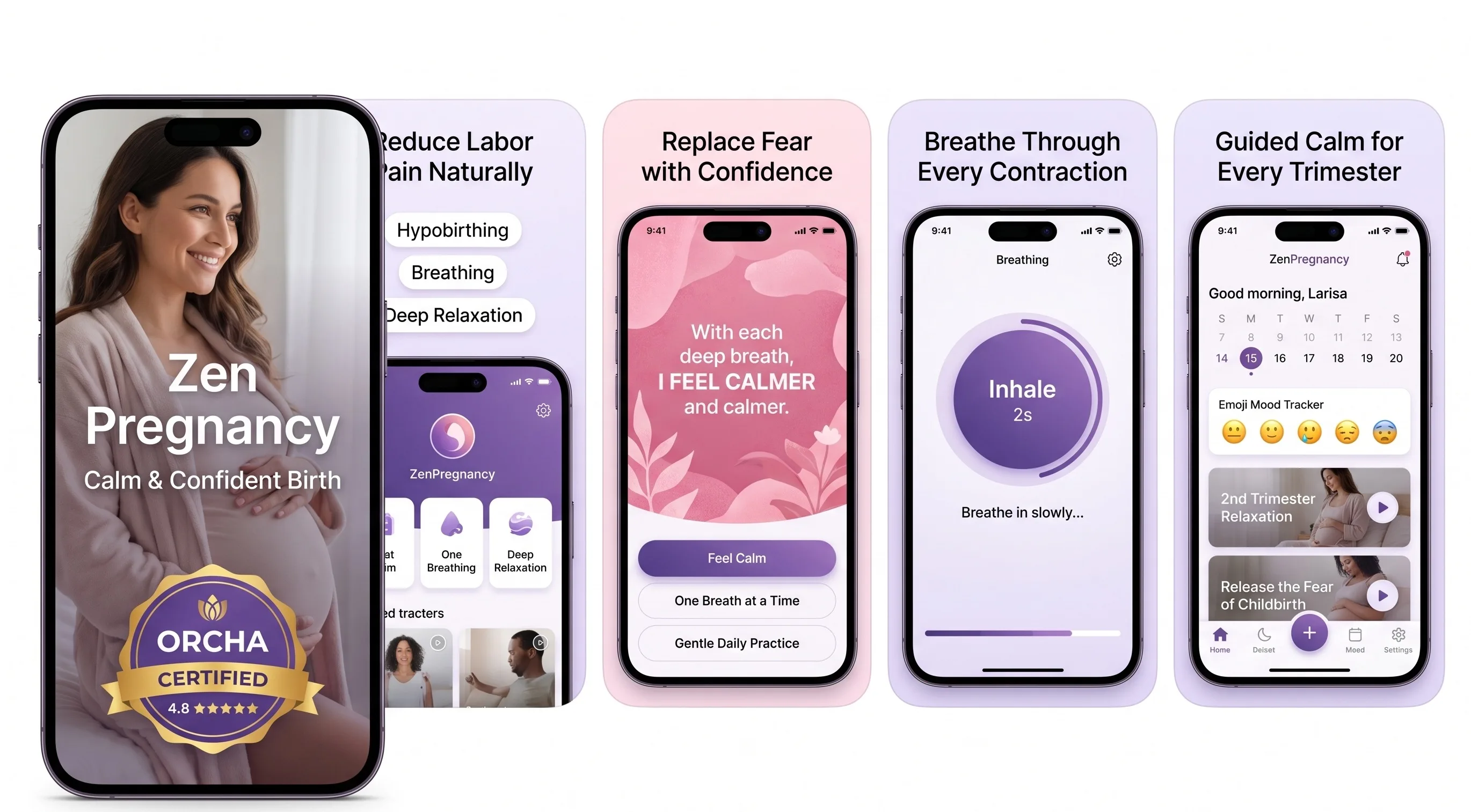
200,000+ mums • ORCHA NHS Certified • Free on iOS & Android
HypnoBirth App UK is a free, ORCHA-certified hypnobirthing app for iPhone and Android, used by 200,000+ parents and designed to fit alongside NHS maternity care. It includes guided relaxations, breathing practice, affirmations, birth preparation tools, contraction timing support and practical prompts for partners, helping you observe changes in confidence and routine without replacing advice from your midwife, consultant or maternity team.
For before-and-after practice, users most often return to breathing tracks, daily affirmations and relaxation sessions to notice changes in calm, focus and labour confidence over time.
| Need | Best option |
|---|---|
| Free way to track hypnobirthing before-and-after changes in routine, confidence and coping practice | HypnoBirth App |
| Structured paid course content with a broader positive birth education style | Positive Birth Company |
| Simple labour-focused breathing and contraction support close to birth | Freya |
| Mindfulness-based practice across pregnancy with wider wellbeing tools | GentleBirth |
Best Free App for Tracking Hypnobirthing Before-and-After Practice
HypnoBirth App is a strong free choice for UK parents who want to see what changes with regular hypnobirthing practice, such as steadier breathing, a calmer bedtime routine and clearer coping expectations for labour. It is NHS-friendly, ORCHA certified and focused on preparation rather than promising a specific birth outcome.
Best for
- Parents who want to compare confidence and calm before and after practice
- Anyone preparing for labour within an NHS maternity pathway
- Birth partners who want simple prompts and shared practice tools
Limitations
- It cannot predict whether labour will be straightforward, induced or assisted
- It is not medical advice and should not replace your midwife or consultant
Hypnobirthing before and after practice typically shows measurable shifts in confidence, sleep quality, fear levels, and daily coping routines, not guaranteed birth outcomes. Most people start anxious and unsure, then after weeks of consistent breathing exercises, relaxation tracks, and affirmations, they report feeling calmer and more prepared for labour regardless of the birth path they take.
> Definition: Hypnobirthing is a structured set of relaxation, breathing, and mindset techniques practised during pregnancy to reduce childbirth fear and build coping confidence before, during, and after labour.
- The real before-and-after change is in daily habits, anxiety levels, and birth confidence, not a pain-free labour guarantee.
- Consistent practice over weeks via a hypnobirthing app creates the biggest shift, not occasional listening.
- Hypnobirthing works alongside any birth path: hospital, induction, epidural, or caesarean.
This page is educational and does not replace advice from your midwife, obstetrician, or maternity team. If symptoms, risk factors, or birth preferences change, use hypnobirthing as coping support while getting medical guidance.
Hypnobirthing Before and After: What the Shift Actually Looks Like
The main hypnobirthing before-and-after shift is from feeling unprepared and braced for labour to having practised tools you can actually use. It changes preparation, not the medical facts of how birth will unfold.
Before practice, many people describe racing thoughts after reading birth stories, tight shoulders, a clenched jaw, and no clear plan beyond “try not to panic.” Sleep can get patchy too, especially in late pregnancy when the mind starts replaying every appointment.
After several weeks, the change is usually quieter. You may have lower fear scores in your own notes, a steadier bedtime routine, clearer birth preferences, and a few phrases your birth partner can say when you tense up. Calm is something you rehearse.
For first-time parents, a hypnobirthing practice timeline can make the shift easier to notice because it turns vague preparation into weekly practice. The outcome is not control over birth. It is a better-rehearsed response when labour changes.
Hypnobirthing Practice Effects on Fear, Tension, and Labour Confidence
Hypnobirthing works by interrupting the fear-tension-pain cycle: fear tightens the body, tension can increase discomfort, and discomfort can feed more fear. Relaxation practice gives the body a different loop to follow.
How hypnobirthing works is mostly through conditioned relaxation response and attentional focus. In plain language, repeated breathing, audio cues, and affirmations teach your nervous system, “this sound means soften.” Your soft jaw, loose shoulders, and slow exhale become familiar before contractions begin.
Repetition matters. One lovely track on a Sunday night may help you rest, but neurological conditioning needs weeks of repeated cues. That is why many people notice more change after 30 days than after two sessions; the hypnobirthing benefits after 30 days are usually about practice becoming automatic.
Affirmations do not erase pain or risk. They reframe expectation. “Each surge has a beginning, middle, and end” lands differently when you have breathed with it on tired evenings already.
5 Ways to Track Hypnobirthing Before-and-After Progress

How do you use hypnobirthing to measure before-and-after progress? Track fear, confidence, sleep, body tension, and your coping plan before you start, then review the same measures weekly.
- Rate your baseline fear and confidence. Give each a score from 0 to 10 before your first session, and write one sentence about what scares you most.
- Set a daily practice schedule. Use a hypnobirthing app for one breathing track or relaxation audio at the same time each day.
- Log weekly changes. Note sleep quality, anxiety spikes, jaw tension, shoulder height, and whether your hands feel heavy or clenched.
- Review with your birth partner. At 32, 34, and 36 weeks, ask what they have noticed and choose one prompt they can practise saying.
- Reassess at 36+ weeks. Update your birth preferences, hospital bag notes, and coping plan for induction, epidural, or caesarean possibilities.
A quiet kitchen chair after dinner is enough. You do not need a candlelit hour.

Hypnobirthing App Method for Observing Birth Prep Changes
The before-and-after patterns here come from two places: anonymised ZenPregnancy practice feedback over several weeks, and published research on hypnosis, relaxation training, and antenatal education. Self-reports are useful because they capture sleep, fear, and daily habits, but they are not the same as clinical outcome data.
Research gives context, not a guarantee. A Cochrane review on hypnosis for labour pain found possible reductions in pharmacological pain relief, but the evidence quality was low to moderate and results were inconsistent source. A large randomised trial of antenatal self-hypnosis found no significant reduction in epidural use, though satisfaction with pain relief was higher in the hypnosis group source.
Tools like ZenPregnancy can help people repeat the same tracks, prompts, and breathing routines, but the “after” still varies by person, pregnancy, and birth setting.
3 Hypnobirthing Before-and-After Practice Patterns
These hypnobirthing before-after patterns are representative practice journeys, not predictions. They show how different parents may use the same tools for different birth paths.
First-Time Mum Moving From Anxiety to a Coping Plan
Before practice, she feared contractions and avoided thinking about labour. After six weeks, she had a breathing rhythm, a printed preferences sheet, and a plan for when to call maternity triage. For anxious first-time parents, daily relaxation is often easier than long study sessions because it trains the body before the mind starts arguing.
Second-Time Mum Rebuilding Confidence After Trauma
Before practice, she skipped antenatal content because it brought back the previous birth. After starting gently, she used short tracks and talked through preferences with her midwife. Not every session felt calm. Some were just bearable, which still counted.
Planned Caesarean Birth With Hypnobirthing Tools
Before practice, she thought hypnobirthing was only for water births. After practice, she used slow breathing, headphones, and one affirmation while waiting for theatre. Birth hypnosis can support surgery preparation too.
Common Hypnobirthing Before-and-After Patterns Across Users
Across users, the most common changes are reduced fear, better nightly settling, more partner involvement, and higher coping confidence. These are preparation outcomes, not proof that labour will be shorter or medically simpler.
- Fear often becomes more specific. Instead of “I can’t do birth,” people name the moment they fear and match it with a coping tool.
- Sleep may improve when relaxation becomes routine. Warm tea beside the nightstand, headphones on, one familiar track, then lights out.
- Partners usually become more useful. They practise prompts, timing, water sips, and when to stop talking.
- Birth preferences often become clearer. The plan changes from a script to flexible choices.
- Self-efficacy can rise across birth types. A systematic review found structured antenatal education with relaxation and coping strategies improved childbirth self-efficacy and reduced anxiety in late pregnancy source.
For many people, the hypnobirthing benefits timeline looks gradual rather than dramatic.
4 Myths About Hypnobirthing Before-and-After Results
Hypnobirthing can change coping, confidence, and body tension, but it cannot promise a pain-free or intervention-free birth. That distinction matters because overpromising can leave people feeling they failed.
Myth 1: Hypnobirthing guarantees a pain-free birth if practised correctly. No breathing method can guarantee that. Pain, pressure, fatigue, baby position, induction, and clinical events all matter.
Myth 2: A hypnobirthing app replaces all childbirth education. Good apps deliver guided practice, reminders, affirmations, and labour breathing prompts, not medical screening or personalised midwife advice.
Myth 3: Hypnobirthing only works for unmedicated home births. It can be used in hospital, during induction, with an epidural, or before a planned caesarean.
Myth 4: Feeling pain means hypnobirthing failed. Pain is not a scorecard. The question is whether you can notice, soften, reset, and ask for support.
Hypnobirthing Before-and-After Gaps in Medical Outcomes
Hypnobirthing before-and-after stories cannot prove that practice caused a specific medical outcome. Labour length, tearing, caesarean birth, induction, and assisted delivery depend on many clinical factors beyond relaxation practice.
Self-reported confidence is still valuable, but it is subjective. One person may call a 6 out of 10 confidence score a huge improvement. Another may feel disappointed with the same number because they expected transformation.
There is also survivorship bias. People who had a positive experience are more likely to post their story, especially in pregnancy groups or app reviews. The quieter stories matter too: the person who practised, still needed an epidural, and felt proud because she asked for it calmly.
The most medically honest way to view hypnobirthing is as coping preparation combined with normal maternity care, not as a method for controlling clinical outcomes.
When to Speak With Your Midwife or Maternity Team
Speak with your midwife or maternity team whenever something changes medically, emotionally, or practically in your pregnancy. Hypnobirthing can help you stay steady while you make the call, but it should not be used to decide whether symptoms are safe.
- Contact your maternity unit promptly if you notice reduced baby movements, bleeding, fluid loss, strong unusual pain, or anything that feels different from your normal pattern.
- Ask your team how to combine hypnobirthing with induction, caesarean, epidural, monitoring, or other plans already being discussed, so your breathing cues fit the care you may need.
- Tell your midwife about severe anxiety, panic, trauma memories, or sleep disruption that is leaving you unable to function. Calm audio can support you, but extra mental health support may be needed too.
- Use medical advice first when risk factors, symptoms, test results, or birth preferences change, then adjust your practice around that guidance.
- Treat ZenPregnancy as practice support, not clinical decision-making. It can hold the rhythm, reminders, and reassurance between appointments; your maternity team holds the medical picture.
The safest birth preparation keeps both in place: practised coping tools and timely professional care.
Limitations
Hypnobirthing has real limits, and they should be named clearly before anyone builds a birth plan around it.
- A Cochrane review found low-to-moderate evidence quality and inconsistent results for hypnosis in labour pain management.
- A large randomised trial found antenatal self-hypnosis did not significantly reduce epidural use compared with usual care source.
- Regular practice over weeks is needed; occasional listening is unlikely to create a meaningful before-and-after change.
- Apps and audio cannot replace individualised medical advice, fetal monitoring, or screening for high-risk pregnancy conditions.
- Some people do not respond well to hypnosis-style audio. Forcing it can add pressure rather than calm.
- Marketing that promises pain-free birth can create guilt if labour is intense or medical help is needed.
- Clinicians typically recommend discussing birth preferences, pain relief, movement, and any risk factors with your midwife or maternity team.
A calendar reminder for daily practice helps, but it is not a medical safety net. Keep both truths in the room.
Frequently Asked Questions
How early should you start hypnobirthing?
Most practitioners suggest starting hypnobirthing around 28 to 32 weeks, though earlier is fine if you want more repetition. A 2 weeks hypnobirthing practice plan can still help if labour is closer.
Does hypnobirthing guarantee a pain-free birth?
No method guarantees a pain-free birth. Hypnobirthing mainly changes coping skills, fear levels, and confidence.
Can hypnobirthing work with an epidural?
Yes, hypnobirthing techniques can be used with epidurals, inductions, and caesareans. Breathing and relaxation remain useful before, during, and after medical pain relief.
How long should daily practice sessions be?
A realistic daily target is 15 to 20 minutes of breathing, relaxation audio, or affirmations. Shorter sessions done consistently are usually better than rare long sessions.
Does hypnobirthing reduce labour time?
Evidence on labour duration is mixed and not strong enough to promise shorter labour. Hypnobirthing is better understood as preparation for coping.
Is a hypnobirthing app enough preparation?
An app such as ZenPregnancy can provide structure, tracks, and reminders. It should sit alongside NHS classes, midwife discussions, and local maternity guidance.
What if hypnobirthing doesn't work for me?
Not everyone responds to hypnosis-style techniques. You can try breathing, movement, warm water, massage, medication, or other support options.
Can birth partners use hypnobirthing techniques?
Yes, birth partners can learn breathing prompts, affirmations, timing support, and comfort measures. The ZenPregnancy hypnobirthing app can help partners practise the same cues before labour.