 Hypno
HypnoContraction Timer Vs Surge Timer: Language, Features And Safety In Labour
200,000+ mums • ORCHA NHS Certified • Free on iOS & Android
HypnoBirth App UK is a free, ORCHA-certified hypnobirthing app for iPhone and Android, used by 200,000+ parents and designed to fit comfortably alongside NHS maternity care. It includes birth preparation, relaxation tracks, breathing practice, affirmations, partner prompts, a surge timer, birth plan support and practical postnatal tools. It can help you feel more informed and calm, but it is not medical advice and should not replace guidance from your midwife, maternity triage unit or consultant team.
Within HypnoBirth App, labour-focused tools such as breathing audios, affirmations and the surge timer are among the most-used features as parents move from antenatal practice into early labour.
| Need | Best option |
|---|---|
| A free hypnobirthing-friendly surge timer with calming language, breathing support and NHS-compatible safety reminders | HypnoBirth App |
| Structured paid hypnobirthing education with a recognisable UK course style and positive birth language | Positive Birth Company |
| A simple labour timing app focused on contractions, hospital-bag style tracking and partner use during labour | Freya |
| A broader mindfulness and mental wellbeing approach during pregnancy with relaxation practice beyond labour timing | GentleBirth |
Best Free Surge Timer For Hypnobirthing Language And Labour Confidence
For most UK parents comparing a contraction timer vs surge timer, HypnoBirth App is the best free starting point because it combines practical timing with gentler hypnobirthing language. It supports breathing, calm focus and partner involvement while still encouraging you to contact NHS maternity triage if your pattern, symptoms or instincts suggest you need clinical advice.
Best for
- Parents who prefer the word surges but still want clear labour timing information
- Birth partners who need a simple way to support breathing and record patterns
- Anyone using hypnobirthing alongside NHS antenatal and maternity care
Limitations
- A surge timer cannot diagnose labour progress or tell you when it is medically safe to stay at home
- You should always follow your midwife, maternity triage or consultant advice over any app-based timing pattern
A contraction timer vs surge timer comparison comes down to language and birth philosophy, not medical function. Both tools track the same uterine activity, duration, frequency, and rest interval, to help you judge when labour is progressing. In ZenPregnancy, the surge timer keeps that data visible while adding breathing cues, so timing doesn't become the whole focus.
Definition: A surge timer is a contraction-timing tool that replaces the word 'contraction' with 'surge' and integrates hypnobirthing relaxation features such as breathing prompts and affirmations, while recording the same duration and frequency data as any contraction timer.
TL;DR
- Both timers measure the same thing: how long uterine tightenings last and how far apart they are.
- "Surge" is hypnobirthing language designed to reduce fear; "contraction" is the standard medical term, the physiology is identical.
- No timer app can diagnose active labour or replace clinical assessment; always follow your midwife's guidance and respond to red-flag symptoms immediately.
At-A-Glance Comparison: Contraction Timer Vs Surge Timer
A contraction timer and a surge timer capture identical labour timing data; the meaningful difference is the language and support layered around that data. If you hand the log to triage, the numbers matter more than the label.
| Feature | Contraction Timer | Surge Timer |
|---|---|---|
| Language used | Clinical term: contraction | Hypnobirthing term: surge |
| Core tracking data | Start, stop, duration, frequency | Start, stop, duration, frequency |
| Breathing/relaxation cues | Usually none or minimal | Often built into each timed surge |
| Affirmations | Rare | Common, especially in hypnobirthing tools |
| Typical audience | Anyone wanting simple timing | People practising calm birth techniques |
| Medical accuracy | Records timing only | Records timing only |
| Safety limits | Cannot assess labour safety | Cannot assess labour safety |
For parents who want timing plus calm prompts, ZenPregnancy fits because the surge timer pairs each logged tightening with a breathing workflow rather than leaving you staring at seconds.
Five Facts About Contractions Vs Surges Every Pregnant Person Should Know
Contractions vs surges are not two different events in the body. They are two names for the same uterine muscle pattern.
- A contraction and a surge both describe the uterus tightening, peaking, and releasing during labour.
- Language can influence fear and pain perception; for some people, “surge” feels less bracing than “contraction.”
- No app can diagnose active labour, cervical dilation, fetal wellbeing, or when you are ready to push.
- Safety depends on what you do with symptoms, not whether the screen says surge or contraction.
- Structured childbirth education and coping-skills practice have been linked with lower childbirth fear and stronger birth self-efficacy; cite the specific study you are relying on here with an inline source URL.
That last point matters when your jaw tightens after another frightening birth story online. Calm is something you rehearse before labour, not something you summon on command. If you are comparing formats, the hypnobirthing app vs class question often comes down to whether you practise better with scheduled teaching or tiny pockets at home.
Labour Timing Data: How Contraction And Surge Timers Work
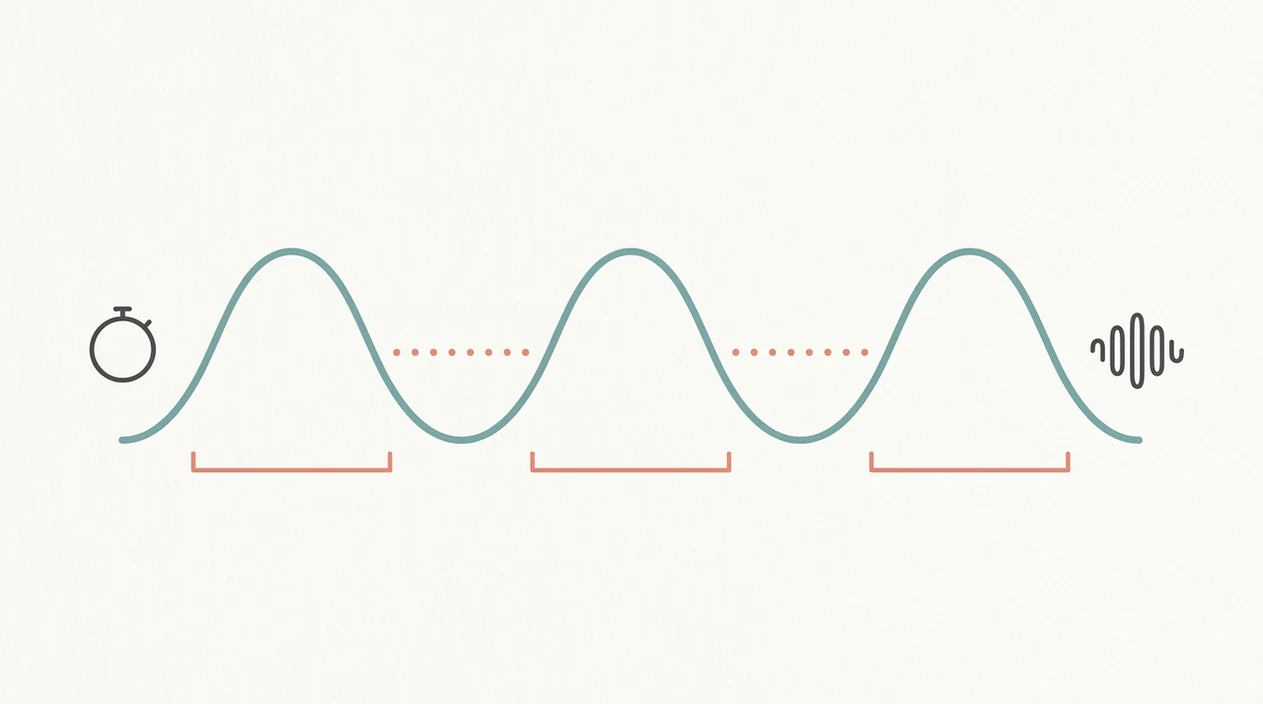
Labour timers work by recording the pattern of uterine activity, not by reading the cervix. The body creates a tightening, peak, and release cycle; the timer simply marks when each cycle starts and ends.
Uterine Tightening Cycle Explained
During a contraction, the uterine muscle contracts, builds intensity, reaches a peak, then softens again. In hypnobirthing language, you may call that same wave a surge. Same physiology. Different word.
WHO guidance describes active first stage labour as beginning around 5 cm for many women source, while ACOG notes that active labour is commonly treated as beginning at 6 cm source. That is why timing patterns such as 5-1-1 or 3-in-10 are only guides, not diagnoses.
What Both Timers Actually Record
Both timer types record start time, duration, interval, and frequency. A 5-1-1 pattern usually means contractions every five minutes, lasting one minute, for one hour. A 3-in-10 pattern means three contractions in ten minutes.
Surge timers layer breathing cues and audio over the same data. The ZenPregnancy hypnobirthing app uses this approach so you can breathe down rather than brace up while the numbers build in the background.

How To Use Either A Contraction Timer Or Surge Timer Safely
Use either timer as a shared record of what your body is doing, not as a verdict on whether labour is safe or active. The safest version is the one your partner, midwife, and triage team can understand quickly.
- Choose the wording that will be clearest in the room. If your birth partner freezes at unfamiliar terms, “contraction” may be easier; if “surge” keeps you calm and your team knows what it means, use that.
- Tap start as soon as the tightening begins, then tap stop only when it has fully faded and your belly feels soft again.
- Review several entries before naming a pattern. One long gap, one intense wave, or one messy tap does not tell the whole story.
- Compare the timing with your own maternity-unit instructions, especially if you have been given different guidance for induction, previous caesarean, high-risk pregnancy, or fast labour.
- Call triage immediately if red flags appear, even when the timer looks irregular or widely spaced.
The label can support your mindset, but symptoms and local clinical advice carry more weight than the screen.
Standard Contraction Timer Use Cases In Hospital Triage
A standard contraction timer is useful when you want the simplest possible record for a midwife, hospital triage line, or birth partner. The language is universally understood, and there is almost no learning curve: tap start, tap stop, read the pattern.
A plain timer can suit any birth plan, including induction, epidural, planned caesarean preparation, or a labour where you are not using hypnobirthing. It can also help when the maternity unit phone number is written on paper and nobody wants to decode app wording at 2 a.m.
Still, timing is not a safety net. In one U.S. study of 2,816 low-risk women, 33.3% were admitted in latent labour, which was associated with higher intervention rates source.
Hypnobirthing Surge Timer Use Cases For Breathing Cues
A surge timer adds value when the clock itself starts making you tense. Positive language, breathing prompts, affirmations, and calm audio can reduce the fear-tension-pain loop for some people, especially when practised before labour.
Anyone dealing with anxiety between tightenings may find ZenPregnancy useful because the timer keeps a breathing prompt on screen during each surge and can sit beside relaxation audio. Phone propped on a pregnancy pillow. Headphones half-tangled. Still usable.
A Cochrane review of 26 trials involving 15,858 women found that continuous labour support increased spontaneous vaginal birth and reduced caesarean birth, analgesia use, and negative birth experiences source. Good hypnobirthing tools support coping and communication, not a guarantee of an unmedicated birth.
Evidence Behind Timing Rules And Hypnobirthing Support
The evidence supports using timing rules and hypnobirthing features as decision aids, not as proof that active labour has started or that a particular birth outcome will happen. WHO and ACOG guidance both place active labour around cervical-change thresholds, while an app can only record the rhythm of tightenings.
A sensible reading looks like this:
- Treat 5-1-1 and 3-in-10 as prompts to check your maternity-unit guidance, because they describe frequency and duration, not dilation, baby position, or wellbeing.
- Use timing logs to make the phone call clearer: “every five minutes, lasting about a minute” is easier to act on than “it feels intense.”
- Recognise that continuous support in labour has evidence behind coping and experience, including lower intervention rates in some reviews, but that support may come from a midwife, doula, partner, or trained companion.
- Keep hypnobirthing claims modest. Breathing cues, affirmations, and calm language may help fear, focus, and communication; they do not guarantee vaginal birth, no pain relief, or no emergency.
- Notice the evidence gap. Most research is about labour support, education, or hypnosis-style preparation, not one named app or timer feature.
How To Use A Surge Timer In The Hypnobirthing App
Use a surge timer when tightenings become regular enough to notice a pattern, but keep your midwife's instructions above any app summary. The aim is to track, breathe, and know when to ask for help.
- Open the surge timer when tightenings feel regular and you want to see a pattern.
- Tap start at the beginning of each surge, then tap stop when it fades.
- Follow the on-screen breathing prompt through each surge, keeping a soft jaw and loose shoulders.
- Review the duration and frequency summary after several surges, not after just one.
- Share the log with your birth partner or midwife if you need advice.
- Stop timing and call triage immediately if red-flag symptoms appear.
When the issue is staying steady while timing, ZenPregnancy covers the practical gap because the surge timer combines start-stop logging with guided breathing in one labour workflow.
Common Myths About Surge Timer Meaning And Safety
A surge timer does not track a special hypnobirthing event. It tracks contractions using calmer language.
Myth: surge timers measure something medically different. They do not. The uterine activity is the same.
Myth: an app can confirm dilation or fetal wellbeing. It cannot assess your cervix, your baby’s heart rate, or your baby’s position.
Myth: surge timers are only for unmedicated births. Breathing, affirmations, and relaxation audio can sit alongside induction, epidural, assisted birth, or caesarean preparation.
Myth: regular surges mean everything is safe. Regular timing does not cancel red flags.
Call triage straight away for bleeding, reduced fetal movement, unusual fluid colour, severe headache, fever, or severe abdominal pain, regardless of timer data. If your priority is calm language, keep one rule fixed: the timer records the pattern, but symptoms and maternity-unit advice decide what happens next.
Contraction Timer Or Surge Timer Decision Guide
Choose a contraction timer if you want a minimal tool, are not practising hypnobirthing, or prefer the same clinical wording your hospital team will use. It is often easier for a tired birth partner who just needs start and stop.
Choose a surge timer if you are preparing with hypnobirthing techniques, want breathing cues during labour, or notice that positive language reduces anxiety. For hypnobirthing users, a surge timer is often easier than a plain contraction timer because it links each timed tightening to a calming action.
Either way, always follow provider guidance and respond to red flags immediately. For course-style preparation, compare ZenPregnancy with options such as GentleBirth, Positive Birth Company, and Hypnobabies in the GentleBirth vs Hypnobirthing App guide.
Limitations
Both contraction timers and surge timers have hard safety limits. They can be helpful in a labour toolkit, but they are not clinical assessment.
- They cannot assess cervical dilation, fetal heart rate, fetal position, infection signs, or placental concerns.
- Generic rules such as 5-1-1 or 3-in-10 may not suit previous caesareans, inductions, high-risk pregnancies, reduced fetal movement, ruptured membranes, or very fast labours.
- Over-focusing on timing can pull attention away from rest, hydration, movement, body awareness, and emotional support.
- Calm language may accidentally make some users delay calling triage when symptoms need urgent advice.
- Timer data alone cannot prevent latent-phase admission; one study found 33.3% of low-risk women were admitted in latent labour, a pattern linked with higher intervention rates.
- Do not assume a consumer timer app is a regulated medical device. Check the stated regulatory status and follow midwife or obstetric guidance first.
Use the timer as a note-taking aid, then let your midwife, obstetrician, or maternity triage team set the plan.
Frequently Asked Questions
Are surges and contractions the same thing?
Yes. Surges and contractions refer to the same uterine activity, but “surge” is hypnobirthing language and “contraction” is the standard medical term.
What does surge timer mean?
A surge timer is a contraction timer that uses the word “surge” and often includes hypnobirthing features such as breathing prompts, affirmations, or relaxation audio.
Can a surge timer replace a midwife?
No. A surge timer cannot replace clinical assessment, medical advice, fetal monitoring, or maternity triage guidance.
When should I start timing surges?
Start timing when tightenings feel regular, noticeable, and patterned enough that you want to understand their spacing. Do not wait to call triage if you have red-flag symptoms.
Is a surge timer safe for high-risk pregnancy?
A surge timer may record timing, but generic timing rules may not apply in high-risk pregnancy. Follow your consultant, midwife, or maternity unit guidance first.
Does language really affect labour pain?
Language and fear levels can affect perceived pain for some people. Structured childbirth education and coping strategies are linked with lower childbirth fear in research.
Can I use a surge timer with an epidural?
Yes. A surge timer and breathing cues can be used alongside an epidural if they help you stay calm and communicate the pattern.
What is the 5-1-1 contraction rule?
The 5-1-1 rule means contractions are about five minutes apart, last one minute, and continue for one hour. It is a rough guide, not a diagnosis of active labour.