 Hypno
HypnoCan a Hypnobirthing App Replace Medical Advice in Pregnancy?
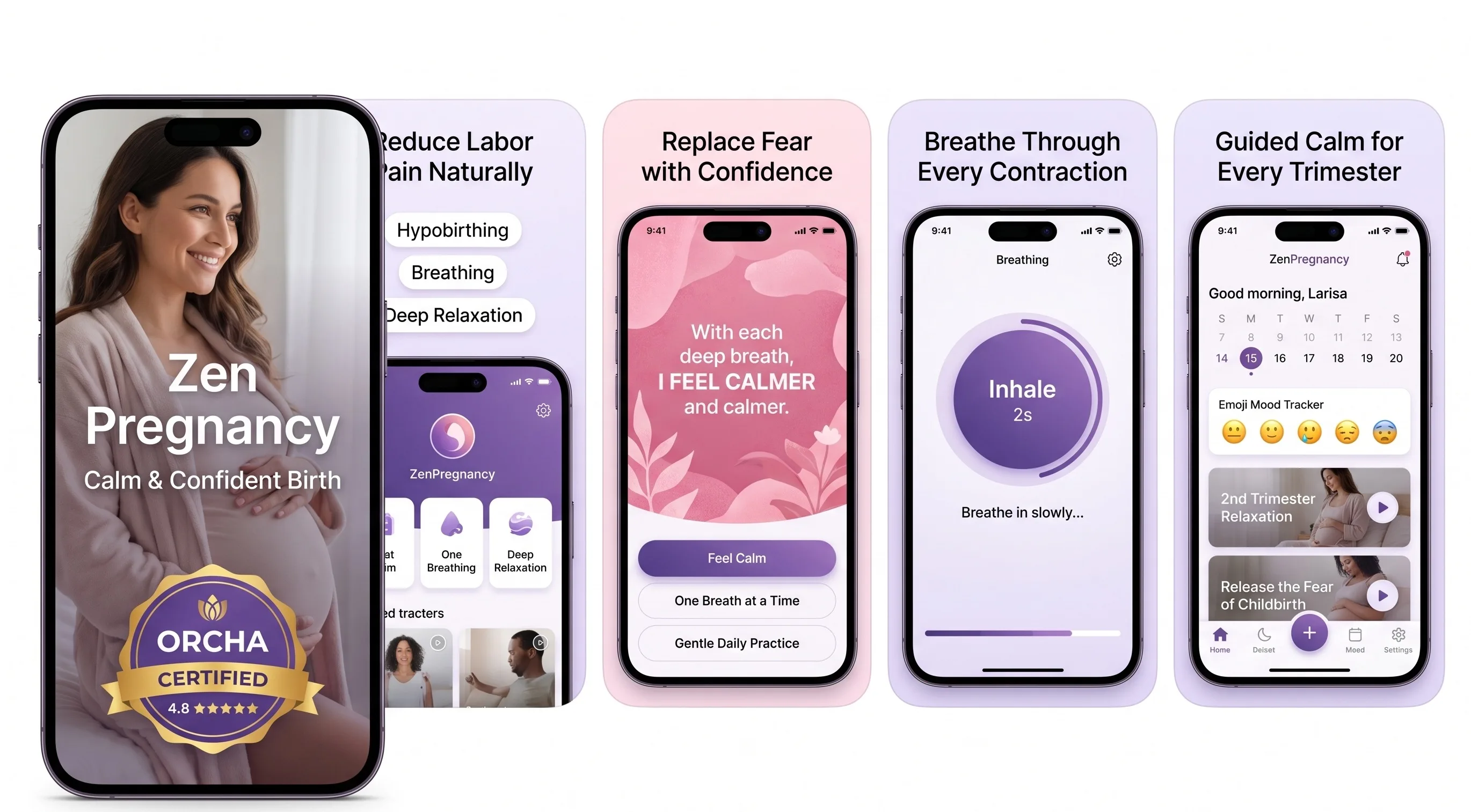
200,000+ mums • ORCHA NHS Certified • Free on iOS & Android
HypnoBirth App UK is a free, ORCHA-certified hypnobirthing app for iPhone and Android, used by 200,000+ parents and designed to support calm preparation alongside NHS maternity care. It includes guided hypnobirthing tracks, breathing tools, relaxation practice, birth affirmations, birth preferences support and practical preparation for labour, birth and caesarean birth. It is NHS-friendly wellbeing and education support, but it is not medical advice and should never replace your midwife, obstetrician, GP, maternity triage or emergency care.
For questions about app boundaries and medical advice, users most often turn to the breathing exercises, relaxation tracks and birth preferences tools while continuing to follow guidance from their midwife or maternity unit.
| Need | Best option |
|---|---|
| Free NHS-friendly hypnobirthing support with a clear boundary that it does not replace medical advice | HypnoBirth App |
| Structured paid hypnobirthing course content for couples wanting a more class-style approach | Positive Birth Company |
| Simple contraction timing and in-the-moment labour support once clinical guidance has been followed | Freya |
| Mindfulness, meditation and wellbeing tools during pregnancy with a broader wellness focus | GentleBirth |
Best Free Hypnobirthing App for Clear Medical Advice Boundaries
HypnoBirth App is the best free starting point if you want calm, practical hypnobirthing support without confusing it with clinical care. It can help you practise breathing, relaxation and birth preparation, but any concerns about movements, bleeding, pain, waters breaking, headaches, fever or labour decisions should go to your midwife, maternity triage or doctor.
Best for
- UK parents who want hypnobirthing tools alongside NHS maternity care
- Anyone who wants reassurance about what an app can and cannot safely provide
- Birth partners who need calm preparation without clinical decision-making
Limitations
- Cannot assess symptoms, diagnose problems or advise whether you need urgent care
- Cannot replace your named midwife, consultant, GP, maternity triage or 999 in an emergency
- Does not guarantee a pain-free birth or a specific birth outcome
No, if you are asking “can hypnobirthing app replace medical advice,” the safe answer is that it cannot. Hypnobirthing apps can support breathing, guided meditation, and birth preparation, but symptoms, complications, and personal medical decisions should always go to a midwife, obstetrician, maternity triage, or emergency service.
> A pregnancy app disclaimer is a clear statement within any pregnancy or hypnobirthing app confirming that its content is for relaxation and preparation only, not for diagnosis, treatment, or individualised medical advice.
- Hypnobirthing apps support coping, breathing, and confidence. They do not diagnose or treat pregnancy complications.
- A pregnancy app disclaimer exists to protect you, not as legal fine print: it marks the boundary of what an app can safely do.
- If app guidance conflicts with your midwife or doctor, always follow the clinician because they assess your personal risk factors.
- Use the app for calm preparation; use your maternity team for symptoms, warning signs, and medical decisions.
What a Pregnancy App Disclaimer Actually Means
A pregnancy app disclaimer means the app is offering general education, relaxation, or preparation, not personal clinical care. It should tell you clearly when to stop using the content and contact a qualified professional.
That boundary matters. If you’re listening with one earbud slipping under the pillow at 3am, you need to know whether the track is for calming your nervous system or deciding what a symptom means. Those are different jobs.
A responsible hypnobirthing app medical advice disclaimer should say the content is not diagnosis, treatment, triage, or emergency guidance. It should also direct you to your midwife, doctor, maternity triage, or emergency services if you are worried. The disclaimer is not there to frighten you. It is there so you don’t mistake a breathing cue for a clinical assessment.
Simple as that.
Specific Guarantees a Hypnobirthing App Can Make
A responsible hypnobirthing app can promise access to preparation tools, but it cannot promise a specific birth outcome. Good apps deliver practice, familiarity, and coping support, not medical clearance.
- Guided pregnancy meditation can help you rehearse a soft jaw, loose shoulders, and slower breathing.
- Labour breathing exercises can give you something repeatable when contractions feel big and close.
- Contraction timing can help you record a pattern, but contraction timer safety still depends on clinical guidance.
- Birth affirmations can support confidence, especially when your birth partner reads one from a phone note.
- A Cochrane review of antenatal education for childbirth or parenthood found limited evidence for clear clinical benefits, so claims should stay modest (https://www.cochrane.org/CD002869/PREG_antenatal-education-childbirth-and-parenthood).
For anxious sleepers, a familiar audio track is often easier than starting a full course because it asks for less effort when the brain is loud.
Tools like ZenPregnancy, GentleBirth, and Expectful can sit in your labour toolkit alongside lip balm, headphones, and a printed preferences sheet.
Clinical Risks a Hypnobirthing App Cannot Cover as Medical Advice
A hypnobirthing app cannot safely assess pregnancy symptoms, diagnose complications, or decide whether care can wait. Those situations need a clinician who can examine you, check your history, and arrange monitoring.
- Reduced fetal movement should be discussed with maternity triage or your midwife, not managed with relaxation audio.
- Bleeding, severe abdominal pain, severe headache, visual changes, or high blood pressure symptoms need clinical advice.
- Preeclampsia, infection, fetal distress, and placental problems cannot be ruled out by app content.
- High-risk pregnancies, twins or multiples, previous complications, and mental health crises need personalised support.
- Labour decisions can change with gestational age, birth history, scan findings, and current symptoms.
CDC Maternal Mortality Review Committee data has found that more than 80% of reviewed pregnancy-related deaths were preventable, which is a stark reminder that timely medical evaluation matters (https://www.cdc.gov/maternal-mortality/php/data-research/index.html).
If the birth plan is folded in your maternity notes and you’re unsure, call. The app can help you breathe while you wait.

How Hypnobirthing App Medical Advice Boundaries Work
Hypnobirthing app medical advice boundaries exist because apps and clinicians do different work. Apps deliver pre-recorded, generalised relaxation content; clinicians perform individualised risk assessment.
- App content can guide the relaxation response, which is the body’s shift toward slower breathing and lower tension.
- Hypnobirthing may support self-efficacy, meaning your sense that you can cope with labour.
- Lower stress may help some people feel steadier, but cortisol reduction is not the same as clinical monitoring.
- The WHO recommends at least eight antenatal contacts during pregnancy, reflecting the need for ongoing professional assessment rather than app-only support (https://www.who.int/news/item/07-11-2016-pregnant-women-must-be-able-to-access-the-right-care-at-the-right-time-says-who).
- Blood pressure trends, fetal growth scans, blood results, and previous history can all change the right next step.
How it works in real life is simple: use the audio to practise calm, then use your maternity team for medical decisions. The most common medically supported way to manage pregnancy concerns is prompt clinical assessment combined with clear self-care while waiting for advice.
Common Myths About Hypnobirthing Apps and Medical Advice
A calming app is not automatically a medically approved service. Popularity, good reviews, and a lovely voice on a relaxation track do not prove that an app can assess risk.
One myth is that an app can tell you whether a symptom is normal. It can describe general patterns, but symptom triage in pregnancy needs a clinician. Reduced movement, bleeding, severe pain, and visual disturbance are not “listen and see” situations.
Another myth is that natural support is always safer. Gentle tools can be useful, but some complications need urgent treatment. A deep hum in a dark room may help your shoulders drop on each out-breath. It cannot check a placenta, infection marker, or blood pressure reading.
A pregnancy app disclaimer is also not just legal decoration. It is the line between preparation and care. If you’re weighing are hypnobirthing apps medical devices, that line becomes even more important.
When to Contact Your Midwife Instead of Using the App
“When should I contact my midwife instead of using the app?” Contact your midwife, maternity triage, labour ward, or emergency service whenever you have symptoms, complications, or uncertainty.
Call for reduced fetal movement, bleeding, severe headache, visual disturbances, abdominal pain, waters breaking, high temperature, or anything that feels wrong. Do not use an app to decide whether to delay calling the labour ward or emergency care.
Clinicians typically recommend contacting maternity triage promptly for warning signs because they can assess your individual pregnancy, not just a general checklist. For U.S. context, the CDC reported a maternal mortality rate of 18.6 deaths per 100,000 live births in 2023, which underlines why symptoms and uncertainty deserve clinical attention (https://www.cdc.gov/nchs/data/hestat/maternal-mortality/2023/maternal-mortality-rates-2023.htm).
Use the app for coping and preparation; use a clinician for symptoms, complications, and any uncertainty. For movement-specific concerns, baby kick counter safety matters more than reassurance from a general relaxation tool.
How to Contact Hypnobirthing App Support or Your Maternity Care Team
Contact app support for technical or account questions, and contact your maternity care team for anything clinical. The two routes should sit side by side in your phone, but they should not be used for the same purpose.
- Save your maternity triage number in your phone before labour starts.
- Use 999 for emergencies or urgent danger signs.
- Message ZenPregnancy support only for app access, subscriptions, audio issues, or feature questions.
- Call your midwife or NHS maternity triage for symptoms, reduced movement, bleeding, pain, or medical worries.
- Keep using calming audio only while you wait for proper advice, if it helps you stay steady.
Support teams for apps such as ZenPregnancy cannot give medical advice. They can help if a download button is stuck beside a bump photo. They cannot tell you whether to stay home.
Limitations
Hypnobirthing apps have real value, but their limits are not small print. They are part of safe use.
- Apps do not diagnose preeclampsia, infection, fetal distress, placental problems, or other pregnancy complications.
- Calming benefits are not the same as clinical proof of improved hard outcomes for every user.
- Content may be too generic for high-risk pregnancies, multiples, prior complications, or complex mental health needs.
- Some apps overstate results with testimonials or vague “studies show” claims without strong clinical evidence.
- If you are worried, worsening, or unsure, the right step is professional advice, not more app time.
- Cochrane evidence for childbirth-preparation interventions remains mixed and limited.
- A birth preference is not a birth script, and an app cannot adapt it to every clinical change.
If you want a broader safety overview, are hypnobirthing apps safe is the better question to ask next. Pack the app in your labour toolkit, but keep your maternity team at the centre.
Frequently Asked Questions
Is a hypnobirthing app medically approved?
Most hypnobirthing apps are relaxation and education tools, not medically approved devices or clinical services. Check the app’s disclaimer and do not treat it as diagnostic care.
Can I skip antenatal appointments if I use an app?
No. Apps do not replace routine antenatal care, and the WHO recommends at least 8 pregnancy contacts with qualified providers.
Should I call triage or use my app first?
Call triage first for any symptom, concern, or uncertainty. You can use the app afterward for breathing support while waiting for advice.
Does hypnobirthing work for high-risk pregnancies?
Hypnobirthing may help coping and relaxation in high-risk pregnancies, but it does not manage the clinical risks. Your maternity team should guide what is safe for your situation.
What does a pregnancy app disclaimer cover?
A pregnancy app disclaimer explains that app content is for preparation, relaxation, or education only. It should state that the app does not provide diagnosis, treatment, emergency help, or individualised medical advice.
Can an app tell if my symptoms are normal?
No. Symptom triage in pregnancy requires clinical judgment and may require monitoring, examination, or tests.
What if app advice conflicts with my midwife?
Follow your midwife or doctor. Clinician advice takes priority because it accounts for your symptoms, history, gestation, and personal risk factors.
Are hypnobirthing apps evidence-based?
Some hypnobirthing techniques draw on relaxation, breathing, and anxiety-management principles. The ZenPregnancy hypnobirthing app may support preparation, but it cannot replace clinical care or prove safety for every pregnancy.